




The sides of the quadrilateral taken in order are 9m, 40m, 15m and 28 m. If the angle between the first two sides is a right angle, find its area.
Answer
 Verified
645.3k+ views
Hint: In this problem, first we will convert the quadrilateral in two triangles then find the area of the right angled triangle. We can find the hypotenuse of the right angled triangle using Pythagoras theorem. After that we can find the area of the triangle formed by the remaining two sides and the hypotenuse of the right angled triangle using Heron’s formula which is given as Area=${\sqrt{(s(s-a)( s-b)(s-c))}}$, where s is semi-perimeter and a, b and c are sides of the triangle.
Complete step-by-step answer:
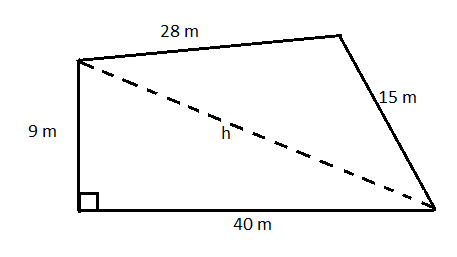
We know that the area of a right angled triangle is given as:
$Area=\dfrac{1}{2}\times( \text{base}\times {\text{perpendicular}})$
Here, we have base = 9 m and perpendicular = 40 m.
Therefore, the area of this right angled triangle is:
$Area=\dfrac{1}{2}\times 9\times 40=180\,{{m}^{2}}$
Now, we will find the hypotenuse of this right angled triangle using the Pythagoras theorem.
We know that according to Pythagoras theorem:
${{h}^{2}}={{p}^{2}}+{{b}^{2}}$
Here, h represents hypotenuse, p is perpendicular and b is the base.
On putting the values of base and perpendicular, we get hypotenuse as:
$\begin{align}
& \Rightarrow {{h}^{2}}={{40}^{2}}+{{9}^{2}} \\
& \Rightarrow {{h}^{2}}=1600+81 \\
& \Rightarrow h=\sqrt{1681} \\
& \Rightarrow h=41 \\
\end{align}$
So, the hypotenuse is 41 m.
Now for the triangle formed by the hypotenuse and the remaining two sides of the quadrilateral, semi-perimeter will be:
$\begin{align}
& \Rightarrow s=\dfrac{\left( 41+15+28 \right)}{2} \\
& \Rightarrow s=\dfrac{84}{2}=42 \\
\end{align}$
So, its semi-perimeter is 42 m.
Therefore, its area using the Heron’s formula will be:
$\begin{align}
& \Rightarrow A=\sqrt{42\left( 42-41 \right)\left( 42-15 \right)\left( 42-28 \right)} \\
& \Rightarrow A=\sqrt{42\times 1\times 27\times 14} \\
& \Rightarrow A=\sqrt{15876} \\
& \Rightarrow A=126\,{{m}^{2}} \\
\end{align}$
Therefore, the total area of the given quadrilateral will be the sum of areas of these two triangles.
So, area = $\left( 180+126 \right){{m}^{2}}=306\,{{m}^{2}}$
Hence, the area of the given quadrilateral is $306\,{{m}^{2}}$.
Note: Students should note that since the angle between sides of length 9 m and 40 m is the right angle. So, we can find the area of the one part of the quadrilateral using the formula for the area of a right angled and triangle. Students should remember the Heron’s formula.
Complete step-by-step answer:
We know that the area of a right angled triangle is given as:
$Area=\dfrac{1}{2}\times( \text{base}\times {\text{perpendicular}})$
Here, we have base = 9 m and perpendicular = 40 m.
Therefore, the area of this right angled triangle is:
$Area=\dfrac{1}{2}\times 9\times 40=180\,{{m}^{2}}$
Now, we will find the hypotenuse of this right angled triangle using the Pythagoras theorem.
We know that according to Pythagoras theorem:
${{h}^{2}}={{p}^{2}}+{{b}^{2}}$
Here, h represents hypotenuse, p is perpendicular and b is the base.
On putting the values of base and perpendicular, we get hypotenuse as:
$\begin{align}
& \Rightarrow {{h}^{2}}={{40}^{2}}+{{9}^{2}} \\
& \Rightarrow {{h}^{2}}=1600+81 \\
& \Rightarrow h=\sqrt{1681} \\
& \Rightarrow h=41 \\
\end{align}$
So, the hypotenuse is 41 m.
Now for the triangle formed by the hypotenuse and the remaining two sides of the quadrilateral, semi-perimeter will be:
$\begin{align}
& \Rightarrow s=\dfrac{\left( 41+15+28 \right)}{2} \\
& \Rightarrow s=\dfrac{84}{2}=42 \\
\end{align}$
So, its semi-perimeter is 42 m.
Therefore, its area using the Heron’s formula will be:
$\begin{align}
& \Rightarrow A=\sqrt{42\left( 42-41 \right)\left( 42-15 \right)\left( 42-28 \right)} \\
& \Rightarrow A=\sqrt{42\times 1\times 27\times 14} \\
& \Rightarrow A=\sqrt{15876} \\
& \Rightarrow A=126\,{{m}^{2}} \\
\end{align}$
Therefore, the total area of the given quadrilateral will be the sum of areas of these two triangles.
So, area = $\left( 180+126 \right){{m}^{2}}=306\,{{m}^{2}}$
Hence, the area of the given quadrilateral is $306\,{{m}^{2}}$.
Note: Students should note that since the angle between sides of length 9 m and 40 m is the right angle. So, we can find the area of the one part of the quadrilateral using the formula for the area of a right angled and triangle. Students should remember the Heron’s formula.
Recently Updated Pages
Master Class 9 General Knowledge: Engaging Questions & Answers for Success

Master Class 9 Maths: Engaging Questions & Answers for Success
Master Class 9 Science: Engaging Questions & Answers for Success
Master Class 9 English: Engaging Questions & Answers for Success
Master Class 9 Social Science: Engaging Questions & Answers for Success
Class 9 Question and Answer - Your Ultimate Solutions Guide
Trending doubts
Find the sum of series 1 + 2 + 3 + 4 + 5 + + 100 class 9 maths CBSE
Difference Between Plant Cell and Animal Cell
Fill the blanks with the suitable prepositions 1 The class 9 english CBSE
What is pollution? How many types of pollution? Define it
Name 10 Living and Non living things class 9 biology CBSE
What is the full form of pH?