




The sides of an equilateral triangle ABC are 12 cm each , D is the foot of the perpendicular from A to BC and E is the midpoint of AD. Then BE is
A.$4\sqrt 3 $cm
B.$6\sqrt 2 $cm
C.$\sqrt {63} $cm
D.None of these
Answer
 Verified
623.7k+ views
Hint: Since we are given an equilateral triangle ABC and AD is perpendicular to BC. By using the property the height of an equilateral triangle bisects its base we get BD=6cm and then by using Pythagoras theorem we can find AD and then considering the small triangle BDE and using Pythagoras theorem we can find BE
Complete step-by-step answer:
Given ABC is an equilateral triangle .
Hence all its sides are equal.
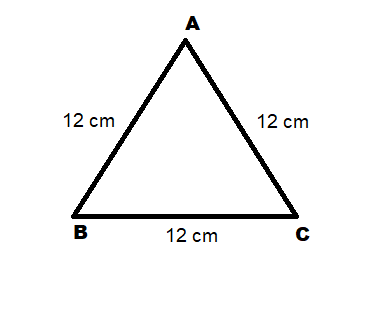
And it's also given that D is the foot of the perpendicular from A to BC
It means that AD is perpendicular to BC
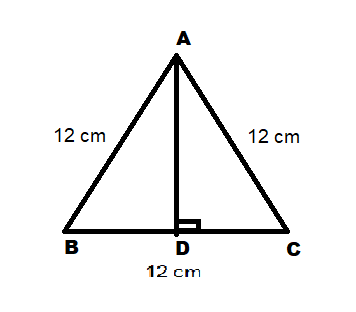
Step 2 :
Since ABC is an equilateral triangle , we know that the height or altitude of an equilateral triangle bisects its base.
Here AD is the height of the triangle .
Therefore it bisects the base and now we have BD=BC=6cm
Step 3:
Now let's find AD by using Pythagoras theorem
Consider the triangle ABD . It is a right triangle .
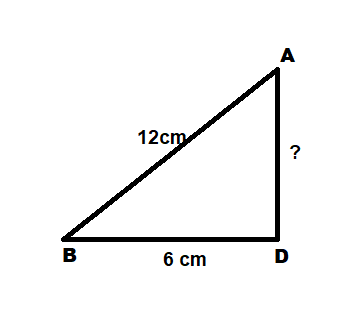
By using Pythagoras theorem
$
\Rightarrow {({\text{Hypotenuse }})^2} = {\text{ Sum of squares of other two sides}} \\
\Rightarrow {\left( {AB} \right)^2} = {\left( {AD} \right)^2} + {\left( {BD} \right)^2} \\
\Rightarrow {12^2} = {\left( {AD} \right)^2} + {6^2} \\
\Rightarrow 144 = {\left( {AD} \right)^2} + 36 \\
\Rightarrow 144 - 36 = {\left( {AD} \right)^2} \\
\Rightarrow 108 = {\left( {AD} \right)^2} \\
\Rightarrow AD = \sqrt {108} \\
$
Now we have that $AD = \sqrt {108} cm$
Step 4 :
We are given that E is the midpoint of AD.
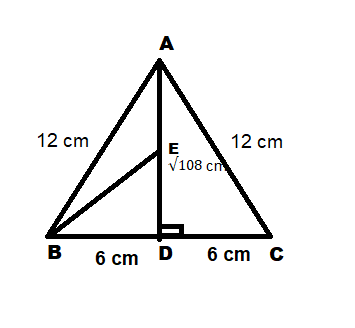
Since E is the midpoint of AD , we have AE=ED=$\frac{{\sqrt {108} }}{2}$cm
We need to find BE , so let's consider the right triangle BDE
Lets use Pythagoras theorem to find BE
\[
\Rightarrow {({\text{Hypotenuse }})^2} = {\text{ Sum of squares of other two sides}} \\
\Rightarrow {\left( {BE} \right)^2} = {\left( {ED} \right)^2} + {\left( {BD} \right)^2} \\
\Rightarrow {\left( {BE} \right)^2} = {\left( {\frac{{\sqrt {108} }}{2}} \right)^2} + {6^2} \\
\Rightarrow {\left( {BE} \right)^2} = \frac{{108}}{4} + 36 \\
\\
\]
Now by taking lcm we get
$
\Rightarrow {\left( {BE} \right)^2} = \frac{{108 + 144}}{4} \\
\Rightarrow {\left( {BE} \right)^2} = \frac{{252}}{4} \\
\Rightarrow {\left( {BE} \right)^2} = 63 \\
\Rightarrow BE = \sqrt {63} cm \\
$
Therefore $BE = \sqrt {63} cm$
The correct option is C
Note: The sides of an equilateral triangle are congruent.
An equilateral triangle is a special case of a triangle where all 3 sides have equal length and all 3 angles are equal to 60 degrees.
Complete step-by-step answer:
Given ABC is an equilateral triangle .
Hence all its sides are equal.
And it's also given that D is the foot of the perpendicular from A to BC
It means that AD is perpendicular to BC
Step 2 :
Since ABC is an equilateral triangle , we know that the height or altitude of an equilateral triangle bisects its base.
Here AD is the height of the triangle .
Therefore it bisects the base and now we have BD=BC=6cm
Step 3:
Now let's find AD by using Pythagoras theorem
Consider the triangle ABD . It is a right triangle .
By using Pythagoras theorem
$
\Rightarrow {({\text{Hypotenuse }})^2} = {\text{ Sum of squares of other two sides}} \\
\Rightarrow {\left( {AB} \right)^2} = {\left( {AD} \right)^2} + {\left( {BD} \right)^2} \\
\Rightarrow {12^2} = {\left( {AD} \right)^2} + {6^2} \\
\Rightarrow 144 = {\left( {AD} \right)^2} + 36 \\
\Rightarrow 144 - 36 = {\left( {AD} \right)^2} \\
\Rightarrow 108 = {\left( {AD} \right)^2} \\
\Rightarrow AD = \sqrt {108} \\
$
Now we have that $AD = \sqrt {108} cm$
Step 4 :
We are given that E is the midpoint of AD.
Since E is the midpoint of AD , we have AE=ED=$\frac{{\sqrt {108} }}{2}$cm
We need to find BE , so let's consider the right triangle BDE
Lets use Pythagoras theorem to find BE
\[
\Rightarrow {({\text{Hypotenuse }})^2} = {\text{ Sum of squares of other two sides}} \\
\Rightarrow {\left( {BE} \right)^2} = {\left( {ED} \right)^2} + {\left( {BD} \right)^2} \\
\Rightarrow {\left( {BE} \right)^2} = {\left( {\frac{{\sqrt {108} }}{2}} \right)^2} + {6^2} \\
\Rightarrow {\left( {BE} \right)^2} = \frac{{108}}{4} + 36 \\
\\
\]
Now by taking lcm we get
$
\Rightarrow {\left( {BE} \right)^2} = \frac{{108 + 144}}{4} \\
\Rightarrow {\left( {BE} \right)^2} = \frac{{252}}{4} \\
\Rightarrow {\left( {BE} \right)^2} = 63 \\
\Rightarrow BE = \sqrt {63} cm \\
$
Therefore $BE = \sqrt {63} cm$
The correct option is C
Note: The sides of an equilateral triangle are congruent.
An equilateral triangle is a special case of a triangle where all 3 sides have equal length and all 3 angles are equal to 60 degrees.
Recently Updated Pages
Master Class 9 General Knowledge: Engaging Questions & Answers for Success

Master Class 9 Maths: Engaging Questions & Answers for Success
Master Class 9 Science: Engaging Questions & Answers for Success
Master Class 9 English: Engaging Questions & Answers for Success
Master Class 9 Social Science: Engaging Questions & Answers for Success
Class 9 Question and Answer - Your Ultimate Solutions Guide
Trending doubts
What is the situation called when no party gets the class 9 social science CBSE
Find the sum of series 1 + 2 + 3 + 4 + 5 + + 100 class 9 maths CBSE
Difference Between Plant Cell and Animal Cell
Fill the blanks with the suitable prepositions 1 The class 9 english CBSE
What is pollution? How many types of pollution? Define it
What is the Full Form of ICSE / ISC ?