




The sides of an acute triangle measure $14\;cm$ , $18\;cm$ , and $20\;cm$ , respectively. Which of the following equations, when solved for $\theta $ , gives the measure of the smallest angle of the triangle? (Note: For any triangle with sides of length $a,b{\text{ and c}}$ that are opposite angles $A,B{\text{ and C}}$ , respectively , $\dfrac{{\sin A}}{A} = \dfrac{{\sin B}}{B} = \dfrac{{\sin C}}{C}$ and ${c^2} = {a^2} + {b^2} - 2ab{\text{ }}\operatorname{Cos} {\text{ C}}$ ) .
A. $\dfrac{{sin\theta }}{{14}} = \dfrac{1}{{18}}$
B. $\dfrac{{sin\theta }}{{14}} = \dfrac{1}{{20}}$
C. $\dfrac{{sin\theta }}{{20}} = \dfrac{1}{{14}}$
D. ${14^2} = {18^2} + {20^2} - 2(18)(20)\cos \theta $
E. ${20^2} = {18^2} + {14^2} - 2(18)(14)\cos \theta $
Answer
 Verified
539.4k+ views
Hint:As given in question for any triangle with sides $A,B{\text{ and C}}$ , we have the $\dfrac{{\sin A}}{A} = \dfrac{{\sin B}}{B} = \dfrac{{\sin C}}{C}$ from the law of sines . From the laws of cosines we have ${c^2} = {a^2} + {b^2} - 2ab\operatorname{Cos} {\text{ C}}$.
Complete step by step answer:
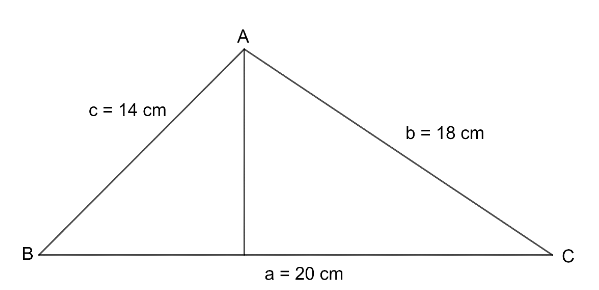
Given : - Side ${\text{A = 20 cm}}$ , Side ${\text{B = 18 cm}}$ , Side ${\text{C = 14 cm}}$
For a triangle can write the cosines as
$\operatorname{Cos} {\text{ A}} = \dfrac{{{b^2} + {c^2} - {a^2}}}{{2bc}}$
$\Rightarrow \operatorname{Cos} {\text{ B}} = \dfrac{{{c^2} + {a^2} - {b^2}}}{{2ac}}$
And $\operatorname{Cos} {\text{ C}} = \dfrac{{{a^2} + {b^2} - {c^2}}}{{2ab}}$
Since , the triangle given in the question has the smallest side of $14\;cm$ which means the angle opposite to this side will be smallest (which we have learnt in earlier classes ) .
So , here in the figure we have $c$ as the smallest side opposite to angle ${\text{C}}$.
Here the angle ${\text{C}}$ is assumed to be $\theta $ as it is asked in the question .
By using LAWS OF COSINES , we have ,
$\operatorname{Cos} {\text{ C}} = \dfrac{{{a^2} + {b^2} - {c^2}}}{{2ab}}$
Substituting the values of $a,b{\text{ and c}}$ , we get
$\operatorname{Cos} {\text{ }}\theta = \dfrac{{{{20}^2} + {{18}^2} - {{14}^2}}}{{2 \times 20 \times 18}}$
On solving further , we get
${14^2} = {18^2} + {20^2} - 2(18)(20)\cos \theta $
This is the required answer.
Therefore, option D is the correct answer.
Note:The acute angled triangle is a triangle in which all three measures less than ${90^ \circ }$, If any angle measures ${90^ \circ }$ or more degrees, we no longer have an acute triangle. The Law of Cosines is used to find the remaining parts of an oblique (non-right) triangle when either the lengths of two sides and the measure of the included angle is known (SAS) or the lengths of the three sides (SSS) are known .
Complete step by step answer:
Given : - Side ${\text{A = 20 cm}}$ , Side ${\text{B = 18 cm}}$ , Side ${\text{C = 14 cm}}$
For a triangle can write the cosines as
$\operatorname{Cos} {\text{ A}} = \dfrac{{{b^2} + {c^2} - {a^2}}}{{2bc}}$
$\Rightarrow \operatorname{Cos} {\text{ B}} = \dfrac{{{c^2} + {a^2} - {b^2}}}{{2ac}}$
And $\operatorname{Cos} {\text{ C}} = \dfrac{{{a^2} + {b^2} - {c^2}}}{{2ab}}$
Since , the triangle given in the question has the smallest side of $14\;cm$ which means the angle opposite to this side will be smallest (which we have learnt in earlier classes ) .
So , here in the figure we have $c$ as the smallest side opposite to angle ${\text{C}}$.
Here the angle ${\text{C}}$ is assumed to be $\theta $ as it is asked in the question .
By using LAWS OF COSINES , we have ,
$\operatorname{Cos} {\text{ C}} = \dfrac{{{a^2} + {b^2} - {c^2}}}{{2ab}}$
Substituting the values of $a,b{\text{ and c}}$ , we get
$\operatorname{Cos} {\text{ }}\theta = \dfrac{{{{20}^2} + {{18}^2} - {{14}^2}}}{{2 \times 20 \times 18}}$
On solving further , we get
${14^2} = {18^2} + {20^2} - 2(18)(20)\cos \theta $
This is the required answer.
Therefore, option D is the correct answer.
Note:The acute angled triangle is a triangle in which all three measures less than ${90^ \circ }$, If any angle measures ${90^ \circ }$ or more degrees, we no longer have an acute triangle. The Law of Cosines is used to find the remaining parts of an oblique (non-right) triangle when either the lengths of two sides and the measure of the included angle is known (SAS) or the lengths of the three sides (SSS) are known .
Recently Updated Pages
Master Class 11 Social Science: Engaging Questions & Answers for Success

Master Class 11 English: Engaging Questions & Answers for Success
Master Class 11 Maths: Engaging Questions & Answers for Success
Master Class 11 Chemistry: Engaging Questions & Answers for Success
Master Class 11 Biology: Engaging Questions & Answers for Success
Master Class 11 Physics: Engaging Questions & Answers for Success
Trending doubts
One Metric ton is equal to kg A 10000 B 1000 C 100 class 11 physics CBSE
Difference Between Prokaryotic Cells and Eukaryotic Cells
How many of the following diseases can be studied with class 11 biology CBSE
Two of the body parts which do not appear in MRI are class 11 biology CBSE
Which of the following enzymes is used for carboxylation class 11 biology CBSE
Explain zero factorial class 11 maths CBSE