




The sides of a triangle are 5, 12, 13 then its area.
Answer
 Verified
615k+ views
Hint:
If we know the length sides of the triangle then we can calculate the area of the triangle by the formula called heron’s formula. The heron’s formula is given by
$ \Rightarrow A = \sqrt {s\left( {s - a} \right)\left( {s - b} \right)\left( {s - c} \right)} $
Where A is the area of triangle; a, b and c are the sides of a triangle and s is the half the perimeter of the triangle i.e.
\[ \Rightarrow s = \dfrac{{a + b + c}}{2}\]
Complete step by step solution:
Let us see what is given to us? In this question all the three sides are given to us i.e.
$ \Rightarrow a = 5$, $b = 12$ and $c = 13$ ………..(1)
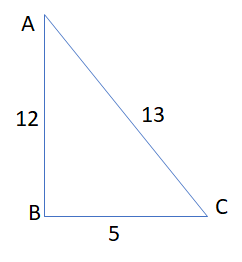
We have to find the area of the triangle.
To find the area of triangle we can use heron’s formula as we know all the three sides by formula:
$ \Rightarrow A = \sqrt {s\left( {s - a} \right)\left( {s - b} \right)\left( {s - c} \right)} $ ………….(2)
To calculate the area, we need to find the value of s i.e.
\[ \Rightarrow s = \dfrac{{a + b + c}}{2}\]
Put the value of a, b and c from (1), we get,
\[ \Rightarrow s = \dfrac{{5 + 12 + 13}}{2}\]
By adding the numbers in numerator, we get,
$ \Rightarrow s = \dfrac{{30}}{2}$
By dividing 2 with 30, we get,
$ \Rightarrow s = 15$ ………….(3)
Put the values of (1) and (3) in (2) and we get,
$ \Rightarrow A = \sqrt {15\left( {15 - 5} \right)\left( {15 - 12} \right)\left( {15 - 13} \right)} $
Using BODMAS rule, first we will solve the brackets and we get,
$ \Rightarrow A = \sqrt {15\left( {10} \right)\left( 3 \right)\left( 2 \right)} $
By multiplying each number inside the square root, we get,
$ \Rightarrow A = \sqrt {900} $
As the square of 30 is 900. Therefore, the square root of 900 is 30 and we get,
$ \Rightarrow A = 30$ ……………(4)
So, the area of the triangle is 30.
Note:
Alternate method:
In this question by analysing the length of the side it is noted that they form Pythagorean triplets i.e. they satisfy the Pythagoras theorem i.e.
$ \Rightarrow {c^2} = {a^2} + {b^{^2}}$
So, it is a right-angle triangle with a and b are sides & c is the hypotenuse. So, area of triangle of right-angle triangle is given by,
$ \Rightarrow A = \dfrac{1}{2} \times a \times b$
Putting value of a and b from (1) and we get,
$ \Rightarrow A = \dfrac{1}{2} \times 5 \times 12$
By cancelling 12 with 2, we get,
$ \Rightarrow A = 5 \times 6$
$ \Rightarrow A = 30$ ……………(5)
By comparing (4) and (5), It is noted by using any method we can get the same answer but for that sides of triangles should form Pythagorean triplets.
If we know the length sides of the triangle then we can calculate the area of the triangle by the formula called heron’s formula. The heron’s formula is given by
$ \Rightarrow A = \sqrt {s\left( {s - a} \right)\left( {s - b} \right)\left( {s - c} \right)} $
Where A is the area of triangle; a, b and c are the sides of a triangle and s is the half the perimeter of the triangle i.e.
\[ \Rightarrow s = \dfrac{{a + b + c}}{2}\]
Complete step by step solution:
Let us see what is given to us? In this question all the three sides are given to us i.e.
$ \Rightarrow a = 5$, $b = 12$ and $c = 13$ ………..(1)
We have to find the area of the triangle.
To find the area of triangle we can use heron’s formula as we know all the three sides by formula:
$ \Rightarrow A = \sqrt {s\left( {s - a} \right)\left( {s - b} \right)\left( {s - c} \right)} $ ………….(2)
To calculate the area, we need to find the value of s i.e.
\[ \Rightarrow s = \dfrac{{a + b + c}}{2}\]
Put the value of a, b and c from (1), we get,
\[ \Rightarrow s = \dfrac{{5 + 12 + 13}}{2}\]
By adding the numbers in numerator, we get,
$ \Rightarrow s = \dfrac{{30}}{2}$
By dividing 2 with 30, we get,
$ \Rightarrow s = 15$ ………….(3)
Put the values of (1) and (3) in (2) and we get,
$ \Rightarrow A = \sqrt {15\left( {15 - 5} \right)\left( {15 - 12} \right)\left( {15 - 13} \right)} $
Using BODMAS rule, first we will solve the brackets and we get,
$ \Rightarrow A = \sqrt {15\left( {10} \right)\left( 3 \right)\left( 2 \right)} $
By multiplying each number inside the square root, we get,
$ \Rightarrow A = \sqrt {900} $
As the square of 30 is 900. Therefore, the square root of 900 is 30 and we get,
$ \Rightarrow A = 30$ ……………(4)
So, the area of the triangle is 30.
Note:
Alternate method:
In this question by analysing the length of the side it is noted that they form Pythagorean triplets i.e. they satisfy the Pythagoras theorem i.e.
$ \Rightarrow {c^2} = {a^2} + {b^{^2}}$
So, it is a right-angle triangle with a and b are sides & c is the hypotenuse. So, area of triangle of right-angle triangle is given by,
$ \Rightarrow A = \dfrac{1}{2} \times a \times b$
Putting value of a and b from (1) and we get,
$ \Rightarrow A = \dfrac{1}{2} \times 5 \times 12$
By cancelling 12 with 2, we get,
$ \Rightarrow A = 5 \times 6$
$ \Rightarrow A = 30$ ……………(5)
By comparing (4) and (5), It is noted by using any method we can get the same answer but for that sides of triangles should form Pythagorean triplets.
Recently Updated Pages
Master Class 11 English: Engaging Questions & Answers for Success

Master Class 11 Social Science: Engaging Questions & Answers for Success
Master Class 11 Maths: Engaging Questions & Answers for Success
Master Class 11 Biology: Engaging Questions & Answers for Success
Master Class 11 Physics: Engaging Questions & Answers for Success
Master Class 11 Chemistry: Engaging Questions & Answers for Success
Trending doubts
What is BLO What is the full form of BLO class 8 social science CBSE
Which Indian state shares the longest international class 8 social science CBSE
Citizens of India can vote at the age of A 18 years class 8 social science CBSE
What is persistence of vision
Full form of STD, ISD and PCO
Give me the opposite gender of Duck class 8 english CBSE