




The sides of a right triangle are in A.P. and the area of the triangle is 24cm. Find the sides of the triangle?
Answer
 Verified
610.2k+ views
Hint: In the above question right triangle is mentioned which has the property of Pythagoras theorem:
$A{C^2} = A{B^2} + B{C^2}$ (Square of hypotenuse is equal to the sum of the squares of the other two sides.)
Arithmetic progression mentioned in the question has the form:
$2b = a + c$ (a, b, c are the terms of the A.P.)
Above mentioned theorem and AP formula will be used to solve the problem.
Complete step-by-step answer:
Arithmetic progression: Arithmetic Progression is a sequence of numbers such that the difference of any two successive numbers is a constant.
Let 1, 2, 3, 4,5 ......is a sequence with a common difference of one.
Pythagoras Theorem states that: In a right triangle square of the longest side is equal to the sum of the square of the other two sides.
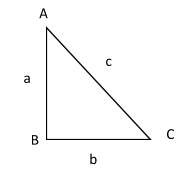
$A{C^2} = A{B^2} + B{C^2}$(mathematical expression for Pythagoras theorem)
Now comes to the calculation part:
Let sides of the triangle be a, b and c.
As the sides are in AP then;
$2b = a + c$
We can also write as:
$ \Rightarrow c = 2b - a$.............1
Substitute the value of c in the expression of Pythagoras theorem.
$
\Rightarrow {c^2} = {a^2} + {b^2} \\
\Rightarrow {(2b - a)^2} = {a^2} + {b^2}
$ (Value of c is substituted)
$
\Rightarrow 4{b^2} + {a^2} - 4ab = {a^2} + {b^2} \\
\Rightarrow 3{b^2} = 4ab
$
Area of the triangle is 24cm2:
$ \Rightarrow \dfrac{1}{2}a \times b = 24$ (From this we will find ab)
$ \Rightarrow ab = 48$ ................2
Substituting the value of ab in expression $3{b^2} = 4ab$:
$
\Rightarrow 3{b^2} = 4 \times 48 \\
\Rightarrow {b^2} = 4 \times 16 \\
\Rightarrow b = 8
$ (Value of side b is calculated as 8)
Side a and c is:
From expression 2 we have:
$
\Rightarrow a = \dfrac{{48}}{b} \\
\Rightarrow a = \dfrac{{48}}{8} = 6
$ (a=6)
From expression 1:
$
\Rightarrow c = 2b - a \\
\Rightarrow c = 2 \times 8 - 6 \\
\Rightarrow c = 10
$ (c=10)
Sides of the triangle are:6, 8 and 10.
Note: To find the $n^{th}$ term of the arithmetic progression we have the expression:
${a_n} = a + (n - 1)d$
Where a is the first term of the AP, n is the nth term of the sequence and d is the common difference.
$A{C^2} = A{B^2} + B{C^2}$ (Square of hypotenuse is equal to the sum of the squares of the other two sides.)
Arithmetic progression mentioned in the question has the form:
$2b = a + c$ (a, b, c are the terms of the A.P.)
Above mentioned theorem and AP formula will be used to solve the problem.
Complete step-by-step answer:
Arithmetic progression: Arithmetic Progression is a sequence of numbers such that the difference of any two successive numbers is a constant.
Let 1, 2, 3, 4,5 ......is a sequence with a common difference of one.
Pythagoras Theorem states that: In a right triangle square of the longest side is equal to the sum of the square of the other two sides.
$A{C^2} = A{B^2} + B{C^2}$(mathematical expression for Pythagoras theorem)
Now comes to the calculation part:
Let sides of the triangle be a, b and c.
As the sides are in AP then;
$2b = a + c$
We can also write as:
$ \Rightarrow c = 2b - a$.............1
Substitute the value of c in the expression of Pythagoras theorem.
$
\Rightarrow {c^2} = {a^2} + {b^2} \\
\Rightarrow {(2b - a)^2} = {a^2} + {b^2}
$ (Value of c is substituted)
$
\Rightarrow 4{b^2} + {a^2} - 4ab = {a^2} + {b^2} \\
\Rightarrow 3{b^2} = 4ab
$
Area of the triangle is 24cm2:
$ \Rightarrow \dfrac{1}{2}a \times b = 24$ (From this we will find ab)
$ \Rightarrow ab = 48$ ................2
Substituting the value of ab in expression $3{b^2} = 4ab$:
$
\Rightarrow 3{b^2} = 4 \times 48 \\
\Rightarrow {b^2} = 4 \times 16 \\
\Rightarrow b = 8
$ (Value of side b is calculated as 8)
Side a and c is:
From expression 2 we have:
$
\Rightarrow a = \dfrac{{48}}{b} \\
\Rightarrow a = \dfrac{{48}}{8} = 6
$ (a=6)
From expression 1:
$
\Rightarrow c = 2b - a \\
\Rightarrow c = 2 \times 8 - 6 \\
\Rightarrow c = 10
$ (c=10)
Sides of the triangle are:6, 8 and 10.
Note: To find the $n^{th}$ term of the arithmetic progression we have the expression:
${a_n} = a + (n - 1)d$
Where a is the first term of the AP, n is the nth term of the sequence and d is the common difference.
Recently Updated Pages
Master Class 12 Economics: Engaging Questions & Answers for Success

Master Class 12 English: Engaging Questions & Answers for Success
Master Class 12 Social Science: Engaging Questions & Answers for Success
Master Class 12 Maths: Engaging Questions & Answers for Success
Master Class 12 Physics: Engaging Questions & Answers for Success
Master Class 11 Social Science: Engaging Questions & Answers for Success
Trending doubts
One Metric ton is equal to kg A 10000 B 1000 C 100 class 11 physics CBSE
Difference Between Prokaryotic Cells and Eukaryotic Cells
Find the value of the expression given below sin 30circ class 11 maths CBSE
Two of the body parts which do not appear in MRI are class 11 biology CBSE
1 ton equals to A 100 kg B 1000 kg C 10 kg D 10000 class 11 physics CBSE
Draw a diagram of nephron and explain its structur class 11 biology CBSE