




The sides of a \[8 \times 8\] square are cut by certain points into pieces of length 1 and 7, 2 and 6, 3 and 5, and 4 and 4 respectively. The area of the quadrilateral determined by these four points is
(a) 28
(b) 36
(c) 48
(d) 8
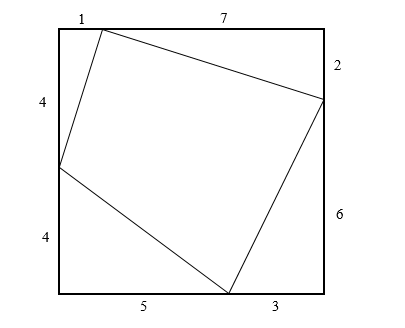
Answer
 Verified
601.8k+ views
Hint: Here, we need to find the area of the quadrilateral. First, we will find the area of the square. Then, we will find the area of the four triangles. Finally, we will use these areas to find the area of the quadrilateral formed by joining the points.
Formula Used: We will use the following formulas:
The area of a square is given by the formula \[{s^2}\], where \[s\] is the length of the side of the square.
The area of a triangle is given by the formula \[\dfrac{1}{2}bh\], where \[b\] is the base of the triangle, and \[h\] is the height of the triangle.
Complete step-by-step answer:
First, we will name the triangles and the quadrilateral formed.
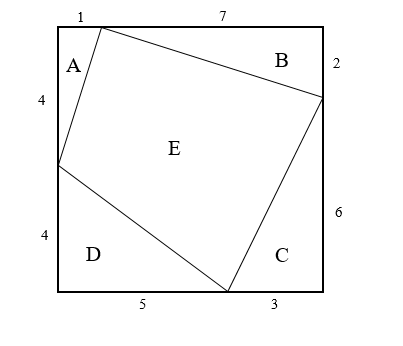
We need to find the area of the quadrilateral E.
First, we will find the area of the square and the four triangles.
The area of a square is given by the formula \[{s^2}\], where \[s\] is the length of the side of the square.
Substituting \[s = 8\] in the formula, we get
\[ \Rightarrow \]Area of the square \[ = {8^2}\]
Applying the exponent on the base, we get
\[ \Rightarrow \]Area of the square \[ = 64\]
Now, we will find the area of the triangle A, B, C, and D.
The area of a triangle is given by the formula \[\dfrac{1}{2}bh\], where \[b\] is the base of the triangle, and \[h\] is the height of the triangle.
Substituting \[b = 1\] and \[h = 4\] in the formula, we get
\[ \Rightarrow \]Area of triangle A \[ = \dfrac{1}{2}\left( 1 \right)\left( 4 \right)\]
Simplifying the expression, we get
\[ \Rightarrow \]Area of triangle A \[ = 2\]
Substituting \[b = 7\] and \[h = 2\] in the formula, we get
\[ \Rightarrow \]Area of triangle B \[ = \dfrac{1}{2}\left( 7 \right)\left( 2 \right)\]
Simplifying the expression, we get
\[ \Rightarrow \]Area of triangle B \[ = 7\]
Substituting \[b = 3\] and \[h = 6\] in the formula, we get
\[ \Rightarrow \]Area of triangle C \[ = \dfrac{1}{2}\left( 3 \right)\left( 6 \right)\]
Simplifying the expression, we get
\[ \Rightarrow \]Area of triangle C \[ = 9\]
Substituting \[b = 5\] and \[h = 4\] in the formula, we get
\[ \Rightarrow \]Area of triangle D \[ = \dfrac{1}{2}\left( 5 \right)\left( 4 \right)\]
Simplifying the expression, we get
\[ \Rightarrow \]Area of triangle D \[ = 10\]
Now, we will find the region of the quadrilateral E.
From the figure, we can observe that the area of the square is the sum of the areas of the four triangles and the quadrilateral.
Therefore, we get
Area of square \[ = \] Area of triangle A \[ + \] Area of triangle B \[ + \] Area of triangle C \[ + \] Area of triangle D \[ + \] Area of quadrilateral E
Substituting the areas of the four triangles and the square, we get
\[ \Rightarrow 64 = 2 + 7 + 9 + 10 + \]Area of quadrilateral E
Adding the terms, we get
\[ \Rightarrow 64 = 28 + \]Area of quadrilateral E
Subtracting 28 from both sides of the equation, we get
\[ \Rightarrow \]Area of quadrilateral E \[ = 64 - 28 = 36\]
Therefore, the area of the quadrilateral formed by joining the points is 36.
Thus, the correct option is option (b).
Note: We used the heights 4, 2, 6, 4 for triangles A, B, C, and D, respectively, because the four triangles are right angled triangles. This is because the four interior angles of a square are right angles. Therefore, the triangles A, B, C, and D are right angled triangles. Right angled triangles are those triangles whose one angle is \[90^\circ \].
Formula Used: We will use the following formulas:
The area of a square is given by the formula \[{s^2}\], where \[s\] is the length of the side of the square.
The area of a triangle is given by the formula \[\dfrac{1}{2}bh\], where \[b\] is the base of the triangle, and \[h\] is the height of the triangle.
Complete step-by-step answer:
First, we will name the triangles and the quadrilateral formed.
We need to find the area of the quadrilateral E.
First, we will find the area of the square and the four triangles.
The area of a square is given by the formula \[{s^2}\], where \[s\] is the length of the side of the square.
Substituting \[s = 8\] in the formula, we get
\[ \Rightarrow \]Area of the square \[ = {8^2}\]
Applying the exponent on the base, we get
\[ \Rightarrow \]Area of the square \[ = 64\]
Now, we will find the area of the triangle A, B, C, and D.
The area of a triangle is given by the formula \[\dfrac{1}{2}bh\], where \[b\] is the base of the triangle, and \[h\] is the height of the triangle.
Substituting \[b = 1\] and \[h = 4\] in the formula, we get
\[ \Rightarrow \]Area of triangle A \[ = \dfrac{1}{2}\left( 1 \right)\left( 4 \right)\]
Simplifying the expression, we get
\[ \Rightarrow \]Area of triangle A \[ = 2\]
Substituting \[b = 7\] and \[h = 2\] in the formula, we get
\[ \Rightarrow \]Area of triangle B \[ = \dfrac{1}{2}\left( 7 \right)\left( 2 \right)\]
Simplifying the expression, we get
\[ \Rightarrow \]Area of triangle B \[ = 7\]
Substituting \[b = 3\] and \[h = 6\] in the formula, we get
\[ \Rightarrow \]Area of triangle C \[ = \dfrac{1}{2}\left( 3 \right)\left( 6 \right)\]
Simplifying the expression, we get
\[ \Rightarrow \]Area of triangle C \[ = 9\]
Substituting \[b = 5\] and \[h = 4\] in the formula, we get
\[ \Rightarrow \]Area of triangle D \[ = \dfrac{1}{2}\left( 5 \right)\left( 4 \right)\]
Simplifying the expression, we get
\[ \Rightarrow \]Area of triangle D \[ = 10\]
Now, we will find the region of the quadrilateral E.
From the figure, we can observe that the area of the square is the sum of the areas of the four triangles and the quadrilateral.
Therefore, we get
Area of square \[ = \] Area of triangle A \[ + \] Area of triangle B \[ + \] Area of triangle C \[ + \] Area of triangle D \[ + \] Area of quadrilateral E
Substituting the areas of the four triangles and the square, we get
\[ \Rightarrow 64 = 2 + 7 + 9 + 10 + \]Area of quadrilateral E
Adding the terms, we get
\[ \Rightarrow 64 = 28 + \]Area of quadrilateral E
Subtracting 28 from both sides of the equation, we get
\[ \Rightarrow \]Area of quadrilateral E \[ = 64 - 28 = 36\]
Therefore, the area of the quadrilateral formed by joining the points is 36.
Thus, the correct option is option (b).
Note: We used the heights 4, 2, 6, 4 for triangles A, B, C, and D, respectively, because the four triangles are right angled triangles. This is because the four interior angles of a square are right angles. Therefore, the triangles A, B, C, and D are right angled triangles. Right angled triangles are those triangles whose one angle is \[90^\circ \].
Recently Updated Pages
Master Class 12 Business Studies: Engaging Questions & Answers for Success

Master Class 12 Biology: Engaging Questions & Answers for Success
Master Class 12 Chemistry: Engaging Questions & Answers for Success
Class 12 Question and Answer - Your Ultimate Solutions Guide
Master Class 11 Social Science: Engaging Questions & Answers for Success
Master Class 11 English: Engaging Questions & Answers for Success
Trending doubts
Explain the Treaty of Vienna of 1815 class 10 social science CBSE
Who Won 36 Oscar Awards? Record Holder Revealed
What is the median of the first 10 natural numbers class 10 maths CBSE
Why is it 530 pm in india when it is 1200 afternoon class 10 social science CBSE
The highest temperature in Karnataka is recorded in class 10 social science CBSE
Define Potential, Developed, Stock and Reserved resources