



The side of an equilateral triangle is increasing at the rate of $2cm/\sec $ . At what rate is its area increasing when the side of the triangle is $20cm$ ?
Answer
 Verified
587.4k+ views
Hint: So in this question we will assume an equilateral triangle having the side as $x{\text{ cm}}$ . Then by using the formula of area of an equilateral triangle $A = \dfrac{{\sqrt 3 }}{4}{x^2}$ . On differentiating it we will get the rate. In this, we will solve this problem.
Formula used:
The area of an equilateral triangle is given as
$A = \dfrac{{\sqrt 3 }}{4}{x^2}$
Here,
$x$ , will be the side of the triangle
$A$ , will be its area.
Complete step-by-step answer:
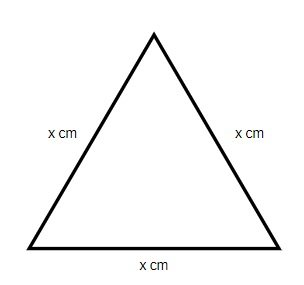
As from the figure, we can see that we have an equilateral triangle given, and let us assume that its side is $x{\text{ cm}}$ .
Therefore by using the formula of an equilateral triangle, we have
$A = \dfrac{{\sqrt 3 }}{4}{x^2}$ , we will let it equation $1$
Also, we have the rate of change of side given as mathematically we can write it as
$ \Rightarrow \dfrac{{dx}}{{dt}} = 2cm/s$
Now on differentiating the equation $1$ , with respect to the time, we get
$ \Rightarrow \dfrac{{dA}}{{dt}} = \dfrac{{\sqrt 3 }}{4} \times 2x \times \dfrac{{dx}}{{dt}}$
And on solving the above equation, we get
$ \Rightarrow \dfrac{{dA}}{{dt}} = \dfrac{{\sqrt 3 x}}{2} \times \dfrac{{dx}}{{dt}}$
From the question we know, when $x = 20cm$ , then
$ \Rightarrow \dfrac{{dA}}{{dt}} = \dfrac{{20\sqrt 3 }}{2} \times 2$
Since, the same term will cancel out each other, therefore on solving we have the equation
$ \Rightarrow \dfrac{{dA}}{{dt}} = 20\sqrt 3 c{m^2}/s$
Therefore $20\sqrt 3 c{m^2}/s$ , will be the rate at which the area is increasing.
Note: This question has two to three basic concepts and by using all of these we can easily solve the solution. Firstly we should have the basic knowledge of the differentiation and also we should know the formula for finding the area of an equilateral triangle. By using all these concepts we can easily solve the question like this. Also from this question, we learn that the change in rate can be expressed in terms of derivatives.
Formula used:
The area of an equilateral triangle is given as
$A = \dfrac{{\sqrt 3 }}{4}{x^2}$
Here,
$x$ , will be the side of the triangle
$A$ , will be its area.
Complete step-by-step answer:
As from the figure, we can see that we have an equilateral triangle given, and let us assume that its side is $x{\text{ cm}}$ .
Therefore by using the formula of an equilateral triangle, we have
$A = \dfrac{{\sqrt 3 }}{4}{x^2}$ , we will let it equation $1$
Also, we have the rate of change of side given as mathematically we can write it as
$ \Rightarrow \dfrac{{dx}}{{dt}} = 2cm/s$
Now on differentiating the equation $1$ , with respect to the time, we get
$ \Rightarrow \dfrac{{dA}}{{dt}} = \dfrac{{\sqrt 3 }}{4} \times 2x \times \dfrac{{dx}}{{dt}}$
And on solving the above equation, we get
$ \Rightarrow \dfrac{{dA}}{{dt}} = \dfrac{{\sqrt 3 x}}{2} \times \dfrac{{dx}}{{dt}}$
From the question we know, when $x = 20cm$ , then
$ \Rightarrow \dfrac{{dA}}{{dt}} = \dfrac{{20\sqrt 3 }}{2} \times 2$
Since, the same term will cancel out each other, therefore on solving we have the equation
$ \Rightarrow \dfrac{{dA}}{{dt}} = 20\sqrt 3 c{m^2}/s$
Therefore $20\sqrt 3 c{m^2}/s$ , will be the rate at which the area is increasing.
Note: This question has two to three basic concepts and by using all of these we can easily solve the solution. Firstly we should have the basic knowledge of the differentiation and also we should know the formula for finding the area of an equilateral triangle. By using all these concepts we can easily solve the question like this. Also from this question, we learn that the change in rate can be expressed in terms of derivatives.

Recently Updated Pages
Master Class 8 Social Science: Engaging Questions & Answers for Success

Master Class 8 Science: Engaging Questions & Answers for Success
Master Class 8 Maths: Engaging Questions & Answers for Success
Class 8 Question and Answer - Your Ultimate Solutions Guide
Master Class 9 Social Science: Engaging Questions & Answers for Success
Master Class 9 Science: Engaging Questions & Answers for Success
Trending doubts
What are gulf countries and why they are called Gulf class 8 social science CBSE
What is BLO What is the full form of BLO class 8 social science CBSE
Give full form of LPG and CNG class 8 chemistry CBSE
Citizens of India can vote at the age of A 18 years class 8 social science CBSE
Advantages and disadvantages of science
Give me the opposite gender of Duck class 8 english CBSE