




The S.I unit of G is
$
(a){\text{ }}{{\text{N}}^2}{m^2}/Kg \\
(b){\text{ N}}{m^2}/Kg \\
(c){\text{ N}}m/Kg \\
(d){\text{ N}}{m^2}/K{g^2} \\
$
Answer
 Verified
622.8k+ views
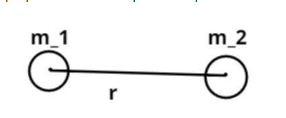
Hint: In this question use the concept that the force $({F_g})$ between two bodies of masses ${m_1}{\text{ and }}{{\text{m}}_2}$each is proportional to the product of their masses and inversely proportional to the square of separation between the two bodies.
Step by step answer:
As we know that every object is the universe attracts every other object with a force (${F_g}$) directed along the line of centers for the two objects which is proportional to the product of their masses and inversely proportional to the square of separation between the two bodies that is ${F_g} \propto \dfrac{{{m_1}{m_2}}}{{{r^2}}}$. This proportionality is overtook by a constant called G. Find the dimensions of G using the dimensions of the entities coming in formula.
$ \Rightarrow {F_g} \propto \dfrac{{{m_1}{m_2}}}{{{r^2}}}$, where ${m_1} = $Mass of first object
${m_2} = $Mass of second object
$r = $Separation between two objects.
Now when we apply the proportionality constant it is become,
$ \Rightarrow {F_g} = G\dfrac{{{m_1}{m_2}}}{{{r^2}}}$........... (1), where G = universal gravitational constant.
Now as we know that the dimension of force (F) is $\left[ {{M^1}{L^1}{T^{ - 2}}} \right]$.
And we all know distance is measured in meters so the dimension of r is [$L$] and the dimension of mass is [M].
Therefore, the dimension of G is
$ \Rightarrow G = \dfrac{{\left[ {{M^1}{L^1}{T^{ - 2}}} \right]\left[ {{L^2}} \right]}}{{\left[ {{M^2}} \right]}}$
Now on simplifying we have,
$ \Rightarrow G = \left[ {{M^{ - 1}}{L^3}{T^{ - 2}}} \right]$
Now as we know that the unit of force is Newton having symbol (N), the unit of mass is kg and the unit of distance is meter.
So the unit of G is $\dfrac{{{m^3}}}{{kg.{s^2}}}$
Now from equation (1) gravitational constant (G) is
$ \Rightarrow G = \dfrac{{{F_g}{r^2}}}{{{m_1}{m_2}}}$
So the unit of gravitational constant is $\dfrac{{N.{m^2}}}{{{{\left( {kg} \right)}^2}}}$ so both the units are same, and the constant value is $6.674 \times {10^{ - 11}}$$\dfrac{{N.{m^2}}}{{{{\left( {kg} \right)}^2}}}$ or $\dfrac{{{m^3}}}{{kg.{s^2}}}$
So this is the required answer.
Hence option (D) is the correct answer.
Note: Generally there is a confusion regarding the proportionality constant G and acceleration due to gravity g. These both are different G is a proportionality constant and is equal to $6.673 \times {10^{ - 11}}N{m^2}K{g^{ - 2}}$ whereas the value of g is 9.8. The S.I unit of g is meter/sec.
Step by step answer:
As we know that every object is the universe attracts every other object with a force (${F_g}$) directed along the line of centers for the two objects which is proportional to the product of their masses and inversely proportional to the square of separation between the two bodies that is ${F_g} \propto \dfrac{{{m_1}{m_2}}}{{{r^2}}}$. This proportionality is overtook by a constant called G. Find the dimensions of G using the dimensions of the entities coming in formula.
$ \Rightarrow {F_g} \propto \dfrac{{{m_1}{m_2}}}{{{r^2}}}$, where ${m_1} = $Mass of first object
${m_2} = $Mass of second object
$r = $Separation between two objects.
Now when we apply the proportionality constant it is become,
$ \Rightarrow {F_g} = G\dfrac{{{m_1}{m_2}}}{{{r^2}}}$........... (1), where G = universal gravitational constant.
Now as we know that the dimension of force (F) is $\left[ {{M^1}{L^1}{T^{ - 2}}} \right]$.
And we all know distance is measured in meters so the dimension of r is [$L$] and the dimension of mass is [M].
Therefore, the dimension of G is
$ \Rightarrow G = \dfrac{{\left[ {{M^1}{L^1}{T^{ - 2}}} \right]\left[ {{L^2}} \right]}}{{\left[ {{M^2}} \right]}}$
Now on simplifying we have,
$ \Rightarrow G = \left[ {{M^{ - 1}}{L^3}{T^{ - 2}}} \right]$
Now as we know that the unit of force is Newton having symbol (N), the unit of mass is kg and the unit of distance is meter.
So the unit of G is $\dfrac{{{m^3}}}{{kg.{s^2}}}$
Now from equation (1) gravitational constant (G) is
$ \Rightarrow G = \dfrac{{{F_g}{r^2}}}{{{m_1}{m_2}}}$
So the unit of gravitational constant is $\dfrac{{N.{m^2}}}{{{{\left( {kg} \right)}^2}}}$ so both the units are same, and the constant value is $6.674 \times {10^{ - 11}}$$\dfrac{{N.{m^2}}}{{{{\left( {kg} \right)}^2}}}$ or $\dfrac{{{m^3}}}{{kg.{s^2}}}$
So this is the required answer.
Hence option (D) is the correct answer.
Note: Generally there is a confusion regarding the proportionality constant G and acceleration due to gravity g. These both are different G is a proportionality constant and is equal to $6.673 \times {10^{ - 11}}N{m^2}K{g^{ - 2}}$ whereas the value of g is 9.8. The S.I unit of g is meter/sec.
Recently Updated Pages
Master Class 11 Social Science: Engaging Questions & Answers for Success

Master Class 11 Physics: Engaging Questions & Answers for Success
Master Class 11 Maths: Engaging Questions & Answers for Success
Master Class 11 Economics: Engaging Questions & Answers for Success
Master Class 11 Computer Science: Engaging Questions & Answers for Success
Master Class 11 Chemistry: Engaging Questions & Answers for Success
Trending doubts
One Metric ton is equal to kg A 10000 B 1000 C 100 class 11 physics CBSE
There are 720 permutations of the digits 1 2 3 4 5 class 11 maths CBSE
1 Quintal is equal to a 110 kg b 10 kg c 100kg d 1000 class 11 physics CBSE
State and prove Bernoullis theorem class 11 physics CBSE
Difference Between Prokaryotic Cells and Eukaryotic Cells
Which among the following are examples of coming together class 11 social science CBSE