




The shortest distance of $\left( 0,0 \right)$ from the curve $y=\dfrac{{{e}^{x}}+{{e}^{-x}}}{2}$ is \[\]
A.$\dfrac{1}{2}$ \[\]
B.$\dfrac{1}{3}$ \[\]
C.2 \[\]
D. None of these \[\]
Answer
 Verified
620.4k+ views
Hint: We use distance formula between any two points $\left( {{x}_{1}},{{y}_{1}} \right),\left( {{x}_{2}},{{y}_{2}} \right)$ on a plane $D=\sqrt{{{\left( {{x}_{2}}-{{x}_{1}} \right)}^{2}}+{{\left( {{y}_{2}}-{{y}_{1}} \right)}^{2}}}$ to find the distance between origin $\left( 0,0 \right)$ and any point on the curve $\left( t,\dfrac{{{e}^{t}}+{{e}^{-t}}}{2} \right)$. We use the first derivative test to minimum distance for shortest path by finding critical points $t=c$ from $\dfrac{d}{dt}D\left( t \right)=0$ and then check if $D\left( t \right)$ changes its sign from negative to positive when we pass $t=c$. If not we use the second derivative test and check if $\dfrac{{{d}^{2}}}{d{{t}^{2}}}D\left( t \right)>0$ at $t=c$. \[\]
Complete step by step answer:
We are given in the question the equation of the following curve
\[y=\dfrac{{{e}^{x}}+{{e}^{-x}}}{2}\]
Let us take represent any point on the curve with variable $t$ as $\left( t,\dfrac{{{e}^{t}}+{{e}^{-t}}}{2} \right)$. We use the distance formula between two points and find the distance $D$ between origin $\left( 0,0 \right)$ and any point on the curve as
\[\begin{align}
& D=\sqrt{{{\left( t-0 \right)}^{2}}+{{\left( \dfrac{{{e}^{t}}+{{e}^{-t}}}{2}-0 \right)}^{2}}} \\
& \Rightarrow D\left( t \right)=\sqrt{{{t}^{2}}+{{\left( \dfrac{{{e}^{t}}+{{e}^{-t}}}{2} \right)}^{2}}} \\
\end{align}\]
We expand ${{\left( {{e}^{t}}+{{e}^{-t}} \right)}^{2}}$ using the algebraic identity ${{\left( a+b \right)}^{2}}={{a}^{2}}+{{b}^{2}}+2ab$for $a={{e}^{t}},b={{e}^{-t}}$ to have the distance function as;
\[\begin{align}
& \Rightarrow D\left( t \right)=\sqrt{{{t}^{2}}+\dfrac{{{\left( {{e}^{t}} \right)}^{2}}+{{\left( {{e}^{-t}} \right)}^{2}}+2{{e}^{t}}{{e}^{-t}}}{{{2}^{2}}}} \\
& \Rightarrow D\left( t \right)=\sqrt{{{t}^{2}}+\dfrac{{{e}^{2t}}+{{e}^{-2t}}+2}{4}} \\
\end{align}\]
The shortest distance between the origin and any point on the curve will occur when the distance function $D\left( t \right)$ is minimum. So let us use first derivative test to find the minima. So we first find the critical points by equating the first derivative of the function to zero. We differentiate $D\left( t \right)$ with respect to $t$ and have;
\[\dfrac{d}{dt}D\left( t \right)=\dfrac{d}{dt}\left( \sqrt{{{t}^{2}}+\dfrac{{{e}^{2t}}+{{e}^{-2t}}+2}{4}} \right)\]
We use the chain rule for differentiation to have;
\[\begin{align}
& \Rightarrow \dfrac{d}{dt}D\left( t \right)=\dfrac{1}{2\sqrt{{{t}^{2}}+\dfrac{{{e}^{2t}}+{{e}^{-2t}}+2}{4}}}\left( \dfrac{d}{dt}\left( {{t}^{2}}+\dfrac{{{e}^{2t}}+{{e}^{-2t}}+2}{4} \right) \right) \\
& \Rightarrow \dfrac{d}{dt}D\left( t \right)=\dfrac{1}{2D\left( t \right)}\left( \dfrac{d}{dt}{{t}^{2}}+\dfrac{d}{dt}\left( \dfrac{{{e}^{2t}}}{4} \right)+\dfrac{d}{dt}\left( \dfrac{{{e}^{-2t}}}{4} \right)+\dfrac{d}{dt}\left( \dfrac{2}{4} \right) \right) \\
& \Rightarrow \dfrac{d}{dt}D\left( t \right)=\dfrac{1}{2D\left( t \right)}\left( 2t+\dfrac{1}{2}{{e}^{2t}}-\dfrac{1}{2}{{e}^{-2t}} \right).....\left( 1 \right) \\
\end{align}\]
We equate the obtained derivative to zero to find the critical points;
\[\begin{align}
& \dfrac{1}{2D\left( t \right)}\left( 2t+\dfrac{1}{2}{{e}^{2t}}-\dfrac{1}{2}{{e}^{-2t}} \right)=0 \\
& \Rightarrow 2t+\dfrac{1}{2}{{e}^{2t}}-\dfrac{1}{2}{{e}^{-2t}}=0 \\
& \Rightarrow 4t+{{e}^{2t}}-{{e}^{-2t}}=0 \\
\end{align}\]
We can use trial and error method and find the only root of the above equation as $t=0$.So $t=0$ is a critical point at and since distance function cannot be negative and will not sign change at $t=0$.We have to use the double derivative test. So let us differentiate $\dfrac{d}{dt}D\left( t \right)$ with respect to $t$ once again in (1) to have;
\[\begin{align}
& \dfrac{d}{dt}\left( \dfrac{d}{dt}D\left( t \right) \right)=\dfrac{1}{2D\left( t \right)}\left( 2t+\dfrac{1}{2}{{e}^{2t}}-\dfrac{1}{2}{{e}^{-2t}} \right) \\
& \Rightarrow \dfrac{{{d}^{2}}D\left( t \right)}{d{{t}^{2}}}=\dfrac{1}{2}\left[ \dfrac{-1}{{{D}^{2}}\left( t \right)}\left( 2t+\dfrac{1}{2}{{e}^{2t}}-\dfrac{1}{2}{{e}^{-2t}} \right)+\dfrac{1}{D\left( t \right)}\left( t+{{e}^{t}}+{{e}^{-t}} \right) \right] \\
\end{align}\]
We put $t=0$ in the above step to have;
\[\begin{align}
& \Rightarrow {{\left. \dfrac{{{d}^{2}}D\left( t \right)}{d{{t}^{2}}} \right|}_{t=0}}=\dfrac{1}{2}\left[ \dfrac{-1}{{{D}^{2}}\left( 0 \right)}\left( 2\times 0+\dfrac{1}{2}{{e}^{2\times 0}}-\dfrac{1}{2}{{e}^{-2\times 0}} \right)+\dfrac{1}{D\left( t \right)}\left( 0+{{e}^{0}}+{{e}^{-0}} \right) \right] \\
& \Rightarrow {{\left. \dfrac{{{d}^{2}}D\left( t \right)}{d{{t}^{2}}} \right|}_{t=0}}=\dfrac{1}{2}\left[ 0+\dfrac{1}{D\left( t \right)}\left( 1 \right) \right] \\
& \Rightarrow {{\left. \dfrac{{{d}^{2}}D\left( t \right)}{d{{t}^{2}}} \right|}_{t=0}}=\dfrac{1}{2D\left( t \right)}\ge 0\left( \because \text{ since distance is always postive } \right) \\
\end{align}\]
So there is a minima occurs at $t=0$ for $D\left( t \right)$ and the point minima is $\left( t,\dfrac{{{e}^{t}}+{{e}^{-t}}}{2} \right)=\left( 0,\dfrac{{{e}^{0}}+{{e}^{-0}}}{2} \right)=\left( 0,1 \right)$. So the shortest path of the curve from the origin is the distance between $\left( 0,1 \right)$ and $\left( 0,0 \right)$ which we can find using the distance formula as 1.
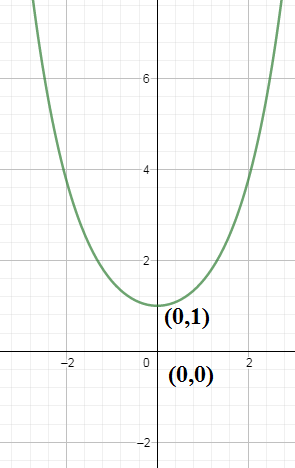
So, the correct answer is “Option D”.
Note: We note that the given function $\dfrac{{{e}^{x}}+{{e}^{-x}}}{2}$ is the cosine hyperbolic $\cosh x$ function whose curve we have plotted and whose differentiation is the sine hyperbolic function $\sinh x=\dfrac{{{e}^{x}}-{{e}^{-x}}}{2}$. If we find the minimization of $D\left( t \right)$ difficult we can also minimize ${{D}^{2}}\left( t \right)$ instead. We should remember that the critical points not only occur at ${{f}^{'}}\left( x \right)=0$ but also at the points the derivative is not defined.
Complete step by step answer:
We are given in the question the equation of the following curve
\[y=\dfrac{{{e}^{x}}+{{e}^{-x}}}{2}\]
Let us take represent any point on the curve with variable $t$ as $\left( t,\dfrac{{{e}^{t}}+{{e}^{-t}}}{2} \right)$. We use the distance formula between two points and find the distance $D$ between origin $\left( 0,0 \right)$ and any point on the curve as
\[\begin{align}
& D=\sqrt{{{\left( t-0 \right)}^{2}}+{{\left( \dfrac{{{e}^{t}}+{{e}^{-t}}}{2}-0 \right)}^{2}}} \\
& \Rightarrow D\left( t \right)=\sqrt{{{t}^{2}}+{{\left( \dfrac{{{e}^{t}}+{{e}^{-t}}}{2} \right)}^{2}}} \\
\end{align}\]
We expand ${{\left( {{e}^{t}}+{{e}^{-t}} \right)}^{2}}$ using the algebraic identity ${{\left( a+b \right)}^{2}}={{a}^{2}}+{{b}^{2}}+2ab$for $a={{e}^{t}},b={{e}^{-t}}$ to have the distance function as;
\[\begin{align}
& \Rightarrow D\left( t \right)=\sqrt{{{t}^{2}}+\dfrac{{{\left( {{e}^{t}} \right)}^{2}}+{{\left( {{e}^{-t}} \right)}^{2}}+2{{e}^{t}}{{e}^{-t}}}{{{2}^{2}}}} \\
& \Rightarrow D\left( t \right)=\sqrt{{{t}^{2}}+\dfrac{{{e}^{2t}}+{{e}^{-2t}}+2}{4}} \\
\end{align}\]
The shortest distance between the origin and any point on the curve will occur when the distance function $D\left( t \right)$ is minimum. So let us use first derivative test to find the minima. So we first find the critical points by equating the first derivative of the function to zero. We differentiate $D\left( t \right)$ with respect to $t$ and have;
\[\dfrac{d}{dt}D\left( t \right)=\dfrac{d}{dt}\left( \sqrt{{{t}^{2}}+\dfrac{{{e}^{2t}}+{{e}^{-2t}}+2}{4}} \right)\]
We use the chain rule for differentiation to have;
\[\begin{align}
& \Rightarrow \dfrac{d}{dt}D\left( t \right)=\dfrac{1}{2\sqrt{{{t}^{2}}+\dfrac{{{e}^{2t}}+{{e}^{-2t}}+2}{4}}}\left( \dfrac{d}{dt}\left( {{t}^{2}}+\dfrac{{{e}^{2t}}+{{e}^{-2t}}+2}{4} \right) \right) \\
& \Rightarrow \dfrac{d}{dt}D\left( t \right)=\dfrac{1}{2D\left( t \right)}\left( \dfrac{d}{dt}{{t}^{2}}+\dfrac{d}{dt}\left( \dfrac{{{e}^{2t}}}{4} \right)+\dfrac{d}{dt}\left( \dfrac{{{e}^{-2t}}}{4} \right)+\dfrac{d}{dt}\left( \dfrac{2}{4} \right) \right) \\
& \Rightarrow \dfrac{d}{dt}D\left( t \right)=\dfrac{1}{2D\left( t \right)}\left( 2t+\dfrac{1}{2}{{e}^{2t}}-\dfrac{1}{2}{{e}^{-2t}} \right).....\left( 1 \right) \\
\end{align}\]
We equate the obtained derivative to zero to find the critical points;
\[\begin{align}
& \dfrac{1}{2D\left( t \right)}\left( 2t+\dfrac{1}{2}{{e}^{2t}}-\dfrac{1}{2}{{e}^{-2t}} \right)=0 \\
& \Rightarrow 2t+\dfrac{1}{2}{{e}^{2t}}-\dfrac{1}{2}{{e}^{-2t}}=0 \\
& \Rightarrow 4t+{{e}^{2t}}-{{e}^{-2t}}=0 \\
\end{align}\]
We can use trial and error method and find the only root of the above equation as $t=0$.So $t=0$ is a critical point at and since distance function cannot be negative and will not sign change at $t=0$.We have to use the double derivative test. So let us differentiate $\dfrac{d}{dt}D\left( t \right)$ with respect to $t$ once again in (1) to have;
\[\begin{align}
& \dfrac{d}{dt}\left( \dfrac{d}{dt}D\left( t \right) \right)=\dfrac{1}{2D\left( t \right)}\left( 2t+\dfrac{1}{2}{{e}^{2t}}-\dfrac{1}{2}{{e}^{-2t}} \right) \\
& \Rightarrow \dfrac{{{d}^{2}}D\left( t \right)}{d{{t}^{2}}}=\dfrac{1}{2}\left[ \dfrac{-1}{{{D}^{2}}\left( t \right)}\left( 2t+\dfrac{1}{2}{{e}^{2t}}-\dfrac{1}{2}{{e}^{-2t}} \right)+\dfrac{1}{D\left( t \right)}\left( t+{{e}^{t}}+{{e}^{-t}} \right) \right] \\
\end{align}\]
We put $t=0$ in the above step to have;
\[\begin{align}
& \Rightarrow {{\left. \dfrac{{{d}^{2}}D\left( t \right)}{d{{t}^{2}}} \right|}_{t=0}}=\dfrac{1}{2}\left[ \dfrac{-1}{{{D}^{2}}\left( 0 \right)}\left( 2\times 0+\dfrac{1}{2}{{e}^{2\times 0}}-\dfrac{1}{2}{{e}^{-2\times 0}} \right)+\dfrac{1}{D\left( t \right)}\left( 0+{{e}^{0}}+{{e}^{-0}} \right) \right] \\
& \Rightarrow {{\left. \dfrac{{{d}^{2}}D\left( t \right)}{d{{t}^{2}}} \right|}_{t=0}}=\dfrac{1}{2}\left[ 0+\dfrac{1}{D\left( t \right)}\left( 1 \right) \right] \\
& \Rightarrow {{\left. \dfrac{{{d}^{2}}D\left( t \right)}{d{{t}^{2}}} \right|}_{t=0}}=\dfrac{1}{2D\left( t \right)}\ge 0\left( \because \text{ since distance is always postive } \right) \\
\end{align}\]
So there is a minima occurs at $t=0$ for $D\left( t \right)$ and the point minima is $\left( t,\dfrac{{{e}^{t}}+{{e}^{-t}}}{2} \right)=\left( 0,\dfrac{{{e}^{0}}+{{e}^{-0}}}{2} \right)=\left( 0,1 \right)$. So the shortest path of the curve from the origin is the distance between $\left( 0,1 \right)$ and $\left( 0,0 \right)$ which we can find using the distance formula as 1.
So, the correct answer is “Option D”.
Note: We note that the given function $\dfrac{{{e}^{x}}+{{e}^{-x}}}{2}$ is the cosine hyperbolic $\cosh x$ function whose curve we have plotted and whose differentiation is the sine hyperbolic function $\sinh x=\dfrac{{{e}^{x}}-{{e}^{-x}}}{2}$. If we find the minimization of $D\left( t \right)$ difficult we can also minimize ${{D}^{2}}\left( t \right)$ instead. We should remember that the critical points not only occur at ${{f}^{'}}\left( x \right)=0$ but also at the points the derivative is not defined.
Recently Updated Pages
Basicity of sulphurous acid and sulphuric acid are

Master Class 11 English: Engaging Questions & Answers for Success
Master Class 11 Physics: Engaging Questions & Answers for Success
Master Class 11 Computer Science: Engaging Questions & Answers for Success
Master Class 11 Chemistry: Engaging Questions & Answers for Success
Master Class 11 Social Science: Engaging Questions & Answers for Success
Trending doubts
Difference Between Prokaryotic Cells and Eukaryotic Cells
Two of the body parts which do not appear in MRI are class 11 biology CBSE
One Metric ton is equal to kg A 10000 B 1000 C 100 class 11 physics CBSE
10 examples of friction in our daily life
Draw a diagram of nephron and explain its structur class 11 biology CBSE
What will happen if the mucus is not secreted by the class 11 biology CBSE