




The shortest distance between two tetrahedral voids is:
(A) $ \text{a}\sqrt{\text{3}} $
(B) $ \dfrac{\text{a}\sqrt{\text{3}}}{2} $
(C) $ \dfrac{\text{a}}{2} $
(D) $ \dfrac{\text{a}\sqrt{\text{3}}}{4} $
Answer
 Verified
611.4k+ views
Hint: The voids in the crystals can be defined as the region of empty space between the molecules of the crystals and this empty space is the region which lies outside the normal van der Waals surface area of molecules in the unit cells and within which no nuclei of the atoms exists.
Complete step by step solution:
To answer this question, let us take the example of the Face Centred Cubic Crystal system. There are a total 8 tetrahedral voids in a Face Centred Cubic lattice. Now if we divide the Face Centred Cubic lattice into 8 smaller cubes then each cube will have one tetrahedral void at the centre of the cube at the body centre of the small cubes. Now if we consider the length of the side of the big Face Centred Cube be a, then on breaking into smaller cubes the edge length of each cube will be $ \dfrac{\text{a}}{2} $ .
The figure below will reveal the situation better:
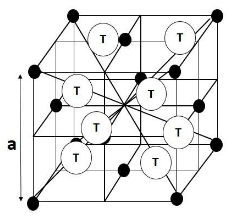
From the figure it is clear that the distance between two tetrahedral voids in a cube is equal to $ \dfrac{\text{a}}{2} $ .
The correct answer here is option C.
Note:
There are two types of voids in the crystal structures: the tetrahedral voids and the octahedral voids. The tetrahedral voids are empty spaces between the particles in a unit cell of a tetrahedral crystal structure, whereas the octahedral voids are the empty spaces between the particles that are present in the unit cell of an octahedral crystal system.
Complete step by step solution:
To answer this question, let us take the example of the Face Centred Cubic Crystal system. There are a total 8 tetrahedral voids in a Face Centred Cubic lattice. Now if we divide the Face Centred Cubic lattice into 8 smaller cubes then each cube will have one tetrahedral void at the centre of the cube at the body centre of the small cubes. Now if we consider the length of the side of the big Face Centred Cube be a, then on breaking into smaller cubes the edge length of each cube will be $ \dfrac{\text{a}}{2} $ .
The figure below will reveal the situation better:
From the figure it is clear that the distance between two tetrahedral voids in a cube is equal to $ \dfrac{\text{a}}{2} $ .
The correct answer here is option C.
Note:
There are two types of voids in the crystal structures: the tetrahedral voids and the octahedral voids. The tetrahedral voids are empty spaces between the particles in a unit cell of a tetrahedral crystal structure, whereas the octahedral voids are the empty spaces between the particles that are present in the unit cell of an octahedral crystal system.
Recently Updated Pages
Which will be the least stable resonating structure class 11 chemistry CBSE

How many 5 digit telephone numbers can be construc-class-11-maths-CBSE
How do you find the angle of the resultant vector class 11 physics CBSE
Draw labelled diagram of the following i Gram seed class 11 biology CBSE
1 Quintal is equal to a 110 kg b 10 kg c 100kg d 1000 class 11 physics CBSE
What is the need and importance of classification class 11 biology CBSE
Trending doubts
Find the value of the expression given below sin 30circ class 11 maths CBSE
The teeth used for biting and cutting food are called class 11 biology CBSE
Bond order ofO2 O2+ O2 and O22 is in order A O2 langle class 11 chemistry CBSE
Frogs heart when taken out of the body continues to class 11 biology CBSE
Can anyone list 10 advantages and disadvantages of friction
Draw a diagram of a plant cell and label at least eight class 11 biology CBSE