




The shape of sulphate ion is:
a.) Hexagonal
b.) Square planar
c.) Trigonal bipyramidal
d.) Tetrahedral
Answer
 Verified
627.3k+ views
Hint:. Through the Lewis dot structure we can find the structure of the molecule which gives the number of bond pairs and lone pairs around the central atom. Using this information along with the VSEPR theory we can obtain the shape of the molecule.
Complete step by step answer:
The chemical formula of the sulfate ion is $SO_{4}^{2-}$
The central atom is sulphur which is having 6 valence electrons in the outermost shell. So the structure of the sulphate ion is :
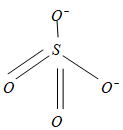
From the above structure we can know about the bond pairs and the lone pairs,
There are four atoms between which sulphur has made bonds so the bond pairs are four in this case and there is no lone pair of electrons on the central atom. If there is the presence of a double bond the pair of bonds constitutes a single unit. And hence there are two double bonds which give two bond pairs and two single bonds constitute two single bonds so total there are 4 bond pairs and since there are no lone pairs on the central atom, the two double bond units and two single bonds arrange themselves as far apart as possible to give a tetrahedral arrangement.
So, the correct answer is “Option D”.
Note: Through VSEPR theory, we can find the geometry and the shape of the given molecule depending upon the bond pair and the loan pair of electrons present on the central atom. As we discussed for the central atom sulfur in the above case.
Complete step by step answer:
The chemical formula of the sulfate ion is $SO_{4}^{2-}$
The central atom is sulphur which is having 6 valence electrons in the outermost shell. So the structure of the sulphate ion is :
From the above structure we can know about the bond pairs and the lone pairs,
There are four atoms between which sulphur has made bonds so the bond pairs are four in this case and there is no lone pair of electrons on the central atom. If there is the presence of a double bond the pair of bonds constitutes a single unit. And hence there are two double bonds which give two bond pairs and two single bonds constitute two single bonds so total there are 4 bond pairs and since there are no lone pairs on the central atom, the two double bond units and two single bonds arrange themselves as far apart as possible to give a tetrahedral arrangement.
So, the correct answer is “Option D”.
Note: Through VSEPR theory, we can find the geometry and the shape of the given molecule depending upon the bond pair and the loan pair of electrons present on the central atom. As we discussed for the central atom sulfur in the above case.
Recently Updated Pages
Master Class 11 English: Engaging Questions & Answers for Success

Master Class 11 Physics: Engaging Questions & Answers for Success
Master Class 11 Computer Science: Engaging Questions & Answers for Success
Master Class 11 Chemistry: Engaging Questions & Answers for Success
Master Class 11 Social Science: Engaging Questions & Answers for Success
Master Class 11 Accountancy: Engaging Questions & Answers for Success
Trending doubts
Difference Between Prokaryotic Cells and Eukaryotic Cells
Two of the body parts which do not appear in MRI are class 11 biology CBSE
One Metric ton is equal to kg A 10000 B 1000 C 100 class 11 physics CBSE
10 examples of friction in our daily life
Draw a diagram of nephron and explain its structur class 11 biology CBSE
Draw a diagram of a plant cell and label at least eight class 11 biology CBSE