




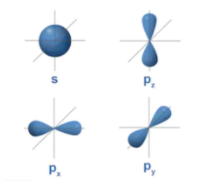
The shape of s -orbital____ and the shape of p- orbital.
Answer
 Verified
661.5k+ views
Hint: In atomic theory finding an atomic orbital is a mathematical process and quantum mechanics that describes the wave-like behaviour of one electron or a pair of electrons in an atom. Every orbital can occupy a maximum of two electrons and has its own quantity of spin.
Complete answer:
There are four different orbital forms (s, p, d, and f) having different sizes, and one orbital will have a maximum of two electrons. The orbitals p, d, and f have separate sub-levels and have more electrons.
An s - orbital is spherical having nucleus in its centre and a p - orbital is dumbbell-shaped and four of the five d orbitals are cloverleaf shaped. The orbitals in an atom are found into different layers or electron shells.
The diagram for the s orbital looks like a sphere having the nucleus as its centre which is found in two dimensions and seen as a circle. So that s-orbitals are spherically symmetric having the probability of finding the electron at a given distance equal in all the directions. Increasing the value of the principal quantum number , size of the s orbital is increased.
And the shape of p-orbitals-
In we can see p- orbital consist of three lobes which lie on either side of the plane passing through the nucleus. These three p orbitals differ from the lobes are oriented whereas they are almost the same in terms of size, shape and energy. The lobes lie along one of the x, y or z-axis, and these three orbitals are given the $2p_x, 2p_y, and 2p_z$. Thus, there are three p orbitals whose axes are perpendicular. Like s orbitals, size, and energy of p orbitals will increase with increase in the principal quantum number i.e. (4p > 3p > 2p).
Hence the correct answer is (A).
Note: Where in an atom Sigma and pi bonds are formed by atomic orbital overlap. By overlapping end- to -end we find sigma bonds and Pi bonds formed when one atomic orbital lobe overlaps another.
Complete answer:
There are four different orbital forms (s, p, d, and f) having different sizes, and one orbital will have a maximum of two electrons. The orbitals p, d, and f have separate sub-levels and have more electrons.
An s - orbital is spherical having nucleus in its centre and a p - orbital is dumbbell-shaped and four of the five d orbitals are cloverleaf shaped. The orbitals in an atom are found into different layers or electron shells.
The diagram for the s orbital looks like a sphere having the nucleus as its centre which is found in two dimensions and seen as a circle. So that s-orbitals are spherically symmetric having the probability of finding the electron at a given distance equal in all the directions. Increasing the value of the principal quantum number , size of the s orbital is increased.
And the shape of p-orbitals-
In we can see p- orbital consist of three lobes which lie on either side of the plane passing through the nucleus. These three p orbitals differ from the lobes are oriented whereas they are almost the same in terms of size, shape and energy. The lobes lie along one of the x, y or z-axis, and these three orbitals are given the $2p_x, 2p_y, and 2p_z$. Thus, there are three p orbitals whose axes are perpendicular. Like s orbitals, size, and energy of p orbitals will increase with increase in the principal quantum number i.e. (4p > 3p > 2p).
Hence the correct answer is (A).
Note: Where in an atom Sigma and pi bonds are formed by atomic orbital overlap. By overlapping end- to -end we find sigma bonds and Pi bonds formed when one atomic orbital lobe overlaps another.
Recently Updated Pages
Which will be the least stable resonating structure class 11 chemistry CBSE

How many 5 digit telephone numbers can be construc-class-11-maths-CBSE
How do you find the angle of the resultant vector class 11 physics CBSE
Draw labelled diagram of the following i Gram seed class 11 biology CBSE
1 Quintal is equal to a 110 kg b 10 kg c 100kg d 1000 class 11 physics CBSE
What is the need and importance of classification class 11 biology CBSE
Trending doubts
Find the value of the expression given below sin 30circ class 11 maths CBSE
One Metric ton is equal to kg A 10000 B 1000 C 100 class 11 physics CBSE
10 examples of friction in our daily life
Draw a diagram of a plant cell and label at least eight class 11 biology CBSE
Difference between physical and chemical change class 11 chemistry CBSE
Proton was discovered by A Thomson B Rutherford C Chadwick class 11 chemistry CBSE