




The shape of \[C{H_3}^ + \] is triangular planar if true enter \[1\] else other \[0\]?
Answer
 Verified
588.9k+ views
Hint: - Atoms bond together to form molecules that have different sizes and shapes. Molecular shape determines several properties of substances like polarity, reactivity. Physical and chemical properties depend on the geometry of a molecule.
Complete step by step answer:
- Atoms are usually not capable of free existence except noble gases. However, a group of atoms is found to exist together as one species with characteristic properties. Such a group is called a molecule. The attractive force which holds various constituents (atoms, ions) together in a molecule is called a chemical bond.
- The shape of a molecule depends upon the number of valence shell electron pairs (bonded and non-bonding electron pairs) is referred to as a bond pair while the unshared/nonbonding pair of electrons on an atom is referred to as a lone pair.
- Electron pairs around the central atom exert repulsive force on one another as possible so that the forces of repulsion are minimised and the shape of the molecules are different.
- The shape of \[C{H_3}^ + \] is a triangular planar in which \[C\] carry positive charge is called carbocation. In \[C{H_3}^ + \] there are three bond pairs and no lone pair.
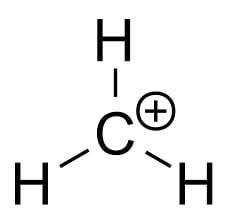
Bond angle- the angle between the lines representing the directions of the bond is called the bond angle. It can be measured by X-ray analysis or by some other spectroscopic methods such as infra-red spectroscopy. The bond angle in the triangular planar is \[{120^0}\].
- The geometry of the molecules is triangular planar have \[s{p^2}\] hybridisation at the central atom \[\left( C \right)\]
Note: Molecular shape determines several properties of a substance including- reactivity, polarity, phase of matter, colour, magnetism, biological activity.
- Number of domains around the central atom determines the geometrical arrangement.
Complete step by step answer:
- Atoms are usually not capable of free existence except noble gases. However, a group of atoms is found to exist together as one species with characteristic properties. Such a group is called a molecule. The attractive force which holds various constituents (atoms, ions) together in a molecule is called a chemical bond.
- The shape of a molecule depends upon the number of valence shell electron pairs (bonded and non-bonding electron pairs) is referred to as a bond pair while the unshared/nonbonding pair of electrons on an atom is referred to as a lone pair.
- Electron pairs around the central atom exert repulsive force on one another as possible so that the forces of repulsion are minimised and the shape of the molecules are different.
- The shape of \[C{H_3}^ + \] is a triangular planar in which \[C\] carry positive charge is called carbocation. In \[C{H_3}^ + \] there are three bond pairs and no lone pair.
Bond angle- the angle between the lines representing the directions of the bond is called the bond angle. It can be measured by X-ray analysis or by some other spectroscopic methods such as infra-red spectroscopy. The bond angle in the triangular planar is \[{120^0}\].
- The geometry of the molecules is triangular planar have \[s{p^2}\] hybridisation at the central atom \[\left( C \right)\]
Note: Molecular shape determines several properties of a substance including- reactivity, polarity, phase of matter, colour, magnetism, biological activity.
- Number of domains around the central atom determines the geometrical arrangement.
Recently Updated Pages
Master Class 12 Economics: Engaging Questions & Answers for Success

Master Class 12 English: Engaging Questions & Answers for Success
Master Class 12 Social Science: Engaging Questions & Answers for Success
Master Class 12 Maths: Engaging Questions & Answers for Success
Master Class 12 Physics: Engaging Questions & Answers for Success
Master Class 9 General Knowledge: Engaging Questions & Answers for Success
Trending doubts
One Metric ton is equal to kg A 10000 B 1000 C 100 class 11 physics CBSE
Difference Between Prokaryotic Cells and Eukaryotic Cells
Two of the body parts which do not appear in MRI are class 11 biology CBSE
1 ton equals to A 100 kg B 1000 kg C 10 kg D 10000 class 11 physics CBSE
Draw a diagram of nephron and explain its structur class 11 biology CBSE
10 examples of friction in our daily life