




The shape of a water molecule which should be tetrahedral has a bent or distorted tetrahedral shape with a bond angle ${104.5^0}$. What could be the reason for this?
A. \[{\ell _p} - {\ell _p}\] repulsion is more than \[{\ell _p} - {b_p}\] repulsion
B. \[{\ell _p} - {b_p}\] repulsion is more than \[{\ell _p} - {\ell _p}\] repulsion
C. \[{\ell _p} - {\ell _p}\] repulsion is equal to \[{\ell _p} - {b_p}\] repulsion
D. Presence of a lone pair does not affect the bond angle.
Answer
 Verified
585.3k+ views
Hint: According to VSEPR theory the shape of a molecule depends upon the number of valence electrons pairs around the central atom. The valence electron pairs that participate in bonding are called Bond pairs (\[{b_p}\]) and that does not participate in bonding are called lone pairs (\[{\ell _p}\]).
Complete answer:
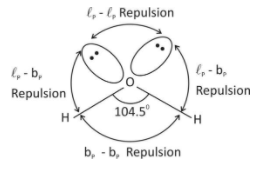
In water the central atom is oxygen with atomic number 8. It has six valence electrons out of these six electrons two are shared with two hydrogen atoms (one with each hydrogen atom) and form two bond pairs. The remaining four electrons remain as two lone pairs (\[{\ell _p}\]).
According the VSEPR theory the repulsive interaction of electron pairs decrease in the given order
Lone pair (\[{\ell _p}\]) – lone pair (\[{\ell _p}\]) $ > $lone pair (\[{\ell _p}\]) – Bond pair (\[{b_p}\]) $ > $Bond Pair (\[{b_p}\]) – Bond Pair (\[{b_p}\]).
The repulsion results in the deviation from idealized shapes and causes alterations in bond angles. The molecule having four bonding electron pairs around the central atom has tetrahedral shape and bond angle is ${109.5^0}.$
But in case of water, due to the presence of lone pairs distortion in geometry take place and bond angle is reduced to ${104.5^0}$ from ${109.5^0}.$
\[{\ell _p} - {\ell _p}\] $ > $\[{\ell _p} - {b_p}\]
Note: Lone pair is localized on the central atom whereas bond pair is shared between two atoms. Hence, lone pair electrons occupy more space and result in greater lone pair-lone pair repulsion.
Complete answer:
In water the central atom is oxygen with atomic number 8. It has six valence electrons out of these six electrons two are shared with two hydrogen atoms (one with each hydrogen atom) and form two bond pairs. The remaining four electrons remain as two lone pairs (\[{\ell _p}\]).
According the VSEPR theory the repulsive interaction of electron pairs decrease in the given order
Lone pair (\[{\ell _p}\]) – lone pair (\[{\ell _p}\]) $ > $lone pair (\[{\ell _p}\]) – Bond pair (\[{b_p}\]) $ > $Bond Pair (\[{b_p}\]) – Bond Pair (\[{b_p}\]).
The repulsion results in the deviation from idealized shapes and causes alterations in bond angles. The molecule having four bonding electron pairs around the central atom has tetrahedral shape and bond angle is ${109.5^0}.$
But in case of water, due to the presence of lone pairs distortion in geometry take place and bond angle is reduced to ${104.5^0}$ from ${109.5^0}.$
\[{\ell _p} - {\ell _p}\] $ > $\[{\ell _p} - {b_p}\]
Note: Lone pair is localized on the central atom whereas bond pair is shared between two atoms. Hence, lone pair electrons occupy more space and result in greater lone pair-lone pair repulsion.
Recently Updated Pages
Master Class 11 Computer Science: Engaging Questions & Answers for Success

Master Class 11 Business Studies: Engaging Questions & Answers for Success
Master Class 11 Economics: Engaging Questions & Answers for Success
Master Class 11 English: Engaging Questions & Answers for Success
Master Class 11 Maths: Engaging Questions & Answers for Success
Master Class 11 Biology: Engaging Questions & Answers for Success
Trending doubts
One Metric ton is equal to kg A 10000 B 1000 C 100 class 11 physics CBSE
There are 720 permutations of the digits 1 2 3 4 5 class 11 maths CBSE
Discuss the various forms of bacteria class 11 biology CBSE
Draw a diagram of a plant cell and label at least eight class 11 biology CBSE
State the laws of reflection of light
Explain zero factorial class 11 maths CBSE