




The shadow of a tree when the angle of elevation of the sun at ${45^ \circ }$ is found to be 20 m longer than when it is ${60^ \circ }$. Find the height of a tree. $\left( {\sqrt 3 = 1.73} \right)$
A) 50 m
B) 27.39 m
C) 47.39 m
D) 40 m
Answer
 Verified
576k+ views
Hint:
Draw a diagram representing the given scenario to understand the problem better. Formulate the equations using properties of the trigonometric identity, such as $\tan \theta = \dfrac{{{\text{Perpendicular}}}}{{{\text{Base}}}}$ for a right angled triangle. Solve the formed equations for two triangles to find the height of the tree.
Complete step by step solution:
It is given in the question that the length of the shadow when the angle of elevation of the sun is ${45^ \circ }$, is 20 m longer than the length of shadow when the angle of elevation of the sun is ${60^ \circ }$.
The above situation can be represented by a diagram as follows.
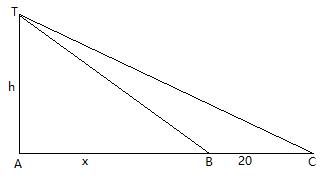
Here $TA$ represents the length of the tree, $AB$ represents the length of the shadow when the angle of elevation of the sun is ${60^ \circ }$, and $AC$ is the length of the shadow when the angle of the elevation of the sun is ${45^ \circ }$.
Let us assume the length $AB$be represented by $x$ and the length $TA$be represented by $h$.
In the triangle $TAB$,
Using the trigonometric ratio $\tan \theta = \dfrac{{{\text{Perpendicular}}}}{{{\text{Base}}}}$,
We can say that $\tan {60^ \circ } = \dfrac{{TA}}{{AB}}$
Upon simplification, we get
$
\sqrt 3 = \dfrac{h}{x} \\
x = \dfrac{h}{{\sqrt 3 }} \\
$
Similarly for the triangle $TAC$, we can say
$\tan {45^ \circ } = \dfrac{{TA}}{{AC}}$
Upon simplification,
$
1 = \dfrac{h}{{x + 20}} \\
h = x + 20 \\
$
Substituting the value $x = \dfrac{h}{{\sqrt 3 }}$in the equation $h = x + 20$, we get
$h = \dfrac{h}{{\sqrt 3 }} + 20$
We can solve the equation $h = \dfrac{h}{{\sqrt 3 }} + 20$ to find the value of $h$
$
h\sqrt 3 = h + 20\sqrt 3 \\
h\left( {\sqrt 3 - 1} \right) = 20\sqrt 3 \\
h = \dfrac{{20\sqrt 3 }}{{\sqrt 3 - 1}} \\
h = \dfrac{{20\left( {1.73} \right)}}{{1.73 - 1}} \\
h \approx 47.397 \\
$
Thus the height of the tree is $47.39$cm.
Thus the option C is the correct answer.
Note:
In a right angled triangle, we can say $\tan \theta = \dfrac{{{\text{Perpendicular}}}}{{{\text{Base}}}}$, where $\theta $ is the angle between the base and the hypotenuse. The question can be better understood with the help of a diagram representing the scenario.
Draw a diagram representing the given scenario to understand the problem better. Formulate the equations using properties of the trigonometric identity, such as $\tan \theta = \dfrac{{{\text{Perpendicular}}}}{{{\text{Base}}}}$ for a right angled triangle. Solve the formed equations for two triangles to find the height of the tree.
Complete step by step solution:
It is given in the question that the length of the shadow when the angle of elevation of the sun is ${45^ \circ }$, is 20 m longer than the length of shadow when the angle of elevation of the sun is ${60^ \circ }$.
The above situation can be represented by a diagram as follows.
Here $TA$ represents the length of the tree, $AB$ represents the length of the shadow when the angle of elevation of the sun is ${60^ \circ }$, and $AC$ is the length of the shadow when the angle of the elevation of the sun is ${45^ \circ }$.
Let us assume the length $AB$be represented by $x$ and the length $TA$be represented by $h$.
In the triangle $TAB$,
Using the trigonometric ratio $\tan \theta = \dfrac{{{\text{Perpendicular}}}}{{{\text{Base}}}}$,
We can say that $\tan {60^ \circ } = \dfrac{{TA}}{{AB}}$
Upon simplification, we get
$
\sqrt 3 = \dfrac{h}{x} \\
x = \dfrac{h}{{\sqrt 3 }} \\
$
Similarly for the triangle $TAC$, we can say
$\tan {45^ \circ } = \dfrac{{TA}}{{AC}}$
Upon simplification,
$
1 = \dfrac{h}{{x + 20}} \\
h = x + 20 \\
$
Substituting the value $x = \dfrac{h}{{\sqrt 3 }}$in the equation $h = x + 20$, we get
$h = \dfrac{h}{{\sqrt 3 }} + 20$
We can solve the equation $h = \dfrac{h}{{\sqrt 3 }} + 20$ to find the value of $h$
$
h\sqrt 3 = h + 20\sqrt 3 \\
h\left( {\sqrt 3 - 1} \right) = 20\sqrt 3 \\
h = \dfrac{{20\sqrt 3 }}{{\sqrt 3 - 1}} \\
h = \dfrac{{20\left( {1.73} \right)}}{{1.73 - 1}} \\
h \approx 47.397 \\
$
Thus the height of the tree is $47.39$cm.
Thus the option C is the correct answer.
Note:
In a right angled triangle, we can say $\tan \theta = \dfrac{{{\text{Perpendicular}}}}{{{\text{Base}}}}$, where $\theta $ is the angle between the base and the hypotenuse. The question can be better understood with the help of a diagram representing the scenario.
Recently Updated Pages
Master Class 10 Computer Science: Engaging Questions & Answers for Success

Master Class 10 General Knowledge: Engaging Questions & Answers for Success
Master Class 10 English: Engaging Questions & Answers for Success
Master Class 10 Social Science: Engaging Questions & Answers for Success
Master Class 10 Maths: Engaging Questions & Answers for Success
Master Class 10 Science: Engaging Questions & Answers for Success
Trending doubts
What is the median of the first 10 natural numbers class 10 maths CBSE
Which women's tennis player has 24 Grand Slam singles titles?
Who is the Brand Ambassador of Incredible India?
Why is there a time difference of about 5 hours between class 10 social science CBSE
Write a letter to the principal requesting him to grant class 10 english CBSE
A moving boat is observed from the top of a 150 m high class 10 maths CBSE