



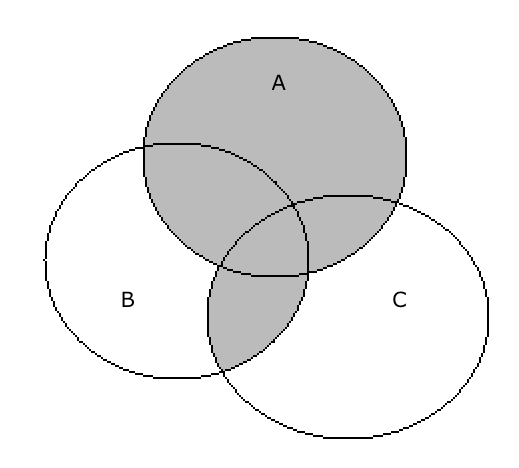
The shaded region in the given Venn diagram represents.
A. \[A \cap \left( {B \cap C} \right)\]
B. \[A \cup \left( {B \cup C} \right)\]
C. \[A \cap \left( {B \cup C} \right)\]
D. \[A \cup \left( {B \cap C} \right)\]
Answer
 Verified
618.3k+ views
Hint: First we will first draw the Venn diagrams of the of the given expressions \[A \cap \left( {B \cap C} \right)\], \[A \cup \left( {B \cup C} \right)\], \[A \cap \left( {B \cup C} \right)\] and \[A \cup \left( {B \cap C} \right)\] and then check with the given diagram to find the required solution.
Complete step by step answer:
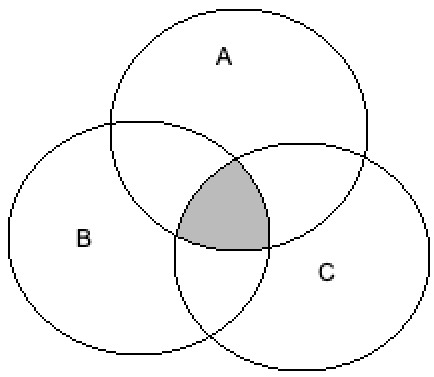
First, we will consider the option \[A \cap \left( {B \cap C} \right)\].
Rewriting the above equation using the distributive law, we get
\[ \Rightarrow A \cap \left( {B \cap C} \right) = \left( {A \cap B} \right) \cap \left( {A \cap C} \right)\]
We will draw the Venn diagram of the above equation by shading the intersection of A, B, and C, we get
Now, we will consider the option \[A \cup \left( {B \cup C} \right)\].
Rewriting the above equation using the distributive law, we get
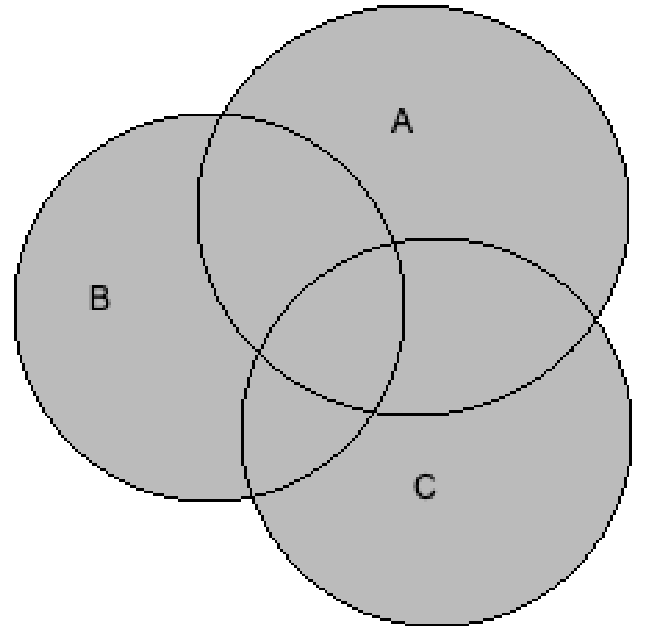
\[ \Rightarrow A \cup \left( {B \cup C} \right) = \left( {A \cup B} \right) \cup \left( {A \cup C} \right)\]
We will draw the Venn diagram of the above equation by shading the union of A, B, and C, we get
Now, we will consider the option \[A \cap \left( {B \cup C} \right)\].
Rewriting the above equation using the distributive law, we get
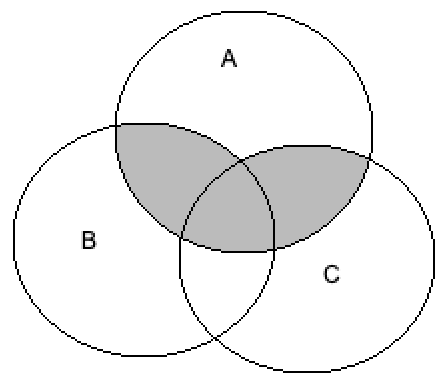
\[ \Rightarrow A \cap \left( {B \cup C} \right) = \left( {A \cap B} \right) \cup \left( {A \cap C} \right)\]
We will draw the Venn diagram of the above equation by shading the union of the intersection of A and B and the intersection of A and C, we get
Now, we will consider the option \[A \cup \left( {B \cap C} \right)\].
Rewriting the above equation using the distributive law, we get
\[ \Rightarrow A \cup \left( {B \cap C} \right) = \left( {A \cup B} \right) \cap \left( {A \cup C} \right)\]
We will draw the Venn diagram of the above equation by shading the intersection of the union of A and B and union of A and C, we get
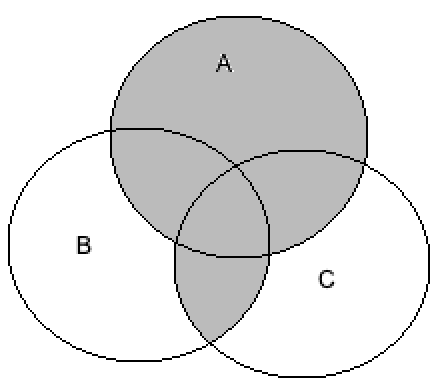
Hence, option D is correct.
Note: In solving these types of questions, students should be familiar with the making of Venn diagrams, complements, union, and intersections. One should shade the region to be selected with some different colors for a better understanding. We should be careful whiles shading the region as one may shade a different part of the diagrams, which is wrong.
Complete step by step answer:
First, we will consider the option \[A \cap \left( {B \cap C} \right)\].
Rewriting the above equation using the distributive law, we get
\[ \Rightarrow A \cap \left( {B \cap C} \right) = \left( {A \cap B} \right) \cap \left( {A \cap C} \right)\]
We will draw the Venn diagram of the above equation by shading the intersection of A, B, and C, we get
Now, we will consider the option \[A \cup \left( {B \cup C} \right)\].
Rewriting the above equation using the distributive law, we get
\[ \Rightarrow A \cup \left( {B \cup C} \right) = \left( {A \cup B} \right) \cup \left( {A \cup C} \right)\]
We will draw the Venn diagram of the above equation by shading the union of A, B, and C, we get
Now, we will consider the option \[A \cap \left( {B \cup C} \right)\].
Rewriting the above equation using the distributive law, we get
\[ \Rightarrow A \cap \left( {B \cup C} \right) = \left( {A \cap B} \right) \cup \left( {A \cap C} \right)\]
We will draw the Venn diagram of the above equation by shading the union of the intersection of A and B and the intersection of A and C, we get
Now, we will consider the option \[A \cup \left( {B \cap C} \right)\].
Rewriting the above equation using the distributive law, we get
\[ \Rightarrow A \cup \left( {B \cap C} \right) = \left( {A \cup B} \right) \cap \left( {A \cup C} \right)\]
We will draw the Venn diagram of the above equation by shading the intersection of the union of A and B and union of A and C, we get
Hence, option D is correct.
Note: In solving these types of questions, students should be familiar with the making of Venn diagrams, complements, union, and intersections. One should shade the region to be selected with some different colors for a better understanding. We should be careful whiles shading the region as one may shade a different part of the diagrams, which is wrong.
Recently Updated Pages
Master Class 8 English: Engaging Questions & Answers for Success

Master Class 8 Science: Engaging Questions & Answers for Success
Master Class 8 Maths: Engaging Questions & Answers for Success
Class 8 Question and Answer - Your Ultimate Solutions Guide
Master Class 8 Social Science: Engaging Questions & Answers for Success
Master Class 12 Economics: Engaging Questions & Answers for Success
Trending doubts
What is BLO What is the full form of BLO class 8 social science CBSE
Citizens of India can vote at the age of A 18 years class 8 social science CBSE
Right to vote is a AFundamental Right BFundamental class 8 social science CBSE
Give me the opposite gender of Duck class 8 english CBSE
Full form of STD, ISD and PCO
Explain land use pattern in India and why has the land class 8 social science CBSE