




The sets E = {All even numbers} and O = {All odd numbers} are
A.Null Sets
B.Singleton Sets
C.Disjoint Sets
D.Overlapping Sets
Answer
 Verified
585.3k+ views
Hint: This question is related with the basics of ‘Set theory’. By understanding the following definitions, we can easily give the answer to it.
Null set: The set which has no element in it is called a null set. Null set is also known as an empty set. It is denoted by $\phi $ .
Singleton set: The set which has one and only one element in it is called a singleton set.
Disjoint sets: Suppose there are two sets A and B. If no element in both sets A and B is common, then the sets A and B are called disjoint sets.
Overlapping sets: Suppose there are two sets A and B. If at least one element in both sets A and B is common, then the sets are called overlapping sets.
Complete step-by-step answer:
It is given that; the set E contains all even numbers in it.
So, \[E = \left\{ {2,4,6,8,10, \ldots } \right\} \ldots \left( i \right)\]
It is also given that; the set O contains all odd numbers in it.
So, \[O = \left\{ {1,3,5,7,9, \ldots } \right\} \ldots \left( {ii} \right)\]
Hence, from equations (i) and (ii), It is clear that no element of the sets E and O are similar.
Thus, the sets E and O are disjoint sets.
Note: The sets can also be represented by venn – diagram method. Venn – diagram method is a pictorial representation of the sets in different conditions.
Hence, the given condition using the venn – diagram can be represented as below.
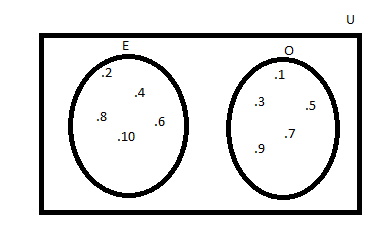
Here, we can see that none of the elements of set E and set O are the same. Hence, both sets will not touch each other and hence they are disjoint sets.
Null set: The set which has no element in it is called a null set. Null set is also known as an empty set. It is denoted by $\phi $ .
Singleton set: The set which has one and only one element in it is called a singleton set.
Disjoint sets: Suppose there are two sets A and B. If no element in both sets A and B is common, then the sets A and B are called disjoint sets.
Overlapping sets: Suppose there are two sets A and B. If at least one element in both sets A and B is common, then the sets are called overlapping sets.
Complete step-by-step answer:
It is given that; the set E contains all even numbers in it.
So, \[E = \left\{ {2,4,6,8,10, \ldots } \right\} \ldots \left( i \right)\]
It is also given that; the set O contains all odd numbers in it.
So, \[O = \left\{ {1,3,5,7,9, \ldots } \right\} \ldots \left( {ii} \right)\]
Hence, from equations (i) and (ii), It is clear that no element of the sets E and O are similar.
Thus, the sets E and O are disjoint sets.
Note: The sets can also be represented by venn – diagram method. Venn – diagram method is a pictorial representation of the sets in different conditions.
Hence, the given condition using the venn – diagram can be represented as below.
Here, we can see that none of the elements of set E and set O are the same. Hence, both sets will not touch each other and hence they are disjoint sets.
Recently Updated Pages
Master Class 11 Computer Science: Engaging Questions & Answers for Success

Master Class 11 Business Studies: Engaging Questions & Answers for Success
Master Class 11 Economics: Engaging Questions & Answers for Success
Master Class 11 English: Engaging Questions & Answers for Success
Master Class 11 Maths: Engaging Questions & Answers for Success
Master Class 11 Biology: Engaging Questions & Answers for Success
Trending doubts
One Metric ton is equal to kg A 10000 B 1000 C 100 class 11 physics CBSE
There are 720 permutations of the digits 1 2 3 4 5 class 11 maths CBSE
Discuss the various forms of bacteria class 11 biology CBSE
Draw a diagram of a plant cell and label at least eight class 11 biology CBSE
State the laws of reflection of light
Explain zero factorial class 11 maths CBSE