




The set of quantum numbers \[n\text{ }=\text{ }4,\text{ }l\text{ }=\text{ }0,\text{ }m\text{ }=\text{ }0,\text{ }s\text{ }=\text{ }+\dfrac{1}{2}\text{ }\]corresponds to the most loosely bound ground state electron of which one of the following atoms?
A. \[Na\]
B. \[Cl\]
C. \[Cr\]
D. \[Rb\]
Answer
 Verified
637.5k+ views
Hint: \[n\](principal quantum number)
\[l\](azimuthal quantum number) [\[l\]= (\[n-1\])]
\[m\](magnetic quantum number) (-\[l\],.., 0,..,+\[l\])
\[s\](spin quantum number)
By taking the given values and using these formulas, derive the electronic configuration and find out the atom.
The element is a transition metal.
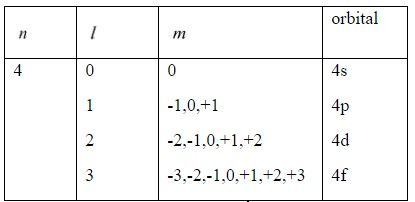
Complete step by step answer:
As per given information, the atom has 4s orbital as the outer shell, so there are two electrons in the valence shell.
= 4, so the atom belongs to any element of the fourth period of the periodic table.
The element may be anyone from potassium to zinc. In short, any element from atomic number 19 to 30 will be the correct answer.
Chromium (\[Cr\]) is the element with the given set of quantum numbers in the question.
Electronic configuration is \[[Ar]3{{d}^{5}}4{{s}^{1}}\]. The valence shell has one electron, the element belongs to the fourth period with\[\text{ }l\text{ }=\text{ }0,\text{ }m\text{ }=\text{ }0\].
So, the correct option is C.
Note: \[n\](principal quantum number) determines the energy and size of an atom. The number indicates the period in which the element belongs to in the periodic table.
\[l\](azimuthal quantum number) determines the shape and angular dependence of an atom.
\[m\](magnetic quantum number) determines the orientation of the atom in space. It also determines the number of electrons possible to be present in the valence shell.
\[s\](spin quantum number) determines the electron spin (magnetic moment) of the atom.
\[l\](azimuthal quantum number) [\[l\]= (\[n-1\])]
\[m\](magnetic quantum number) (-\[l\],.., 0,..,+\[l\])
\[s\](spin quantum number)
By taking the given values and using these formulas, derive the electronic configuration and find out the atom.
The element is a transition metal.
Complete step by step answer:
As per given information, the atom has 4s orbital as the outer shell, so there are two electrons in the valence shell.
= 4, so the atom belongs to any element of the fourth period of the periodic table.
The element may be anyone from potassium to zinc. In short, any element from atomic number 19 to 30 will be the correct answer.
Chromium (\[Cr\]) is the element with the given set of quantum numbers in the question.
Electronic configuration is \[[Ar]3{{d}^{5}}4{{s}^{1}}\]. The valence shell has one electron, the element belongs to the fourth period with\[\text{ }l\text{ }=\text{ }0,\text{ }m\text{ }=\text{ }0\].
So, the correct option is C.
Note: \[n\](principal quantum number) determines the energy and size of an atom. The number indicates the period in which the element belongs to in the periodic table.
\[l\](azimuthal quantum number) determines the shape and angular dependence of an atom.
\[m\](magnetic quantum number) determines the orientation of the atom in space. It also determines the number of electrons possible to be present in the valence shell.
\[s\](spin quantum number) determines the electron spin (magnetic moment) of the atom.
Recently Updated Pages
Master Class 12 Economics: Engaging Questions & Answers for Success

Master Class 12 English: Engaging Questions & Answers for Success
Master Class 12 Social Science: Engaging Questions & Answers for Success
Master Class 12 Maths: Engaging Questions & Answers for Success
Master Class 12 Physics: Engaging Questions & Answers for Success
Master Class 11 Social Science: Engaging Questions & Answers for Success
Trending doubts
One Metric ton is equal to kg A 10000 B 1000 C 100 class 11 physics CBSE
Difference Between Prokaryotic Cells and Eukaryotic Cells
Find the value of the expression given below sin 30circ class 11 maths CBSE
Two of the body parts which do not appear in MRI are class 11 biology CBSE
1 ton equals to A 100 kg B 1000 kg C 10 kg D 10000 class 11 physics CBSE
Draw a diagram of nephron and explain its structur class 11 biology CBSE