




The separation of sister chromatids takes place during
A. Anaphase I
B. Prophase I
C. Anaphase II
D. Prophases II
E. Metaphase I
Answer
 Verified
630.6k+ views
Hint: The reduction in the number of chromosomes essentially occurs in the first half of the meiosis process i.e. during meiosis I.
Complete answer:
It is divided into meiosis I and meiosis II.
During the first phase of meiosis I namely, prophase I, the chromosomes start condensing and pairing up.
This process ultimately leads to crossing over, where the homologous chromosomes exchange parts to form recombinants. The chiasmata prove that crossing over has taken place.
In the next step i.e. during metaphase I, the homologous pairs of chromosomes align themselves at the metaphase plate.
In anaphase I, the homologous pairs are pulled away from each other.
The sister chromatids of each chromosome, however, remain attached to one another and don't come apart.
In the last step of meiosis, I which is telophase I, the chromosomes arrive at opposite poles of the cell.
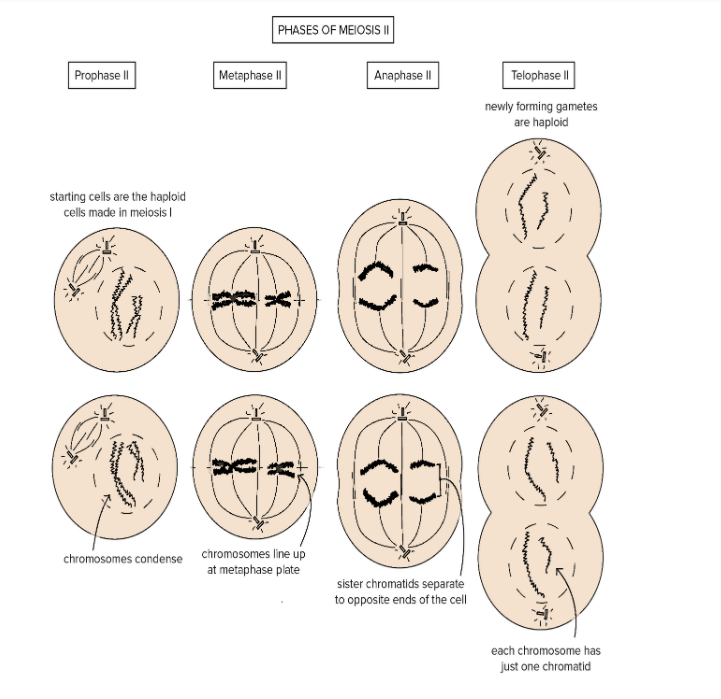
During prophase II, chromosomes again condense, and the nuclear envelope breaks down.
In metaphase II, the chromosomes readily line up individually along with the equatorial plate.
It is in anaphase II, that the sister chromatids of the homologous pair finally separate and are pulled away from each other towards the opposite poles of the cell.
Ultimately, in telophase II, the nuclear membranes reappear around each set of chromosomes, and these chromosomes undergo decondensation.
After cytokinesis, new cells arise and meiosis comes to an end resulting in 4 haploid daughter cells.
Therefore, the correct answer is option C. Anaphase II.
Note: Meiosis is called the reductional division as it halves the number of chromosomes present in an organism (to produce gametes).
It is responsible for bringing variations in a gene pool due to crossing over.
The diagram depicts the events taking place during meiosis:
Complete answer:
It is divided into meiosis I and meiosis II.
During the first phase of meiosis I namely, prophase I, the chromosomes start condensing and pairing up.
This process ultimately leads to crossing over, where the homologous chromosomes exchange parts to form recombinants. The chiasmata prove that crossing over has taken place.
In the next step i.e. during metaphase I, the homologous pairs of chromosomes align themselves at the metaphase plate.
In anaphase I, the homologous pairs are pulled away from each other.
The sister chromatids of each chromosome, however, remain attached to one another and don't come apart.
In the last step of meiosis, I which is telophase I, the chromosomes arrive at opposite poles of the cell.
During prophase II, chromosomes again condense, and the nuclear envelope breaks down.
In metaphase II, the chromosomes readily line up individually along with the equatorial plate.
It is in anaphase II, that the sister chromatids of the homologous pair finally separate and are pulled away from each other towards the opposite poles of the cell.
Ultimately, in telophase II, the nuclear membranes reappear around each set of chromosomes, and these chromosomes undergo decondensation.
After cytokinesis, new cells arise and meiosis comes to an end resulting in 4 haploid daughter cells.
Therefore, the correct answer is option C. Anaphase II.
Note: Meiosis is called the reductional division as it halves the number of chromosomes present in an organism (to produce gametes).
It is responsible for bringing variations in a gene pool due to crossing over.
The diagram depicts the events taking place during meiosis:
Recently Updated Pages
Master Class 11 English: Engaging Questions & Answers for Success

Master Class 11 Social Science: Engaging Questions & Answers for Success
Master Class 11 Maths: Engaging Questions & Answers for Success
Master Class 11 Biology: Engaging Questions & Answers for Success
Master Class 11 Physics: Engaging Questions & Answers for Success
Master Class 11 Chemistry: Engaging Questions & Answers for Success
Trending doubts
Explain the Treaty of Vienna of 1815 class 10 social science CBSE
What is the Total Duration of Football Match?
First Cotton Mill of India
In which year voting age was reduced from 21 to 18?
10 examples of evaporation in daily life with explanations
What planets have no moons Which one has only one moon class 10 physics CBSE