




The semi-vertical angle of a cone is \[{45^\circ}\]. If the height of the cone is 20.025, then its approximate lateral surface area is
A. \[401\sqrt 2 \pi \]
B. \[400\sqrt 2 \pi \]
C. \[399\sqrt 2 \pi \]
D. None of these
Answer
 Verified
643.8k+ views
Hint: First of all, find the slant height of the cone and relation between radius and height of the cone by the given semi-vertical angle. Now, the approximate lateral surface area of the cone is given by \[S + \Delta S\] where \[S\] is the LSA of the cone. So, use this concept to reach the solution of the given problem.
Complete step-by-step answer:
Let \[r\] be the radius, \[h\] be the height and \[l\] be the slant height of a cone of semi-vertical angle \[{45^\circ}\].
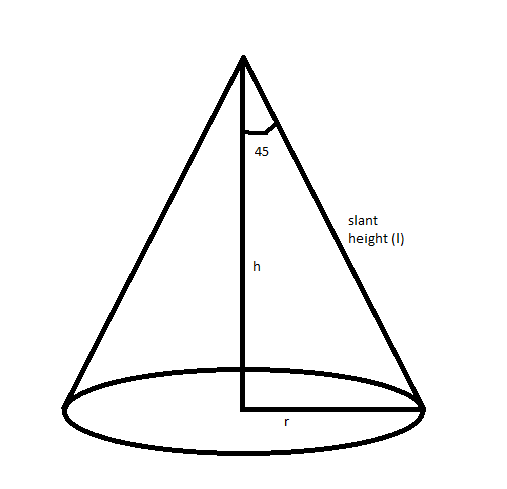
From the figure,
\[
\Rightarrow \tan {45^\circ} = \dfrac{r}{h} \\
\Rightarrow 1 = \dfrac{r}{h} \\
\therefore r = h \\
\]
We know that \[l = \sqrt {{r^2} + {h^2}} \].
So, slant height of the given cone is
\[
\Rightarrow l = \sqrt {{r^2} + {h^2}} \\
\Rightarrow l = \sqrt {{h^2} + {h^2}} = \sqrt {2{h^2}} {\text{ }}\left[ {\because r = h} \right] \\
\therefore l = \sqrt 2 h \\
\]
Let \[h = 20\] and \[h + \Delta h = 20.0025\]
So, \[\Delta h = 20.025 - 20 = 0.025\]
We know that the lateral surface area of the cone with radius \[r\] and slant height \[l\] is given by \[S = \pi rl\].
So, the lateral surface area of the given cone is
$\Rightarrow$ \[S = \pi h\sqrt 2 h = \sqrt 2 \pi {h^2}{\text{ }}\left[ {\because r = h{\text{ and }}l = \sqrt 2 h} \right]\]
The approximate lateral surface area of the cone is given by \[S + \Delta S\].
Now, consider \[\Delta S\]
\[
\Rightarrow \Delta S = {\left( {\dfrac{{ds}}{{dh}}} \right)_{h = 20}}\Delta h \\
\Rightarrow \Delta S = {\left[ {\dfrac{d}{{dh}}\left( {\sqrt 2 \pi {h^2}} \right)} \right]_{h = 20}}\Delta h \\
\Rightarrow \Delta S = {\left[ {2\sqrt 2 \pi h} \right]_{h = 20}}\Delta h \\
\Rightarrow \Delta S = \left[ {40\sqrt 2 \pi } \right] \times 0.025{\text{ }}\left[ {\because \Delta h = 0.025} \right] \\
\therefore \Delta S = \sqrt 2 \pi \\
\]
And
\[
\Rightarrow S = \sqrt 2 \pi {h^2} \\
\Rightarrow S = \sqrt 2 \pi {\left( {20} \right)^2}{\text{ }}\left[ {\because h = 20} \right] \\
\therefore S = 400\sqrt 2 \pi \\
\]
Hence the approximate value of lateral surface area of the cone is
\[S + \Delta S = 400\sqrt 2 \pi + \sqrt 2 \pi = 401\sqrt 2 \pi \]
Thus, the correct option is A. \[401\sqrt 2 \pi \]
Note: The semi-vertical angle of the cone is the angle between the height and slant height of the cone. The slant height of the cone of radius \[r\] and height \[h\] is given by \[l = \sqrt {{r^2} + {h^2}} \]. The lateral surface area of the cone with radius \[r\] and slant height \[l\] is given by \[S = \pi rl\].
Complete step-by-step answer:
Let \[r\] be the radius, \[h\] be the height and \[l\] be the slant height of a cone of semi-vertical angle \[{45^\circ}\].
From the figure,
\[
\Rightarrow \tan {45^\circ} = \dfrac{r}{h} \\
\Rightarrow 1 = \dfrac{r}{h} \\
\therefore r = h \\
\]
We know that \[l = \sqrt {{r^2} + {h^2}} \].
So, slant height of the given cone is
\[
\Rightarrow l = \sqrt {{r^2} + {h^2}} \\
\Rightarrow l = \sqrt {{h^2} + {h^2}} = \sqrt {2{h^2}} {\text{ }}\left[ {\because r = h} \right] \\
\therefore l = \sqrt 2 h \\
\]
Let \[h = 20\] and \[h + \Delta h = 20.0025\]
So, \[\Delta h = 20.025 - 20 = 0.025\]
We know that the lateral surface area of the cone with radius \[r\] and slant height \[l\] is given by \[S = \pi rl\].
So, the lateral surface area of the given cone is
$\Rightarrow$ \[S = \pi h\sqrt 2 h = \sqrt 2 \pi {h^2}{\text{ }}\left[ {\because r = h{\text{ and }}l = \sqrt 2 h} \right]\]
The approximate lateral surface area of the cone is given by \[S + \Delta S\].
Now, consider \[\Delta S\]
\[
\Rightarrow \Delta S = {\left( {\dfrac{{ds}}{{dh}}} \right)_{h = 20}}\Delta h \\
\Rightarrow \Delta S = {\left[ {\dfrac{d}{{dh}}\left( {\sqrt 2 \pi {h^2}} \right)} \right]_{h = 20}}\Delta h \\
\Rightarrow \Delta S = {\left[ {2\sqrt 2 \pi h} \right]_{h = 20}}\Delta h \\
\Rightarrow \Delta S = \left[ {40\sqrt 2 \pi } \right] \times 0.025{\text{ }}\left[ {\because \Delta h = 0.025} \right] \\
\therefore \Delta S = \sqrt 2 \pi \\
\]
And
\[
\Rightarrow S = \sqrt 2 \pi {h^2} \\
\Rightarrow S = \sqrt 2 \pi {\left( {20} \right)^2}{\text{ }}\left[ {\because h = 20} \right] \\
\therefore S = 400\sqrt 2 \pi \\
\]
Hence the approximate value of lateral surface area of the cone is
\[S + \Delta S = 400\sqrt 2 \pi + \sqrt 2 \pi = 401\sqrt 2 \pi \]
Thus, the correct option is A. \[401\sqrt 2 \pi \]
Note: The semi-vertical angle of the cone is the angle between the height and slant height of the cone. The slant height of the cone of radius \[r\] and height \[h\] is given by \[l = \sqrt {{r^2} + {h^2}} \]. The lateral surface area of the cone with radius \[r\] and slant height \[l\] is given by \[S = \pi rl\].
Recently Updated Pages
Master Class 10 English: Engaging Questions & Answers for Success

Master Class 10 Social Science: Engaging Questions & Answers for Success
Master Class 10 Computer Science: Engaging Questions & Answers for Success
Class 10 Question and Answer - Your Ultimate Solutions Guide
Master Class 10 General Knowledge: Engaging Questions & Answers for Success
Master Class 10 Maths: Engaging Questions & Answers for Success
Trending doubts
Explain the Treaty of Vienna of 1815 class 10 social science CBSE
Who Won 36 Oscar Awards? Record Holder Revealed
What is the median of the first 10 natural numbers class 10 maths CBSE
Why is it 530 pm in india when it is 1200 afternoon class 10 social science CBSE
Make a sketch of the human nerve cell What function class 10 biology CBSE
Define Potential, Developed, Stock and Reserved resources