




The sedimentation coefficient of complete ribosomes in bacterial cells is
(a) 70S
(b) 80S
(c) 78S
(d) 73S
(e) 60S
Answer
 Verified
571.5k+ views
Hint: Bacterial ribosomes consist of two subunits with sedimentation rates of the 50S and 30S. Ribosomes are made up of rRNA also known as ribosomal RNA and proteins.
Complete answer:
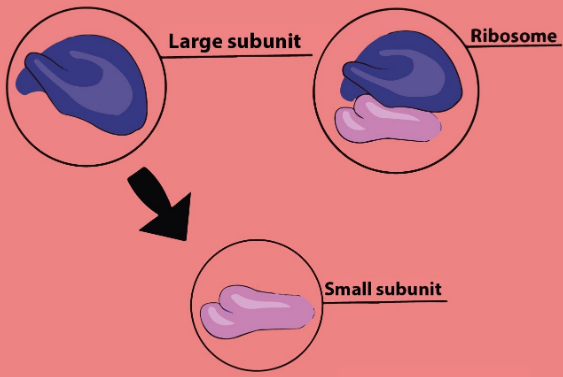
Bacterial cells are also known as prokaryotic cells and consist of cell membranes along with tough cell walls made up of peptidoglycan. Under these membranes lies the cytoplasm along with the nucleus and other organelles. Free ribosomes are in the cytoplasm as well as some are attached to the endoplasmic reticulum. Ribosomes are usually small circular structures that are composed of rRNA and proteins. In prokaryotes, ribosomes consist of two subunits with densities of the 50S and 30S. These two subunits combine in order to form the 70S ribosome which is 25nm in diameter. A bacterial cell may contain up to 15,000 ribosomes.
Ribosomes play a major role in protein synthesis as they receive and then translate the genetic information for the formation of specific proteins.
Additional information:
Ribosomes usually consist of two subunits, a smaller subunit, and a larger subunit. In the prokaryotic cells, the two subunits are the 50S which is the larger subunit, and the 30S which is the smaller subunit. Here ‘S’ stands for the svedberg unit and is a non-metric unit to specify the sedimentation rate. In biology, the sedimentation rate or sedimentation coefficient is the rate at which a molecule or particle moves to the bottom of the test tube under centrifugal force.
The value of S or sedimentation coefficient mainly depends on factors such as the mass, density, and shape of the particular molecule. The 30S ribosomal subunit consists of 16S rRNA with 21 proteins whereas the 50S ribosomal subunit consists of 5S and 23S rRNA along with 31 proteins.
So, the correct answer is ‘70S’.
Notes:
In bacteria specifically, transcription and translation are coupled. This means that the RNA polymerase binds to the 30S ribosomal subunit to form a machine called expressome which can carry out both transcription and translation.
Complete answer:
Bacterial cells are also known as prokaryotic cells and consist of cell membranes along with tough cell walls made up of peptidoglycan. Under these membranes lies the cytoplasm along with the nucleus and other organelles. Free ribosomes are in the cytoplasm as well as some are attached to the endoplasmic reticulum. Ribosomes are usually small circular structures that are composed of rRNA and proteins. In prokaryotes, ribosomes consist of two subunits with densities of the 50S and 30S. These two subunits combine in order to form the 70S ribosome which is 25nm in diameter. A bacterial cell may contain up to 15,000 ribosomes.
Ribosomes play a major role in protein synthesis as they receive and then translate the genetic information for the formation of specific proteins.
Additional information:
Ribosomes usually consist of two subunits, a smaller subunit, and a larger subunit. In the prokaryotic cells, the two subunits are the 50S which is the larger subunit, and the 30S which is the smaller subunit. Here ‘S’ stands for the svedberg unit and is a non-metric unit to specify the sedimentation rate. In biology, the sedimentation rate or sedimentation coefficient is the rate at which a molecule or particle moves to the bottom of the test tube under centrifugal force.
The value of S or sedimentation coefficient mainly depends on factors such as the mass, density, and shape of the particular molecule. The 30S ribosomal subunit consists of 16S rRNA with 21 proteins whereas the 50S ribosomal subunit consists of 5S and 23S rRNA along with 31 proteins.
So, the correct answer is ‘70S’.
Notes:
In bacteria specifically, transcription and translation are coupled. This means that the RNA polymerase binds to the 30S ribosomal subunit to form a machine called expressome which can carry out both transcription and translation.
Recently Updated Pages
Master Class 11 Social Science: Engaging Questions & Answers for Success

Master Class 11 English: Engaging Questions & Answers for Success
Master Class 11 Maths: Engaging Questions & Answers for Success
Master Class 11 Chemistry: Engaging Questions & Answers for Success
Master Class 11 Biology: Engaging Questions & Answers for Success
Master Class 11 Physics: Engaging Questions & Answers for Success
Trending doubts
One Metric ton is equal to kg A 10000 B 1000 C 100 class 11 physics CBSE
Difference Between Prokaryotic Cells and Eukaryotic Cells
There are 720 permutations of the digits 1 2 3 4 5 class 11 maths CBSE
Draw a diagram of a plant cell and label at least eight class 11 biology CBSE
Two of the body parts which do not appear in MRI are class 11 biology CBSE
Which gas is abundant in air class 11 chemistry CBSE