




The second’s hand of a watch has a length 6 cm. Speed of end point and magnitude of difference velocity at two perpendicular positions will be
A. $2\pi \text{ }\&\text{ } 0\text{ }mm/s$
B. $2\sqrt 2 \pi\text{ } \& \text{ }4.44\text{ }mm/s$
C. $2\sqrt 2 \pi \text{ }\&\text{ } 2\pi\text{ } mm/s$
D. $2\pi \text{ }\&\text{ } 2\sqrt 2 \pi\text{ } mm/s$
Answer
 Verified
660.9k+ views
Hint: In this question, we first draw the figure for better understanding then we write the equation$v = r\omega $ . We have $r = l = 6cm$ but to find $\omega $ we use the time taken by the second hand to complete one revolution and get $60\sec = 2\pi rad$ using this we found $\omega = \dfrac{{2\pi }}{{60}}rad/\sec $. After we get $v = 2\pi mm/\sec $. Then to find the magnitude of the difference of velocity at two perpendicular positions we use \[\Delta v = {\vec v_j} + ( - {\vec v_i})\] and \[\left| {\Delta v} \right| = \sqrt {{v^2}_j + {v^2}_i} \]. And finally, we get \[\left| {\Delta v} \right| = 2\sqrt 2 \pi cm/\sec \].
Complete Step-by-Step solution:
First, we need to draw a clock with the second hand at two different positions that are perpendicular to each other and the length $l$ of the second’s hand is given as 6 cm. The required diagram is shown in figure 1.
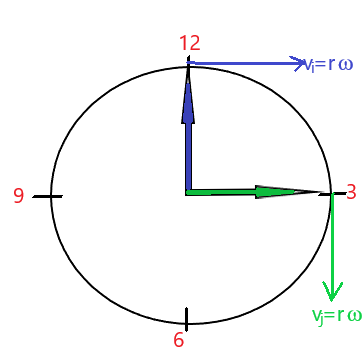
Figure 1
Now here we can see that the expression of velocity $v$ at the end is given by
$v = r\omega $-------------------------------- (1)
Where $r$ is the radius of the clock which is equal to the length of the second hand that is
$r = l = 6cm$----------------------------- (2)
And $\omega $ is the angular velocity.
Here angular velocity is unknown, so now to find the angular velocity we will use the second’s hand because of the reason that the second hand completes one revolution in 60 seconds.
And we know one revolution is taken as $2\pi $radian. So, we get
$60\sec = 2\pi rad$
$ \Rightarrow 1\sec = \dfrac{{2\pi }}{{60}}rad$
$ \Rightarrow \omega = \dfrac{{2\pi }}{{60}}rad/\sec $----------------------- (3)
Now substituting equation (2) and (3) in equation (1), we will get
$v = \left( {6cm} \right) \times (\dfrac{{2\pi }}{{60}}rad/\sec )$
$ \Rightarrow v = \dfrac{{2\pi }}{{10}}cm/\sec $
$ \Rightarrow v = \dfrac{{2\pi }}{{10}} \times 10mm/\sec $
$ \Rightarrow v = 2\pi mm/\sec $
$ \Rightarrow v = {\vec v_j} = {\vec v_i} = 2\pi mm/\sec $
Hence the speed of endpoint is $2\pi mm/\sec $
Now we were asked to find the magnitude of the difference of velocity at two perpendicular positions that is
\[\Delta v = {\vec v_j} - {\vec v_i}\]
As can be seen in figure 2.
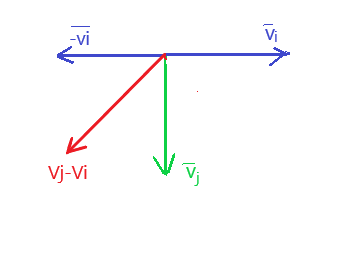
Figure 2
\[ \Rightarrow \Delta v = {\vec v_j} + ( - {\vec v_i})\]
Now magnitude is given as
\[ \Rightarrow \left| {\Delta v} \right| = \sqrt {{v^2}_j + {v^2}_i} \]
Substituting ${\vec v_j} = {\vec v_i} = 2\pi mm/\sec $, we will get
\[ \Rightarrow \left| {\Delta v} \right| = \sqrt {{{\left( {2\pi } \right)}^2} + {{\left( {2\pi } \right)}^2}} \]
\[ \Rightarrow \left| {\Delta v} \right| = \sqrt {2 \times {{\left( {2\pi } \right)}^2}} \]
\[ \Rightarrow \left| {\Delta v} \right| = 2\sqrt 2 \pi mm/\sec \]
Hence, the magnitude of the difference of velocity at two perpendicular positions \[2\sqrt 2 \pi \text{ }mm/\sec \]
Therefore option D is correct.
Note: For solving these types of questions we need to have a clear understanding of angular velocity and how to find it using revolution/sec. We need to know about the second hand, hour hand, and minute’s hand, what is the revolution time of each, and what angle is subtended by these hands of the clock. At last, we need to know how to solve vectors and find their magnitude.
Complete Step-by-Step solution:
First, we need to draw a clock with the second hand at two different positions that are perpendicular to each other and the length $l$ of the second’s hand is given as 6 cm. The required diagram is shown in figure 1.
Figure 1
Now here we can see that the expression of velocity $v$ at the end is given by
$v = r\omega $-------------------------------- (1)
Where $r$ is the radius of the clock which is equal to the length of the second hand that is
$r = l = 6cm$----------------------------- (2)
And $\omega $ is the angular velocity.
Here angular velocity is unknown, so now to find the angular velocity we will use the second’s hand because of the reason that the second hand completes one revolution in 60 seconds.
And we know one revolution is taken as $2\pi $radian. So, we get
$60\sec = 2\pi rad$
$ \Rightarrow 1\sec = \dfrac{{2\pi }}{{60}}rad$
$ \Rightarrow \omega = \dfrac{{2\pi }}{{60}}rad/\sec $----------------------- (3)
Now substituting equation (2) and (3) in equation (1), we will get
$v = \left( {6cm} \right) \times (\dfrac{{2\pi }}{{60}}rad/\sec )$
$ \Rightarrow v = \dfrac{{2\pi }}{{10}}cm/\sec $
$ \Rightarrow v = \dfrac{{2\pi }}{{10}} \times 10mm/\sec $
$ \Rightarrow v = 2\pi mm/\sec $
$ \Rightarrow v = {\vec v_j} = {\vec v_i} = 2\pi mm/\sec $
Hence the speed of endpoint is $2\pi mm/\sec $
Now we were asked to find the magnitude of the difference of velocity at two perpendicular positions that is
\[\Delta v = {\vec v_j} - {\vec v_i}\]
As can be seen in figure 2.
Figure 2
\[ \Rightarrow \Delta v = {\vec v_j} + ( - {\vec v_i})\]
Now magnitude is given as
\[ \Rightarrow \left| {\Delta v} \right| = \sqrt {{v^2}_j + {v^2}_i} \]
Substituting ${\vec v_j} = {\vec v_i} = 2\pi mm/\sec $, we will get
\[ \Rightarrow \left| {\Delta v} \right| = \sqrt {{{\left( {2\pi } \right)}^2} + {{\left( {2\pi } \right)}^2}} \]
\[ \Rightarrow \left| {\Delta v} \right| = \sqrt {2 \times {{\left( {2\pi } \right)}^2}} \]
\[ \Rightarrow \left| {\Delta v} \right| = 2\sqrt 2 \pi mm/\sec \]
Hence, the magnitude of the difference of velocity at two perpendicular positions \[2\sqrt 2 \pi \text{ }mm/\sec \]
Therefore option D is correct.
Note: For solving these types of questions we need to have a clear understanding of angular velocity and how to find it using revolution/sec. We need to know about the second hand, hour hand, and minute’s hand, what is the revolution time of each, and what angle is subtended by these hands of the clock. At last, we need to know how to solve vectors and find their magnitude.
Recently Updated Pages
Class 10 Question and Answer - Your Ultimate Solutions Guide

Master Class 10 Computer Science: Engaging Questions & Answers for Success
Master Class 10 General Knowledge: Engaging Questions & Answers for Success
Master Class 12 Economics: Engaging Questions & Answers for Success
Master Class 12 Social Science: Engaging Questions & Answers for Success
Master Class 12 English: Engaging Questions & Answers for Success
Trending doubts
Explain the Treaty of Vienna of 1815 class 10 social science CBSE
The slogan Jai Hind was given by A Lal Bahadur Shastri class 10 social science CBSE
10 examples of evaporation in daily life with explanations
What is the full form of POSCO class 10 social science CBSE
Five things I will do to build a great India class 10 english CBSE
Identify the feminine form of noun nephew a shenephew class 10 english CBSE