




The roots of the cubic equation $ {{\left( z+ab \right)}^{3}}={{a}^{3}} $ such that $ a\ne 0 $ represent the vertices of a triangle of sides of length
\[\begin{align}
& A.\dfrac{1}{\sqrt{3}}\left| ab \right| \\
& B.\sqrt{3}\left| a \right| \\
& C.\sqrt{3}\left| b \right| \\
& D.\left| a \right| \\
\end{align}\]
Answer
 Verified
598.2k+ views
Hint:
In this question, we are given that, roots of cubic equation $ {{\left( z+ab \right)}^{3}}={{a}^{3}} $ are the vertices of a triangle and we need to find the length of sides of the triangle. For this we will first calculate the roots $ \left( {{z}_{1}},{{z}_{2}},{{z}_{3}} \right) $ of the equation using the cube root of unity $ \left( \omega \right) $ . Then using them we will find the length of the sides of triangle given by $ \left| {{z}_{1}}-{{z}_{2}} \right|,\left| {{z}_{2}}-{{z}_{3}} \right|,\left| {{z}_{3}}-{{z}_{1}} \right| $ .
We will use the following formula:
(I) Cube root of unity are $ 1,\omega ,{{\omega }^{2}} $ where $ \omega =\dfrac{-1}{2}+\dfrac{i\sqrt{3}}{2}\text{ and }{{\omega }^{2}}=\dfrac{-1}{2}-\dfrac{i\sqrt{3}}{2} $ .
(II) $ \left| x+iy \right|=\sqrt{{{x}^{2}}+{{y}^{2}}} $
Complete step by step answer:
Here we are given the equation as, $ {{\left( z+ab \right)}^{3}}={{a}^{3}} $ where z is complex number and $ a\ne 0 $ . To solve this question, let us write the right side of the equation as $ {{\left( z+ab \right)}^{3}}={{a}^{3}}\cdot 1 $ .
Let us take cube root on both sides, we get, $ {{\left( {{\left( z+ab \right)}^{3}} \right)}^{\dfrac{1}{3}}}={{\left( {{a}^{3}}\cdot 1 \right)}^{\dfrac{1}{3}}} $ .
We know, $ {{\left( {{a}^{m}} \right)}^{m}}={{a}^{mn}} $ so we get $ {{\left( z+ab \right)}^{\dfrac{3}{3}}}={{a}^{\dfrac{3}{3}}}{{\left( 1 \right)}^{\dfrac{1}{3}}}\Rightarrow z+ab=a{{\left( 1 \right)}^{\dfrac{1}{3}}} $ .
We know that cube roots of unity $ {{\left( 1 \right)}^{\dfrac{1}{3}}} $ are $ 1,\omega ,{{\omega }^{2}} $ where $ \omega =\dfrac{-1}{2}+\dfrac{i\sqrt{3}}{2}\text{ and }{{\omega }^{2}}=\dfrac{-1}{2}-\dfrac{i\sqrt{3}}{2} $ .
So we get three equation as,
$ z+ab=a,z+ab=a\omega \text{ and }z+ab=a{{\omega }^{2}} $ .
Let us solve for z we get, $ z+ab=a\Rightarrow z=a-ab $ .
Let this root be $ {{z}_{1}} $ so we have $ {{z}_{1}}=a-ab $ .
$ z+ab=a\omega \Rightarrow z=a\omega -ab $ .
Let this root be $ {{z}_{2}} $ so we have $ {{z}_{2}}=a\omega -ab $ .
$ z+ab=a{{\omega }^{2}}\Rightarrow z=a{{\omega }^{2}}-ab $ .
Let this root be $ {{z}_{3}} $ so we have $ {{z}_{3}}=a{{\omega }^{2}}-ab $ .
Therefore, roots of the equation are $ {{z}_{1}}=a-ab,{{z}_{2}}=a\omega -ab\text{ and }{{z}_{3}}=a{{\omega }^{2}}-ab $ .
These represent vertices of a triangle,
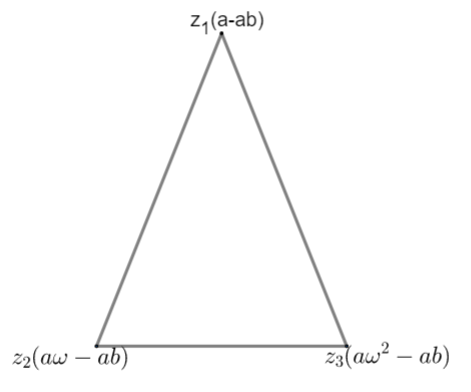
Now let us find the length of the sides of this triangle. We know length of sides of triangle with vertices $ {{z}_{1}},{{z}_{2}},{{z}_{3}} $ are given by $ \left| {{z}_{1}}-{{z}_{2}} \right|,\left| {{z}_{2}}-{{z}_{3}} \right|,\left| {{z}_{3}}-{{z}_{1}} \right| $ .
So let us calculate them, we have length
\[\begin{align}
& \left| {{z}_{1}}-{{z}_{2}} \right|=\left| a-ab-\left( a\omega -ab \right) \right| \\
& \Rightarrow \left| a-ab-a\omega +ab \right| \\
& \Rightarrow \left| a-a\omega \right| \\
& \Rightarrow \left| a\left( 1-\omega \right) \right| \\
\end{align}\]
We know that $ \left| ab \right|=\left| a \right|\left| b \right| $ so we get,
$ \left| {{z}_{1}}-{{z}_{2}} \right|=\left| a \right|\left| 1-\omega \right| $
Putting in the values of $ \omega $ as $ \dfrac{-1}{2}+\dfrac{i\sqrt{3}}{2} $ We get,
\[\begin{align}
& \left| {{z}_{1}}-{{z}_{2}} \right|=\left| a \right|\left| 1-\left( \dfrac{-1}{2}+\dfrac{i\sqrt{3}}{2} \right) \right| \\
& \Rightarrow \left| a \right|\left| 1+\dfrac{1}{2}-\dfrac{i\sqrt{3}}{2} \right| \\
& \Rightarrow \left| a \right|\left| \dfrac{3}{2}-\dfrac{i\sqrt{3}}{2} \right| \\
\end{align}\]
Now we know $ \left| x+iy \right|={{\left( {{x}^{2}}+{{y}^{2}} \right)}^{\dfrac{1}{2}}} $ so we get,
\[\begin{align}
& \left| {{z}_{1}}-{{z}_{2}} \right|=\left| a \right|{{\left( {{\left( \dfrac{3}{2} \right)}^{2}}+{{\left( \dfrac{-\sqrt{3}}{2} \right)}^{2}} \right)}^{\dfrac{1}{2}}} \\
& \Rightarrow \left| a \right|{{\left( \dfrac{9}{4}+\dfrac{3}{4} \right)}^{\dfrac{1}{2}}} \\
& \Rightarrow \left| a \right|{{\left( \dfrac{12}{4} \right)}^{\dfrac{1}{2}}} \\
& \Rightarrow \left| a \right|{{\left( 3 \right)}^{\dfrac{1}{2}}} \\
& \Rightarrow \left| a \right|\sqrt{3} \\
& \Rightarrow \sqrt{3}\left| a \right| \\
\end{align}\]
So length of one of the sides of triangle is \[\sqrt{3}\left| a \right|\].
Since this option already matches and this question has one solution only so we have our answer as \[\sqrt{3}\left| a \right|\].
Hence option B is the correct answer.
Note:
Students should keep in mind all the formulas for solving this sum. They can also find the values of $ \left| {{Z}_{2}}-{{Z}_{3}} \right|\text{ and }\left| {{Z}_{3}}-{{Z}_{1}} \right| $ to check their answer. They will get the same answer i.e. \[\left| {{Z}_{1}}-{{Z}_{2}} \right|=\left| {{Z}_{2}}-{{Z}_{3}} \right|=\left| {{Z}_{3}}-{{Z}_{1}} \right|=\sqrt{3}\left| a \right|\] Take care of signs while solving this sum. Students should keep in mind the values of cube root of unity.
In this question, we are given that, roots of cubic equation $ {{\left( z+ab \right)}^{3}}={{a}^{3}} $ are the vertices of a triangle and we need to find the length of sides of the triangle. For this we will first calculate the roots $ \left( {{z}_{1}},{{z}_{2}},{{z}_{3}} \right) $ of the equation using the cube root of unity $ \left( \omega \right) $ . Then using them we will find the length of the sides of triangle given by $ \left| {{z}_{1}}-{{z}_{2}} \right|,\left| {{z}_{2}}-{{z}_{3}} \right|,\left| {{z}_{3}}-{{z}_{1}} \right| $ .
We will use the following formula:
(I) Cube root of unity are $ 1,\omega ,{{\omega }^{2}} $ where $ \omega =\dfrac{-1}{2}+\dfrac{i\sqrt{3}}{2}\text{ and }{{\omega }^{2}}=\dfrac{-1}{2}-\dfrac{i\sqrt{3}}{2} $ .
(II) $ \left| x+iy \right|=\sqrt{{{x}^{2}}+{{y}^{2}}} $
Complete step by step answer:
Here we are given the equation as, $ {{\left( z+ab \right)}^{3}}={{a}^{3}} $ where z is complex number and $ a\ne 0 $ . To solve this question, let us write the right side of the equation as $ {{\left( z+ab \right)}^{3}}={{a}^{3}}\cdot 1 $ .
Let us take cube root on both sides, we get, $ {{\left( {{\left( z+ab \right)}^{3}} \right)}^{\dfrac{1}{3}}}={{\left( {{a}^{3}}\cdot 1 \right)}^{\dfrac{1}{3}}} $ .
We know, $ {{\left( {{a}^{m}} \right)}^{m}}={{a}^{mn}} $ so we get $ {{\left( z+ab \right)}^{\dfrac{3}{3}}}={{a}^{\dfrac{3}{3}}}{{\left( 1 \right)}^{\dfrac{1}{3}}}\Rightarrow z+ab=a{{\left( 1 \right)}^{\dfrac{1}{3}}} $ .
We know that cube roots of unity $ {{\left( 1 \right)}^{\dfrac{1}{3}}} $ are $ 1,\omega ,{{\omega }^{2}} $ where $ \omega =\dfrac{-1}{2}+\dfrac{i\sqrt{3}}{2}\text{ and }{{\omega }^{2}}=\dfrac{-1}{2}-\dfrac{i\sqrt{3}}{2} $ .
So we get three equation as,
$ z+ab=a,z+ab=a\omega \text{ and }z+ab=a{{\omega }^{2}} $ .
Let us solve for z we get, $ z+ab=a\Rightarrow z=a-ab $ .
Let this root be $ {{z}_{1}} $ so we have $ {{z}_{1}}=a-ab $ .
$ z+ab=a\omega \Rightarrow z=a\omega -ab $ .
Let this root be $ {{z}_{2}} $ so we have $ {{z}_{2}}=a\omega -ab $ .
$ z+ab=a{{\omega }^{2}}\Rightarrow z=a{{\omega }^{2}}-ab $ .
Let this root be $ {{z}_{3}} $ so we have $ {{z}_{3}}=a{{\omega }^{2}}-ab $ .
Therefore, roots of the equation are $ {{z}_{1}}=a-ab,{{z}_{2}}=a\omega -ab\text{ and }{{z}_{3}}=a{{\omega }^{2}}-ab $ .
These represent vertices of a triangle,
Now let us find the length of the sides of this triangle. We know length of sides of triangle with vertices $ {{z}_{1}},{{z}_{2}},{{z}_{3}} $ are given by $ \left| {{z}_{1}}-{{z}_{2}} \right|,\left| {{z}_{2}}-{{z}_{3}} \right|,\left| {{z}_{3}}-{{z}_{1}} \right| $ .
So let us calculate them, we have length
\[\begin{align}
& \left| {{z}_{1}}-{{z}_{2}} \right|=\left| a-ab-\left( a\omega -ab \right) \right| \\
& \Rightarrow \left| a-ab-a\omega +ab \right| \\
& \Rightarrow \left| a-a\omega \right| \\
& \Rightarrow \left| a\left( 1-\omega \right) \right| \\
\end{align}\]
We know that $ \left| ab \right|=\left| a \right|\left| b \right| $ so we get,
$ \left| {{z}_{1}}-{{z}_{2}} \right|=\left| a \right|\left| 1-\omega \right| $
Putting in the values of $ \omega $ as $ \dfrac{-1}{2}+\dfrac{i\sqrt{3}}{2} $ We get,
\[\begin{align}
& \left| {{z}_{1}}-{{z}_{2}} \right|=\left| a \right|\left| 1-\left( \dfrac{-1}{2}+\dfrac{i\sqrt{3}}{2} \right) \right| \\
& \Rightarrow \left| a \right|\left| 1+\dfrac{1}{2}-\dfrac{i\sqrt{3}}{2} \right| \\
& \Rightarrow \left| a \right|\left| \dfrac{3}{2}-\dfrac{i\sqrt{3}}{2} \right| \\
\end{align}\]
Now we know $ \left| x+iy \right|={{\left( {{x}^{2}}+{{y}^{2}} \right)}^{\dfrac{1}{2}}} $ so we get,
\[\begin{align}
& \left| {{z}_{1}}-{{z}_{2}} \right|=\left| a \right|{{\left( {{\left( \dfrac{3}{2} \right)}^{2}}+{{\left( \dfrac{-\sqrt{3}}{2} \right)}^{2}} \right)}^{\dfrac{1}{2}}} \\
& \Rightarrow \left| a \right|{{\left( \dfrac{9}{4}+\dfrac{3}{4} \right)}^{\dfrac{1}{2}}} \\
& \Rightarrow \left| a \right|{{\left( \dfrac{12}{4} \right)}^{\dfrac{1}{2}}} \\
& \Rightarrow \left| a \right|{{\left( 3 \right)}^{\dfrac{1}{2}}} \\
& \Rightarrow \left| a \right|\sqrt{3} \\
& \Rightarrow \sqrt{3}\left| a \right| \\
\end{align}\]
So length of one of the sides of triangle is \[\sqrt{3}\left| a \right|\].
Since this option already matches and this question has one solution only so we have our answer as \[\sqrt{3}\left| a \right|\].
Hence option B is the correct answer.
Note:
Students should keep in mind all the formulas for solving this sum. They can also find the values of $ \left| {{Z}_{2}}-{{Z}_{3}} \right|\text{ and }\left| {{Z}_{3}}-{{Z}_{1}} \right| $ to check their answer. They will get the same answer i.e. \[\left| {{Z}_{1}}-{{Z}_{2}} \right|=\left| {{Z}_{2}}-{{Z}_{3}} \right|=\left| {{Z}_{3}}-{{Z}_{1}} \right|=\sqrt{3}\left| a \right|\] Take care of signs while solving this sum. Students should keep in mind the values of cube root of unity.
Recently Updated Pages
Master Class 12 Economics: Engaging Questions & Answers for Success

Master Class 12 English: Engaging Questions & Answers for Success
Master Class 12 Social Science: Engaging Questions & Answers for Success
Master Class 12 Maths: Engaging Questions & Answers for Success
Master Class 12 Physics: Engaging Questions & Answers for Success
Master Class 10 English: Engaging Questions & Answers for Success
Trending doubts
Explain the Treaty of Vienna of 1815 class 10 social science CBSE
Why is it 530 pm in india when it is 1200 afternoon class 10 social science CBSE
What is the full form of POSCO class 10 social science CBSE
Define Potential, Developed, Stock and Reserved resources
Which Country Has the Largest Border with India?
Complete the sentence with the most appropriate word class 10 english CBSE