




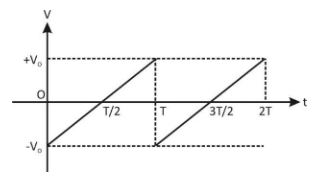
The rms value for the saw-tooth voltage of peak value ${V_0}$ from $t = 0$ to $t = 2T$ as shown in the figure is \[\dfrac{{{v_0}}}{{\sqrt x }}\]. Find the value of x.
Answer
 Verified
614.7k+ views
Hint: In this question, we need to determine the value of ‘x’ such that \[\dfrac{{{v_0}}}{{\sqrt x }}\] is the rms value of the saw-tooth voltage of peak value ${V_0}$ from $t = 0$ to $t = 2T$. For this, we will use the definition of the rms value of the wave and compare the rms value given in the question with the calculated value.
Complete step by step answer:
The rms value is defined as the square root of the mean value of the squared function. If ${T_P}$ is the time period of the wavefront then, the rms value is given as
\[{V_{RMS}} = \dfrac{1}{{{T_P}}}\int_0^{{T_P}} {{v^2}dt} {\text{ - - - - }}(i)\]
On working the equation (i) for calculating the rms value, we will get the equation of ‘v’ in the function of time ‘t’.
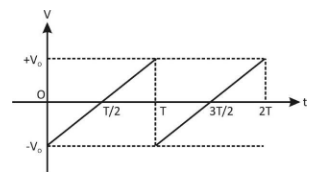
Let’s have a look straight line $BC$in the graph, the slope of this line is $m = \dfrac{{{V_0}}}{{\left( {\dfrac{T}{2}} \right)}} = \dfrac{{2{V_0}}}{T}$, so the equation of this straight line is given by the equation,
$
g = mx + C \\
\Rightarrow V = \dfrac{{2{v_0}}}{T}t + ( - {v_0}) \\
\Rightarrow V = \dfrac{{2{v_0}t}}{T} = {v_0} \\
$
Now, substituting the value of ‘v’ in the equation (i) we get
\[
\Rightarrow\int_0^{{T_P}} {{v^2}dt} = {\int_0^T {\left( {\dfrac{{2{v_0}t}}{T} - {v_0}} \right)} ^2}dt\,\,\,\,\,\,\,\,(\because {T_P} = T) \\
\Rightarrow\int_0^{{T_P}} {{v^2}dt}= \int_0^T {\left[ {{{\left( {\dfrac{{2{v_0}t}}{T}} \right)}^2} + v_0^2 - 2 \times \dfrac{{2{v_0}t}}{T} \times {V_0}} \right]} dt \\
\Rightarrow\int_0^{{T_P}} {{v^2}dt}= \int_0^T {\left( {\dfrac{{4v_0^2{t^2}}}{{{T^2}}} + v_0^2 - \dfrac{{4v_0^2t}}{T}} \right)} dt \\
\Rightarrow\int_0^{{T_P}} {{v^2}dt}= \dfrac{{4v_0^2}}{T}\int_0^T {{t^2}dt + v_0^2\int_0^2 {dt - \int_0^T t } \,dt} \\
\Rightarrow\int_0^{{T_P}} {{v^2}dt}= \dfrac{{4v_0^2}}{{{T^2}}}{\left[ {\dfrac{{{t^3}}}{3}} \right]^T} + v_0^2[t]_0^T - \dfrac{{4v_0^2}}{T}\left[ {\dfrac{{{t^2}}}{2}} \right]_0^T \\
\Rightarrow\int_0^{{T_P}} {{v^2}dt}= \dfrac{{4v_0^2}}{{{T^2}}}\left[ {\dfrac{{{T^3}}}{3}} \right] + v_0^2[T] -\dfrac{{4v_0^2}}{T}\left[ {\dfrac{{{T^2}}}{2}} \right] \\
\Rightarrow\int_0^{{T_P}} {{v^2}dt}= \dfrac{{4v_0^2T + 6v_0^2T - 12v_0^2T}}{6} \\
\Rightarrow\int_0^{{T_P}} {{v^2}dt}= \dfrac{{14v_0^2T - 12v_0^2T}}{6} - - - - - (ii) \\
\]
Divided both sides by T of equation (i)
\[\dfrac{1}{T}\int_0^{{T_P}} {{v^2}dt} = \dfrac{{v_0^2}}{3} - - - - (iii)\]
Taking under the root of both the sides in equation (ii)
\[\sqrt {\dfrac{1}{T}\int_0^{{T_P}} {{v^2}dt} } = \sqrt {\dfrac{{v_0^2}}{3}} \]
As, $T = {T_P}$ so, the above equation can be written as:
\[\therefore\sqrt {\dfrac{1}{{{T_P}}}\int_0^{{T_P}} {{v^2}dt} } = \dfrac{{{v_0}}}{{\sqrt 3 }} - - - - (iv)\]
Comparing the equation (1) and (4), we can say that ${V_{rms}} = \dfrac{{{v_0}}}{{\sqrt 3 }}$.
According to the question, ${V_{rms}} = \dfrac{{{v_0}}}{{\sqrt x }} = \dfrac{{{v_0}}}{{\sqrt 3 }}$
Hence, $x = 3$.
Note:The rms value is the effective value of a varying voltage or current. It is equivalent to steady DC (constant) value which gives the same effect. The rms stands for root mean square, and it is a way of expressing AC quantity of voltage or current in terms functionally equivalent to DC.
Complete step by step answer:
The rms value is defined as the square root of the mean value of the squared function. If ${T_P}$ is the time period of the wavefront then, the rms value is given as
\[{V_{RMS}} = \dfrac{1}{{{T_P}}}\int_0^{{T_P}} {{v^2}dt} {\text{ - - - - }}(i)\]
On working the equation (i) for calculating the rms value, we will get the equation of ‘v’ in the function of time ‘t’.
Let’s have a look straight line $BC$in the graph, the slope of this line is $m = \dfrac{{{V_0}}}{{\left( {\dfrac{T}{2}} \right)}} = \dfrac{{2{V_0}}}{T}$, so the equation of this straight line is given by the equation,
$
g = mx + C \\
\Rightarrow V = \dfrac{{2{v_0}}}{T}t + ( - {v_0}) \\
\Rightarrow V = \dfrac{{2{v_0}t}}{T} = {v_0} \\
$
Now, substituting the value of ‘v’ in the equation (i) we get
\[
\Rightarrow\int_0^{{T_P}} {{v^2}dt} = {\int_0^T {\left( {\dfrac{{2{v_0}t}}{T} - {v_0}} \right)} ^2}dt\,\,\,\,\,\,\,\,(\because {T_P} = T) \\
\Rightarrow\int_0^{{T_P}} {{v^2}dt}= \int_0^T {\left[ {{{\left( {\dfrac{{2{v_0}t}}{T}} \right)}^2} + v_0^2 - 2 \times \dfrac{{2{v_0}t}}{T} \times {V_0}} \right]} dt \\
\Rightarrow\int_0^{{T_P}} {{v^2}dt}= \int_0^T {\left( {\dfrac{{4v_0^2{t^2}}}{{{T^2}}} + v_0^2 - \dfrac{{4v_0^2t}}{T}} \right)} dt \\
\Rightarrow\int_0^{{T_P}} {{v^2}dt}= \dfrac{{4v_0^2}}{T}\int_0^T {{t^2}dt + v_0^2\int_0^2 {dt - \int_0^T t } \,dt} \\
\Rightarrow\int_0^{{T_P}} {{v^2}dt}= \dfrac{{4v_0^2}}{{{T^2}}}{\left[ {\dfrac{{{t^3}}}{3}} \right]^T} + v_0^2[t]_0^T - \dfrac{{4v_0^2}}{T}\left[ {\dfrac{{{t^2}}}{2}} \right]_0^T \\
\Rightarrow\int_0^{{T_P}} {{v^2}dt}= \dfrac{{4v_0^2}}{{{T^2}}}\left[ {\dfrac{{{T^3}}}{3}} \right] + v_0^2[T] -\dfrac{{4v_0^2}}{T}\left[ {\dfrac{{{T^2}}}{2}} \right] \\
\Rightarrow\int_0^{{T_P}} {{v^2}dt}= \dfrac{{4v_0^2T + 6v_0^2T - 12v_0^2T}}{6} \\
\Rightarrow\int_0^{{T_P}} {{v^2}dt}= \dfrac{{14v_0^2T - 12v_0^2T}}{6} - - - - - (ii) \\
\]
Divided both sides by T of equation (i)
\[\dfrac{1}{T}\int_0^{{T_P}} {{v^2}dt} = \dfrac{{v_0^2}}{3} - - - - (iii)\]
Taking under the root of both the sides in equation (ii)
\[\sqrt {\dfrac{1}{T}\int_0^{{T_P}} {{v^2}dt} } = \sqrt {\dfrac{{v_0^2}}{3}} \]
As, $T = {T_P}$ so, the above equation can be written as:
\[\therefore\sqrt {\dfrac{1}{{{T_P}}}\int_0^{{T_P}} {{v^2}dt} } = \dfrac{{{v_0}}}{{\sqrt 3 }} - - - - (iv)\]
Comparing the equation (1) and (4), we can say that ${V_{rms}} = \dfrac{{{v_0}}}{{\sqrt 3 }}$.
According to the question, ${V_{rms}} = \dfrac{{{v_0}}}{{\sqrt x }} = \dfrac{{{v_0}}}{{\sqrt 3 }}$
Hence, $x = 3$.
Note:The rms value is the effective value of a varying voltage or current. It is equivalent to steady DC (constant) value which gives the same effect. The rms stands for root mean square, and it is a way of expressing AC quantity of voltage or current in terms functionally equivalent to DC.
Recently Updated Pages
Master Class 12 Economics: Engaging Questions & Answers for Success

Master Class 12 English: Engaging Questions & Answers for Success
Master Class 12 Social Science: Engaging Questions & Answers for Success
Master Class 12 Maths: Engaging Questions & Answers for Success
Master Class 12 Physics: Engaging Questions & Answers for Success
Master Class 9 General Knowledge: Engaging Questions & Answers for Success
Trending doubts
Which are the Top 10 Largest Countries of the World?
Draw a labelled sketch of the human eye class 12 physics CBSE
Differentiate between homogeneous and heterogeneous class 12 chemistry CBSE
Why is the cell called the structural and functional class 12 biology CBSE
Draw ray diagrams each showing i myopic eye and ii class 12 physics CBSE
Which is the correct genotypic ratio of mendel dihybrid class 12 biology CBSE