




The r.m.s. the value of an a.c. of 50 Hz is 10A. The time taken by the alternating current in reaching from zero to maximum value and peak value of current will be:
(A) $2 \times 10^{-2}$ s and 14.14 A
(B) $1 \times 10^{-2}$ s and 7.07 A
(C) $5 \times 10^{-3}$ s and 7.07 A
(D) $5 \times 10^{-3}$ s and 14.14 A
Answer
 Verified
577.5k+ views
Hint: In an alternating current supply, the amplitude of the wave is the peak value of the current. The time it takes to reach from zero to peak is the time period divided by 4 as the time period is the time it takes for completion of one cycle (0 to 2$ \pi$).
Formula used:
The time period and the frequency of the a.c. current (wave ) are related as:
$f = \dfrac{1}{T}$ .
The r.m.s. value of the current and the peak value of the current are related as:
$I_{rms} = \dfrac{I_0}{\sqrt{2}}$
Complete answer:
We are given that the given a.c. current has a frequency of 50 Hz. The time period of this supply is therefore,
$T = \dfrac{1}{50} = 0.02 $ s.
The time period is the time taken for one whole wave/cycle to pass. One whole wave consists of a crest and a trough. One-fourth of this wave can be considered the distance between zero and the first peak. This is depicted below:
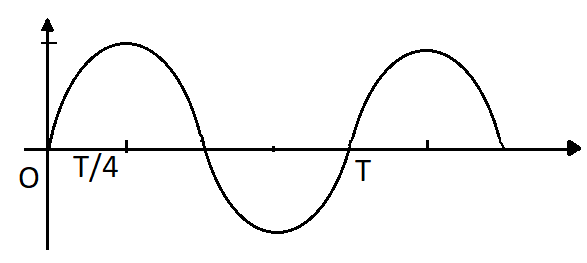
The time period also becomes one-fourth. Therefore, the required time to reach the peak, starting from zero is:
$\dfrac{T}{4} = \dfrac{0.02}{4} = 5 \times 10^{-3}$ s.
Now, the peak value of the current can be obtained from the r.m.s. value of the current as:
$I_0 = \sqrt{2} I_{rms} = \sqrt{2} \times 10 = 14.14$ A.
Therefore, the correct answer is option (D).
Note:
The unit of frequency is Hertz which is also expressed as per second. Keeping this in mind, it becomes simpler to invert the frequency to obtain the time period and obtain the frequency. There is also another term called angular frequency which is used to describe a wave. The unit of angular frequency is in rad/s.
Formula used:
The time period and the frequency of the a.c. current (wave ) are related as:
$f = \dfrac{1}{T}$ .
The r.m.s. value of the current and the peak value of the current are related as:
$I_{rms} = \dfrac{I_0}{\sqrt{2}}$
Complete answer:
We are given that the given a.c. current has a frequency of 50 Hz. The time period of this supply is therefore,
$T = \dfrac{1}{50} = 0.02 $ s.
The time period is the time taken for one whole wave/cycle to pass. One whole wave consists of a crest and a trough. One-fourth of this wave can be considered the distance between zero and the first peak. This is depicted below:
The time period also becomes one-fourth. Therefore, the required time to reach the peak, starting from zero is:
$\dfrac{T}{4} = \dfrac{0.02}{4} = 5 \times 10^{-3}$ s.
Now, the peak value of the current can be obtained from the r.m.s. value of the current as:
$I_0 = \sqrt{2} I_{rms} = \sqrt{2} \times 10 = 14.14$ A.
Therefore, the correct answer is option (D).
Note:
The unit of frequency is Hertz which is also expressed as per second. Keeping this in mind, it becomes simpler to invert the frequency to obtain the time period and obtain the frequency. There is also another term called angular frequency which is used to describe a wave. The unit of angular frequency is in rad/s.
Recently Updated Pages
Master Class 5 English: Engaging Questions & Answers for Success

Master Class 5 Maths: Engaging Questions & Answers for Success
Master Class 5 Social Science: Engaging Questions & Answers for Success
Master Class 5 Science: Engaging Questions & Answers for Success
Class 5 Question and Answer - Your Ultimate Solutions Guide
Master Class 9 General Knowledge: Engaging Questions & Answers for Success
Trending doubts
One Metric ton is equal to kg A 10000 B 1000 C 100 class 11 physics CBSE
What is cell theory Who formulated it class 11 biology CBSE
Phyllotaxy is the arrangement of ALeaflets BLeaves class 11 biology CBSE
Difference Between Prokaryotic Cells and Eukaryotic Cells
The symbiotic association of fungi and algae is called class 11 biology CBSE
Cell theory was formulated by A Schleiden and Schwann class 11 biology CBSE