




The resultant R of two forces acting on a particle is at right angles to one of them and its magnitude is one third of the other force. The ratio of larger force to smaller one is:
(A) 2:1
(B) 3:2$\sqrt{2}$
(C) 3:2
(D) 3:$\sqrt{2}$
Answer
 Verified
592.2k+ views
Hint: The resultant of the two forces is given with the help of parallelogram law of vector addition. A parallelogram can be formed, and as one of the angles is already a right angle, Pythagora's theorem can be used to find the side of the right triangle formed.
Complete answer:
Let the resultant vector have a magnitude of F/3 and one of the forces have the magnitude of F. Now, considering the following figure.
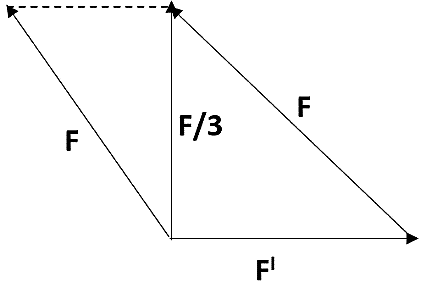
In the figure, the resultant lies in the middle and other vectors are F and F’. F’ is the one we need to find. We can place the force vector F such that it starts at the head of the vector F’ and ends at the head of the resultant vector. In vectors, direction and magnitude is important so we are preserving that in doing so.
Here, the parallelogram gives the magnitude of the remaining force.
The remaining force is given as:
$\sqrt{F^2 - \dfrac{F^2}{9} }= \dfrac{2 \sqrt{2} F}{3}$
Therefore now one of the forces in the question has a magnitude of F and the other force has a magnitude of $3:2 \sqrt{2}$ .
Therefore, the correct answer is option (B).
Note:
There are a lot of similarities between triangle law and parallelogram law of vector addition. In the triangle law, the two forces under consideration are placed in head to tail format while in parallelogram law of vector addition, the two forces are acting at the same point i.e, the tail of both vectors are at the same point. Generally, in questions that deal with forces, parallelogram law is used as a starting point because both the forces act at the same point.
Complete answer:
Let the resultant vector have a magnitude of F/3 and one of the forces have the magnitude of F. Now, considering the following figure.
In the figure, the resultant lies in the middle and other vectors are F and F’. F’ is the one we need to find. We can place the force vector F such that it starts at the head of the vector F’ and ends at the head of the resultant vector. In vectors, direction and magnitude is important so we are preserving that in doing so.
Here, the parallelogram gives the magnitude of the remaining force.
The remaining force is given as:
$\sqrt{F^2 - \dfrac{F^2}{9} }= \dfrac{2 \sqrt{2} F}{3}$
Therefore now one of the forces in the question has a magnitude of F and the other force has a magnitude of $3:2 \sqrt{2}$ .
Therefore, the correct answer is option (B).
Note:
There are a lot of similarities between triangle law and parallelogram law of vector addition. In the triangle law, the two forces under consideration are placed in head to tail format while in parallelogram law of vector addition, the two forces are acting at the same point i.e, the tail of both vectors are at the same point. Generally, in questions that deal with forces, parallelogram law is used as a starting point because both the forces act at the same point.
Recently Updated Pages
If x a + bt + ct2 where x is in meters and t is in class 11 physics CBSE

A car covers the first half distance between two places class 11 physics CBSE
The resultant of two vectors overrightarrow P and overrightarrow class 11 physics CBSE
Find the value of cos 135 class 11 maths CBSE
A mass M is held in place by an applied force F and class 11 physics CBSE
A solution of glucose in water is labelled as 10 dfracwv class 11 chemistry CBSE
Trending doubts
One Metric ton is equal to kg A 10000 B 1000 C 100 class 11 physics CBSE
Find the value of the expression given below sin 30circ class 11 maths CBSE
What do you mean by retardation What is its SI uni class 11 physics CBSE
Draw a diagram of nephron and explain its structur class 11 biology CBSE
10 examples of friction in our daily life
Difference between physical and chemical change class 11 chemistry CBSE