




The resultant of two vectors of magnitude $2$ and $3$ is $1$ the angle between them is?
Answer
 Verified
558.9k+ views
Hint: Here we have given the resultant of two vectors and the vectors are also known. Now by applying the resultant vector formula with the parallelogram law and by drawing a rough diagram we can find the value of angle. The angle here is the angle between the two given vectors.
Complete step by step answer:
As per the problem we have given two vectors of magnitude $2$ and $3$, the resultant of the two vectors is $1$.
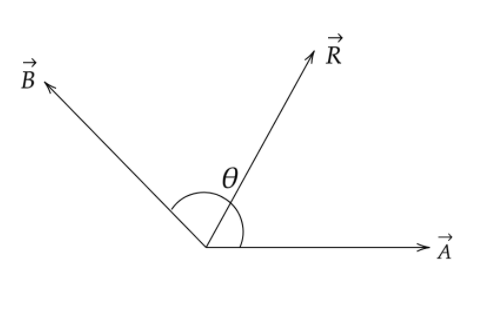
From the parallelogram law of two vectors having some magnitude will give a result vectors which can be represented as,
$R = \sqrt {{{\left( A \right)}^2} + {{\left( B \right)}^2} + 2AB\cos \theta } $
Where,
$A = 2$ and $B = 3$ are two vectors which are at an angle of $\theta $.
$R$ is the resultant of two vectors which is equal to $1$.
Now putting the respective values in the above formula we will get,
$1 = \sqrt {{{\left( 2 \right)}^2} + {{\left( 3 \right)}^2} + 2 \times 2 \times 3\cos \theta } $
Taking the root over to other side and opening the brackets we will get,
$1 = 4 + 9 + 12\cos \theta $
$ \Rightarrow - 12 = 12\cos \theta $
Cancelling the common terms we will get,
$ - 1 = \cos \theta \Rightarrow \theta = {\cos ^{ - 1}}\left( { - 1} \right)$
Hence $\theta = 180^\circ $ as we know $\cos 180 = - 1$
Therefore the angle between the two given vectors is $\theta = 180^\circ $.
That is they are totally opposite to each other or we can say their directions are opposite.
Note: Parallelogram Law states that the resultant of two vector quantities can be represented by its magnitude , direction and sense by two adjacent sides of a parallel both of which are either directed toward or away from the point of their intersection is the diagonal of the parallelogram through that point.
Complete step by step answer:
As per the problem we have given two vectors of magnitude $2$ and $3$, the resultant of the two vectors is $1$.
From the parallelogram law of two vectors having some magnitude will give a result vectors which can be represented as,
$R = \sqrt {{{\left( A \right)}^2} + {{\left( B \right)}^2} + 2AB\cos \theta } $
Where,
$A = 2$ and $B = 3$ are two vectors which are at an angle of $\theta $.
$R$ is the resultant of two vectors which is equal to $1$.
Now putting the respective values in the above formula we will get,
$1 = \sqrt {{{\left( 2 \right)}^2} + {{\left( 3 \right)}^2} + 2 \times 2 \times 3\cos \theta } $
Taking the root over to other side and opening the brackets we will get,
$1 = 4 + 9 + 12\cos \theta $
$ \Rightarrow - 12 = 12\cos \theta $
Cancelling the common terms we will get,
$ - 1 = \cos \theta \Rightarrow \theta = {\cos ^{ - 1}}\left( { - 1} \right)$
Hence $\theta = 180^\circ $ as we know $\cos 180 = - 1$
Therefore the angle between the two given vectors is $\theta = 180^\circ $.
That is they are totally opposite to each other or we can say their directions are opposite.
Note: Parallelogram Law states that the resultant of two vector quantities can be represented by its magnitude , direction and sense by two adjacent sides of a parallel both of which are either directed toward or away from the point of their intersection is the diagonal of the parallelogram through that point.
Recently Updated Pages
If x a + bt + ct2 where x is in meters and t is in class 11 physics CBSE

A car covers the first half distance between two places class 11 physics CBSE
The resultant of two vectors overrightarrow P and overrightarrow class 11 physics CBSE
Find the value of cos 135 class 11 maths CBSE
A mass M is held in place by an applied force F and class 11 physics CBSE
A solution of glucose in water is labelled as 10 dfracwv class 11 chemistry CBSE
Trending doubts
One Metric ton is equal to kg A 10000 B 1000 C 100 class 11 physics CBSE
Find the value of the expression given below sin 30circ class 11 maths CBSE
What do you mean by retardation What is its SI uni class 11 physics CBSE
Draw a diagram of nephron and explain its structur class 11 biology CBSE
10 examples of friction in our daily life
Difference between physical and chemical change class 11 chemistry CBSE