




The resultant of two vectors at angle 150${}^{\circ }$ is 10 units and is perpendicular to one vector. The magnitude of the smaller vector is
$\text{A}\text{. 10units}$
$\text{B}\text{. 10}\sqrt{3}\text{units}$
$\text{C}\text{. 10}\sqrt{2}\text{units}$
$\text{D}\text{. 5}\sqrt{3}\text{units}$
Answer
 Verified
627.9k+ views
Hint: Use the law of Parallelogram for vectors, which gives the resultant of two vectors. The magnitude of the resultant R is given as $R=\sqrt{{{A}^{2}}+{{B}^{2}}+2AB\cos \theta }$, where A and B is the magnitudes of the vectors $\overrightarrow{A}$ and $\overrightarrow{B}$respectively. $\theta $ is the angle between A and B.
Formula used:
$R=\sqrt{{{A}^{2}}+{{B}^{2}}+2AB\cos \theta }$
Complete step by step answer:
The resultant vector $\overrightarrow{R}$ of two vectors $\overrightarrow{A}$ and $\overrightarrow{B}$ is given as $\overrightarrow{R}=\overrightarrow{A}+\overrightarrow{B}$. The magnitude (R) of the resultant is given as $R=\sqrt{{{A}^{2}}+{{B}^{2}}+2AB\cos \theta }$, where A and B is the magnitudes of the vectors $\overrightarrow{A}$ and $\overrightarrow{B}$respectively. $\theta $ is the angle between A and B.
Let us first draw a figure.
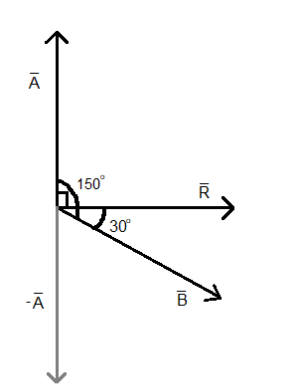
Here, $\left( -\overrightarrow{A} \right)$ is a vector, magnitude is equal to vector A but it is opposite in direction of A.
When we use the resultant formula for $\overrightarrow{R}$, $\overrightarrow{A}$ and $\overrightarrow{B}$, we get $R=\sqrt{{{A}^{2}}+{{B}^{2}}+2AB\cos \theta }$
Here, $\theta ={{150}^{\circ }}$.
$\Rightarrow R=\sqrt{{{A}^{2}}+{{B}^{2}}+2AB\cos (150)}$
$\cos (150)=-\dfrac{\sqrt{3}}{2}$.
$\Rightarrow R=\sqrt{{{A}^{2}}+{{B}^{2}}+2AB\left( -\dfrac{\sqrt{3}}{2} \right)}$
$\Rightarrow R=\sqrt{{{A}^{2}}+{{B}^{2}}-\sqrt{3}AB}$
Square both sides.
$\Rightarrow {{R}^{2}}={{A}^{2}}+{{B}^{2}}-\sqrt{3}AB$ ……..(i).
As per the figure x$\left( -\overrightarrow{A} \right)+\overline{R}=\overline{B}$. Therefore, the magnitude of R is $B=\sqrt{{{A}^{2}}+{{R}^{2}}+2AR\cos 90}$
We know that cos90=0.
$\Rightarrow B=\sqrt{{{A}^{2}}+{{R}^{2}}+0}$
$\Rightarrow B=\sqrt{{{A}^{2}}+{{R}^{2}}}$ ……(ii).
Square both sides.
$\Rightarrow {{B}^{2}}={{A}^{2}}+{{R}^{2}}$ ……(iii).
Substitute the values of B and ${{B}^{2}}$ in equation (i).
Therefore,
$\Rightarrow {{R}^{2}}={{A}^{2}}+({{A}^{2}}+{{R}^{2}})-\sqrt{3}A\left( \sqrt{{{A}^{2}}+{{R}^{2}}} \right)$
Open the brackets.
$\Rightarrow {{R}^{2}}-{{R}^{2}}=2{{A}^{2}}-\sqrt{3}A\left( \sqrt{{{A}^{2}}+{{R}^{2}}} \right)$
$\Rightarrow 0=2{{A}^{2}}-\sqrt{3}A\left( \sqrt{{{A}^{2}}+{{R}^{2}}} \right)$
Therefore,
$2{{A}^{2}}=\sqrt{3}A\left( \sqrt{{{A}^{2}}+{{R}^{2}}} \right)$
Divide both sides by A. Therefore,
$2A=\sqrt{3}\left( \sqrt{{{A}^{2}}+{{R}^{2}}} \right)$
Square both the sides.
$4{{A}^{2}}=3\left( {{A}^{2}}+{{R}^{2}} \right)$
Open the brackets.
$4{{A}^{2}}=3{{A}^{2}}+3{{R}^{2}}$
This implies, ${{A}^{2}}=3{{R}^{2}}$.
Therefore, $A=\sqrt{3}R$.
The given value of R is 10 units. Therefore, $A=\sqrt{3}\left( 10 \right)=10\sqrt{3}units$.
Substitute the value of A in equation (iii).
$\Rightarrow {{B}^{2}}={{\left( \sqrt{3}R \right)}^{2}}+{{R}^{2}}$
$\Rightarrow {{B}^{2}}=3{{R}^{2}}+{{R}^{2}}$
$\Rightarrow {{B}^{2}}=4{{R}^{2}}$
This implies that $B=2R=2\times 10=20units$.
Therefore, the magnitudes of A and B are $10\sqrt{3}$units and 20 units respectively.
Hence, the smaller vector is $\overrightarrow{A}$ with a magnitude of $10\sqrt{3}$ units.
Therefore, the correct option is B.
Note: This problem can also be solved by resolving the vectors into their components.
Resolve vector $\overline{B}$ into horizontal components along vector $\overline{R}$ and a vertical component along vector $-\overline{A}$. The horizontal component is equal to $B\cos (60)$ and the vertical component is equal to $B\sin (60)$.
Since the $\overline{B}$ is the resultant of $-\overline{A}$ and $\overline{R}$, $B\cos (60)=R$ and $B\sin (60)=A$.
Therefore, $B=\dfrac{R}{\cos 60}$.
$\cos (60)=\dfrac{1}{2}$ and R=10units.
$\Rightarrow B=\dfrac{R}{\left( \dfrac{1}{2} \right)}=2R=2\times 10=20units$
We also have $B\sin (60)=A$. Substitute the value of B.
Therefore, $A=(20).\left( \dfrac{\sqrt{3}}{2} \right)=10\sqrt{3}units$
Therefore, the smaller vector is $\overline{A}$ and its magnitude is $10\sqrt{3}units$.
Formula used:
$R=\sqrt{{{A}^{2}}+{{B}^{2}}+2AB\cos \theta }$
Complete step by step answer:
The resultant vector $\overrightarrow{R}$ of two vectors $\overrightarrow{A}$ and $\overrightarrow{B}$ is given as $\overrightarrow{R}=\overrightarrow{A}+\overrightarrow{B}$. The magnitude (R) of the resultant is given as $R=\sqrt{{{A}^{2}}+{{B}^{2}}+2AB\cos \theta }$, where A and B is the magnitudes of the vectors $\overrightarrow{A}$ and $\overrightarrow{B}$respectively. $\theta $ is the angle between A and B.
Let us first draw a figure.
Here, $\left( -\overrightarrow{A} \right)$ is a vector, magnitude is equal to vector A but it is opposite in direction of A.
When we use the resultant formula for $\overrightarrow{R}$, $\overrightarrow{A}$ and $\overrightarrow{B}$, we get $R=\sqrt{{{A}^{2}}+{{B}^{2}}+2AB\cos \theta }$
Here, $\theta ={{150}^{\circ }}$.
$\Rightarrow R=\sqrt{{{A}^{2}}+{{B}^{2}}+2AB\cos (150)}$
$\cos (150)=-\dfrac{\sqrt{3}}{2}$.
$\Rightarrow R=\sqrt{{{A}^{2}}+{{B}^{2}}+2AB\left( -\dfrac{\sqrt{3}}{2} \right)}$
$\Rightarrow R=\sqrt{{{A}^{2}}+{{B}^{2}}-\sqrt{3}AB}$
Square both sides.
$\Rightarrow {{R}^{2}}={{A}^{2}}+{{B}^{2}}-\sqrt{3}AB$ ……..(i).
As per the figure x$\left( -\overrightarrow{A} \right)+\overline{R}=\overline{B}$. Therefore, the magnitude of R is $B=\sqrt{{{A}^{2}}+{{R}^{2}}+2AR\cos 90}$
We know that cos90=0.
$\Rightarrow B=\sqrt{{{A}^{2}}+{{R}^{2}}+0}$
$\Rightarrow B=\sqrt{{{A}^{2}}+{{R}^{2}}}$ ……(ii).
Square both sides.
$\Rightarrow {{B}^{2}}={{A}^{2}}+{{R}^{2}}$ ……(iii).
Substitute the values of B and ${{B}^{2}}$ in equation (i).
Therefore,
$\Rightarrow {{R}^{2}}={{A}^{2}}+({{A}^{2}}+{{R}^{2}})-\sqrt{3}A\left( \sqrt{{{A}^{2}}+{{R}^{2}}} \right)$
Open the brackets.
$\Rightarrow {{R}^{2}}-{{R}^{2}}=2{{A}^{2}}-\sqrt{3}A\left( \sqrt{{{A}^{2}}+{{R}^{2}}} \right)$
$\Rightarrow 0=2{{A}^{2}}-\sqrt{3}A\left( \sqrt{{{A}^{2}}+{{R}^{2}}} \right)$
Therefore,
$2{{A}^{2}}=\sqrt{3}A\left( \sqrt{{{A}^{2}}+{{R}^{2}}} \right)$
Divide both sides by A. Therefore,
$2A=\sqrt{3}\left( \sqrt{{{A}^{2}}+{{R}^{2}}} \right)$
Square both the sides.
$4{{A}^{2}}=3\left( {{A}^{2}}+{{R}^{2}} \right)$
Open the brackets.
$4{{A}^{2}}=3{{A}^{2}}+3{{R}^{2}}$
This implies, ${{A}^{2}}=3{{R}^{2}}$.
Therefore, $A=\sqrt{3}R$.
The given value of R is 10 units. Therefore, $A=\sqrt{3}\left( 10 \right)=10\sqrt{3}units$.
Substitute the value of A in equation (iii).
$\Rightarrow {{B}^{2}}={{\left( \sqrt{3}R \right)}^{2}}+{{R}^{2}}$
$\Rightarrow {{B}^{2}}=3{{R}^{2}}+{{R}^{2}}$
$\Rightarrow {{B}^{2}}=4{{R}^{2}}$
This implies that $B=2R=2\times 10=20units$.
Therefore, the magnitudes of A and B are $10\sqrt{3}$units and 20 units respectively.
Hence, the smaller vector is $\overrightarrow{A}$ with a magnitude of $10\sqrt{3}$ units.
Therefore, the correct option is B.
Note: This problem can also be solved by resolving the vectors into their components.
Resolve vector $\overline{B}$ into horizontal components along vector $\overline{R}$ and a vertical component along vector $-\overline{A}$. The horizontal component is equal to $B\cos (60)$ and the vertical component is equal to $B\sin (60)$.
Since the $\overline{B}$ is the resultant of $-\overline{A}$ and $\overline{R}$, $B\cos (60)=R$ and $B\sin (60)=A$.
Therefore, $B=\dfrac{R}{\cos 60}$.
$\cos (60)=\dfrac{1}{2}$ and R=10units.
$\Rightarrow B=\dfrac{R}{\left( \dfrac{1}{2} \right)}=2R=2\times 10=20units$
We also have $B\sin (60)=A$. Substitute the value of B.
Therefore, $A=(20).\left( \dfrac{\sqrt{3}}{2} \right)=10\sqrt{3}units$
Therefore, the smaller vector is $\overline{A}$ and its magnitude is $10\sqrt{3}units$.
Recently Updated Pages
Master Class 11 Social Science: Engaging Questions & Answers for Success

Master Class 11 English: Engaging Questions & Answers for Success
Master Class 11 Maths: Engaging Questions & Answers for Success
Master Class 11 Chemistry: Engaging Questions & Answers for Success
Master Class 11 Biology: Engaging Questions & Answers for Success
Master Class 11 Physics: Engaging Questions & Answers for Success
Trending doubts
One Metric ton is equal to kg A 10000 B 1000 C 100 class 11 physics CBSE
Difference Between Prokaryotic Cells and Eukaryotic Cells
How many of the following diseases can be studied with class 11 biology CBSE
Draw a diagram of a plant cell and label at least eight class 11 biology CBSE
Two of the body parts which do not appear in MRI are class 11 biology CBSE
Which gas is abundant in air class 11 chemistry CBSE