




The resultant of two forces of 3 kg-wt and 4 kg-wt which are inclined at
30$^{\circ }$angles to each other is
A.$\sqrt{25+6\sqrt{3}}$
B.$\sqrt{25+12\sqrt{3}}$
C.$\sqrt{37}$
D.$\sqrt{13}$
Answer
 Verified
573.9k+ views
Hint: The magnitude of the forces are given as well as at what angle they are inclined that is also given, we know the resultant of two forces which are inclined at an angle has a formula we have to put the values and just solve the equation.
Complete answer:
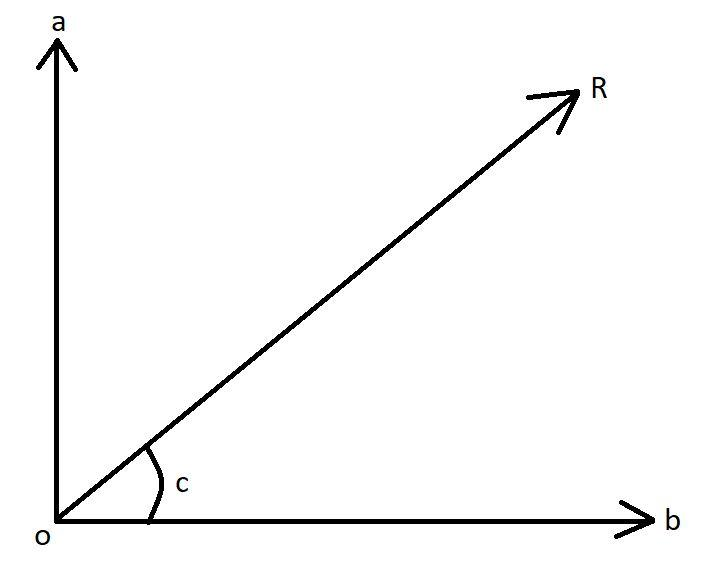
R is the resultant vector of a and b together, we are considering c as the angle between the resultant and b.
The two forces given are 3kg-wt and 4kg-wt,
We know that the resultant of two forces which are inclined at an angle theta is,
$=\sqrt{{{a}^{2}}+{{b}^{2}}+2ab\cos \theta }$
So, according to problem,
$=\sqrt{{{3}^{2}}+{{4}^{2}}+2\times 4\times 3\cos {{30}^{\circ }}}$
$=\sqrt{9+16+2\times 4\times 3\times \dfrac{\sqrt{3}}{2}}$,(cos 30$^{{}^\circ }=\dfrac{\sqrt{3}}{2}$)
$=\sqrt{9+16+24\times \dfrac{\sqrt{3}}{2}}$
$=\sqrt{9+16+12\times \sqrt{3}}$
$=\sqrt{25+12\sqrt{3}}$(Ans)
Therefore option B is the correct option.
Additional Information:
Gravitational force acting on a body of mass 1 kg is known as One kilogram weight. 1 kg mass is 9.8 N by the above statement we mean that.
Sine, Cosine, and Tangent are three major trigonometric ratios based on Trigonometry.
The vector quantity which is equivalent to the combined effect of two or more component vectors acting at the same point is known as resultant(force ,velocity, etc).
A plane that is inclined at an angle to the horizontal is known as an inclined plane.
Force is the product of mass and acceleration, it is the reason for change of a stationary object to a movie one.
Note:
Students sometimes go wrong in the trigonometrical conversion that is the value of certain angles of sin, cosine, tan, cot, etc. In the formula of resultant ‘a’ and ‘b’ represent two magnitudes. Remember the values are inside a square root and also squared.
Complete answer:
R is the resultant vector of a and b together, we are considering c as the angle between the resultant and b.
The two forces given are 3kg-wt and 4kg-wt,
We know that the resultant of two forces which are inclined at an angle theta is,
$=\sqrt{{{a}^{2}}+{{b}^{2}}+2ab\cos \theta }$
So, according to problem,
$=\sqrt{{{3}^{2}}+{{4}^{2}}+2\times 4\times 3\cos {{30}^{\circ }}}$
$=\sqrt{9+16+2\times 4\times 3\times \dfrac{\sqrt{3}}{2}}$,(cos 30$^{{}^\circ }=\dfrac{\sqrt{3}}{2}$)
$=\sqrt{9+16+24\times \dfrac{\sqrt{3}}{2}}$
$=\sqrt{9+16+12\times \sqrt{3}}$
$=\sqrt{25+12\sqrt{3}}$(Ans)
Therefore option B is the correct option.
Additional Information:
Gravitational force acting on a body of mass 1 kg is known as One kilogram weight. 1 kg mass is 9.8 N by the above statement we mean that.
Sine, Cosine, and Tangent are three major trigonometric ratios based on Trigonometry.
The vector quantity which is equivalent to the combined effect of two or more component vectors acting at the same point is known as resultant(force ,velocity, etc).
A plane that is inclined at an angle to the horizontal is known as an inclined plane.
Force is the product of mass and acceleration, it is the reason for change of a stationary object to a movie one.
Note:
Students sometimes go wrong in the trigonometrical conversion that is the value of certain angles of sin, cosine, tan, cot, etc. In the formula of resultant ‘a’ and ‘b’ represent two magnitudes. Remember the values are inside a square root and also squared.
Recently Updated Pages
Master Class 11 Social Science: Engaging Questions & Answers for Success

Master Class 11 English: Engaging Questions & Answers for Success
Master Class 11 Maths: Engaging Questions & Answers for Success
Master Class 11 Chemistry: Engaging Questions & Answers for Success
Master Class 11 Biology: Engaging Questions & Answers for Success
Master Class 11 Physics: Engaging Questions & Answers for Success
Trending doubts
One Metric ton is equal to kg A 10000 B 1000 C 100 class 11 physics CBSE
Difference Between Prokaryotic Cells and Eukaryotic Cells
Draw a diagram of a plant cell and label at least eight class 11 biology CBSE
Two of the body parts which do not appear in MRI are class 11 biology CBSE
Which gas is abundant in air class 11 chemistry CBSE
10 examples of friction in our daily life