




The resultant of two forces acting at an angle of ${{150}^{0}}$ is $10kgwt$ and is perpendicular to one of the forces. The smaller force is:
A. $10\sqrt{3}kgwt$
B. $20\sqrt{3}kgwt$
C. $20kgwt$
D. $20/\sqrt{3}kgwt$
Answer
 Verified
651.3k+ views
Hint: This problem can be solved by drawing a proper diagram with two coordinate axes and solving for the components of the force along these axes. The sum of the components of the two forces along each axis must be equal to the component of the resultant force along that axis.
Complete step-by-step answer:
Let us start off by drawing a proper diagram according to the information given in the question.
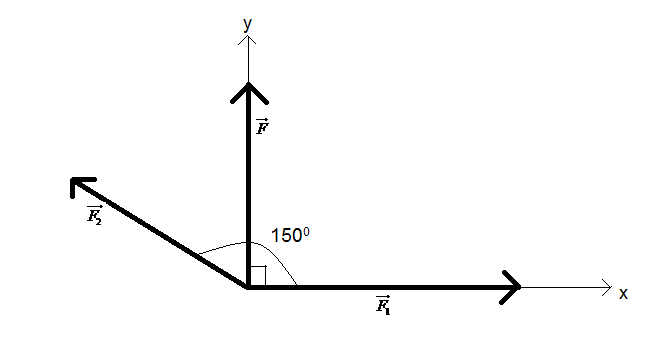
Let the two force vectors be $\overrightarrow{{{F}_{1}}}$ and $\overrightarrow{{{F}_{2}}}$ respectively. The resultant is $\overrightarrow{F}$. Their orientation in the figure is according to the conditions given in the question. We have two coordinate axes x and y as shown in the figure. The sum of the components of the two forces along each axis must be equal to the component of the resultant force along that axis.
The magnitudes of $\overrightarrow{{{F}_{1}}}$, $\overrightarrow{{{F}_{2}}}$ and $\overrightarrow{F}$ are ${{F}_{1}}$,${{F}_{2}}$ and $F$ respectively.
Therefore solving the components along the x-axis we get,
${{F}_{1}}+{{F}_{2}}\cos {{150}^{0}}=F\cos {{90}^{0}}$
$\therefore {{F}_{1}}+{{F}_{2}}\left( -\dfrac{\sqrt{3}}{2} \right)=F\left( 0 \right)$ $\left( \because \cos {{150}^{0}}=-\dfrac{\sqrt{3}}{2},\cos {{90}^{0}}=0 \right)$
$\therefore {{F}_{1}}-\dfrac{\sqrt{3}}{2}{{F}_{2}}=0$
$\therefore {{F}_{1}}=\dfrac{\sqrt{3}}{2}{{F}_{2}}$ --(1)
Now, solving the components along the y-axis we get, ${{F}_{1}}\sin {{0}^{0}}+{{F}_{2}}\sin {{150}^{0}}=F$
$\therefore {{F}_{1}}\left( 0 \right)+{{F}_{2}}\left( \dfrac{1}{2} \right)=F$ $\left( \because \sin {{0}^{0}}=0,\sin {{150}^{0}}=\dfrac{1}{2} \right)$
$\therefore 0+\dfrac{1}{2}{{F}_{2}}=F$
$\therefore \dfrac{1}{2}{{F}_{2}}=F$
$\therefore {{F}_{2}}=2F$ --(2)
Now, according to the question, $F=10kgwt$ Putting this in (2), we get, $\therefore {{F}_{2}}=2F=2\times 10=20kgwt$ --(3)
Putting (3) in (1), we get,
${{F}_{1}}=\dfrac{\sqrt{3}}{2}\times 20=10\sqrt{3}kgwt$
Now, since $10\sqrt{3} < 20$, $\overrightarrow{{{F}_{1}}}$ is the smaller force.
Hence, the magnitude of the smaller force is $10\sqrt{3}kgwt$.
Hence, the correct option is A) $10\sqrt{3}kgwt$.
Note: This problem can be solved by using the cosine law for finding the magnitude of the resultant and equating it to the information given in the question. This gives us one equation. Another equation can be the formula for the angle of the resultant with respect to an individual vector which can also be equated with the help of the information given in the question. Hence, we will get two equations for two variables and can solve for the magnitudes of the individual forces respectively. Then we can check which force is the smaller one and that will be our required answer.
Complete step-by-step answer:
Let us start off by drawing a proper diagram according to the information given in the question.
Let the two force vectors be $\overrightarrow{{{F}_{1}}}$ and $\overrightarrow{{{F}_{2}}}$ respectively. The resultant is $\overrightarrow{F}$. Their orientation in the figure is according to the conditions given in the question. We have two coordinate axes x and y as shown in the figure. The sum of the components of the two forces along each axis must be equal to the component of the resultant force along that axis.
The magnitudes of $\overrightarrow{{{F}_{1}}}$, $\overrightarrow{{{F}_{2}}}$ and $\overrightarrow{F}$ are ${{F}_{1}}$,${{F}_{2}}$ and $F$ respectively.
Therefore solving the components along the x-axis we get,
${{F}_{1}}+{{F}_{2}}\cos {{150}^{0}}=F\cos {{90}^{0}}$
$\therefore {{F}_{1}}+{{F}_{2}}\left( -\dfrac{\sqrt{3}}{2} \right)=F\left( 0 \right)$ $\left( \because \cos {{150}^{0}}=-\dfrac{\sqrt{3}}{2},\cos {{90}^{0}}=0 \right)$
$\therefore {{F}_{1}}-\dfrac{\sqrt{3}}{2}{{F}_{2}}=0$
$\therefore {{F}_{1}}=\dfrac{\sqrt{3}}{2}{{F}_{2}}$ --(1)
Now, solving the components along the y-axis we get, ${{F}_{1}}\sin {{0}^{0}}+{{F}_{2}}\sin {{150}^{0}}=F$
$\therefore {{F}_{1}}\left( 0 \right)+{{F}_{2}}\left( \dfrac{1}{2} \right)=F$ $\left( \because \sin {{0}^{0}}=0,\sin {{150}^{0}}=\dfrac{1}{2} \right)$
$\therefore 0+\dfrac{1}{2}{{F}_{2}}=F$
$\therefore \dfrac{1}{2}{{F}_{2}}=F$
$\therefore {{F}_{2}}=2F$ --(2)
Now, according to the question, $F=10kgwt$ Putting this in (2), we get, $\therefore {{F}_{2}}=2F=2\times 10=20kgwt$ --(3)
Putting (3) in (1), we get,
${{F}_{1}}=\dfrac{\sqrt{3}}{2}\times 20=10\sqrt{3}kgwt$
Now, since $10\sqrt{3} < 20$, $\overrightarrow{{{F}_{1}}}$ is the smaller force.
Hence, the magnitude of the smaller force is $10\sqrt{3}kgwt$.
Hence, the correct option is A) $10\sqrt{3}kgwt$.
Note: This problem can be solved by using the cosine law for finding the magnitude of the resultant and equating it to the information given in the question. This gives us one equation. Another equation can be the formula for the angle of the resultant with respect to an individual vector which can also be equated with the help of the information given in the question. Hence, we will get two equations for two variables and can solve for the magnitudes of the individual forces respectively. Then we can check which force is the smaller one and that will be our required answer.
Recently Updated Pages
Master Class 11 English: Engaging Questions & Answers for Success

Master Class 11 Physics: Engaging Questions & Answers for Success
Master Class 11 Computer Science: Engaging Questions & Answers for Success
Master Class 11 Chemistry: Engaging Questions & Answers for Success
Master Class 11 Social Science: Engaging Questions & Answers for Success
Master Class 11 Accountancy: Engaging Questions & Answers for Success
Trending doubts
Difference Between Prokaryotic Cells and Eukaryotic Cells
Two of the body parts which do not appear in MRI are class 11 biology CBSE
One Metric ton is equal to kg A 10000 B 1000 C 100 class 11 physics CBSE
10 examples of friction in our daily life
Draw a diagram of nephron and explain its structur class 11 biology CBSE
Draw a diagram of a plant cell and label at least eight class 11 biology CBSE