




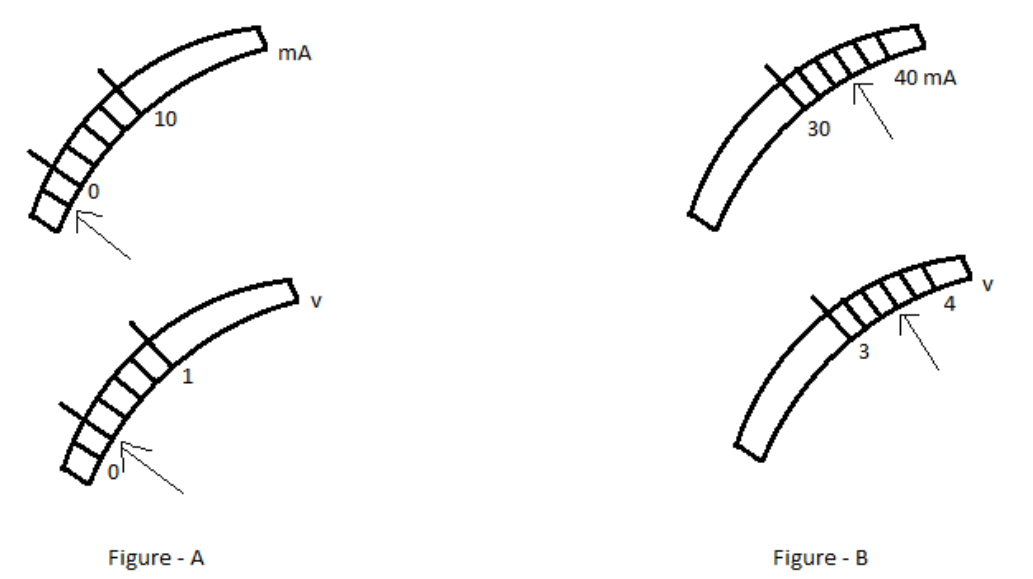
The rest positions of the needles in a milli-ammeter and voltmeter not in use are shown in the figure A. When a student uses these in his experiment, the readings of the needles are in the positions shown in figure B. What are the correct values of current and voltage in the experiment?
Answer
 Verified
604.8k+ views
Hint: In order to find the correct values of current and voltage in the experiment, we calculate the zero error of both the ammeter and the voltmeter. Then we add or subtract this value from the reading obtained from the apparatus after the experiment.
Complete Step-by-Step solution:
Here we are supposed to deduct every single piece of information from the given diagram. Hence we consider the given diagrams are drawn to scale.
First we should figure out the zero error from the initial scale and then we take down the apparent value from the final scale.
Zero error is the indication of false reading an instrument gives when the true measured value of the quantity is zero. Example: If the needle of an ammeter fails to reach the reading zero when no current passes through it. We take the value the ammeter points at, add/subtract it from the value obtained on it later.
If the zero error is positive (i.e. if this value is above zero) then we subtract it from the result obtained on the scale and if the zero error is negative we add it to the final answer.
Correct value on an apparatus is obtained by the formula,
Correct value = ±Zero correction + Apparent value.
Apparent value is the final reading obtained on the faulty scale.
Now from figure A:
The scale between zero and ten is divided into five equal parts, so each part is of the value 2mA.
The arrow points one unit below zero (hence we add it to the apparent value). Therefore the zero correction is said to be 2mA.
The apparent value obtained from the ammeter is 36mA from the figure.
Therefore the correct value is given by:
Correct value = 2 + 36 = 38mA.
Now from figure B:
The scale between zero and ten is divided into five equal parts, so each part is of the value 0.2V.
The arrow points one unit above zero (hence we subtract it from the apparent value). Therefore the zero correction is said to be 0.2V.
The apparent value obtained from the ammeter is 3.6V from the figure.
Therefore the correct value is given by:
Correct value = – 0.2 + 3.6 = 3.4V.
The correct values of current and voltage in this experiment are 38mA and 3.4V respectively.
Note – In order to answer this type of question the key is to carefully take down all the relevant data from the diagram. We count each of the readings carefully and take the input. It is important to know when to add/subtract the zero correction. We should also look if there are any criteria mentioned to which the diagram is drawn, if there’s no units mentioned we consider the diagram is drawn as per scale.
Complete Step-by-Step solution:
Here we are supposed to deduct every single piece of information from the given diagram. Hence we consider the given diagrams are drawn to scale.
First we should figure out the zero error from the initial scale and then we take down the apparent value from the final scale.
Zero error is the indication of false reading an instrument gives when the true measured value of the quantity is zero. Example: If the needle of an ammeter fails to reach the reading zero when no current passes through it. We take the value the ammeter points at, add/subtract it from the value obtained on it later.
If the zero error is positive (i.e. if this value is above zero) then we subtract it from the result obtained on the scale and if the zero error is negative we add it to the final answer.
Correct value on an apparatus is obtained by the formula,
Correct value = ±Zero correction + Apparent value.
Apparent value is the final reading obtained on the faulty scale.
Now from figure A:
The scale between zero and ten is divided into five equal parts, so each part is of the value 2mA.
The arrow points one unit below zero (hence we add it to the apparent value). Therefore the zero correction is said to be 2mA.
The apparent value obtained from the ammeter is 36mA from the figure.
Therefore the correct value is given by:
Correct value = 2 + 36 = 38mA.
Now from figure B:
The scale between zero and ten is divided into five equal parts, so each part is of the value 0.2V.
The arrow points one unit above zero (hence we subtract it from the apparent value). Therefore the zero correction is said to be 0.2V.
The apparent value obtained from the ammeter is 3.6V from the figure.
Therefore the correct value is given by:
Correct value = – 0.2 + 3.6 = 3.4V.
The correct values of current and voltage in this experiment are 38mA and 3.4V respectively.
Note – In order to answer this type of question the key is to carefully take down all the relevant data from the diagram. We count each of the readings carefully and take the input. It is important to know when to add/subtract the zero correction. We should also look if there are any criteria mentioned to which the diagram is drawn, if there’s no units mentioned we consider the diagram is drawn as per scale.
Recently Updated Pages
Master Class 10 Computer Science: Engaging Questions & Answers for Success

Master Class 10 General Knowledge: Engaging Questions & Answers for Success
Master Class 10 English: Engaging Questions & Answers for Success
Master Class 10 Social Science: Engaging Questions & Answers for Success
Master Class 10 Maths: Engaging Questions & Answers for Success
Master Class 10 Science: Engaging Questions & Answers for Success
Trending doubts
Which women's tennis player has 24 Grand Slam singles titles?
Who is the Brand Ambassador of Incredible India?
Why is there a time difference of about 5 hours between class 10 social science CBSE
Which Country is Called "The Land of Festivals"?
What type of cell is found in the Seminiferous tub class 10 biology CBSE
What are the public facilities provided by the government? Also explain each facility