




What will be the resistivity of a conductor with a current density of $2.5A{{m}^{-2}}$ if an electric field $5\times {{10}^{-8}}V{{m}^{-1}}$ is applied to it?
$\begin{align}
& A.1.0\times {{10}^{-8}}\Omega m \\
& B.2.0\times {{10}^{-8}}\Omega m \\
& C.0.5\times {{10}^{-8}}\Omega m \\
& D.12.5\times {{10}^{-8}}\Omega m \\
\end{align}$
Answer
 Verified
617.1k+ views
Hint: The current density is the ratio of the current to the area of the material. The voltage will be equivalent to the product of the current flowing and the resistance of the circuit. The voltage can be found by taking the product of the electric field and the length of the material. Substituting all these in the equation of voltage and rearranging the equation will give the correct answer.
Complete step-by-step solution
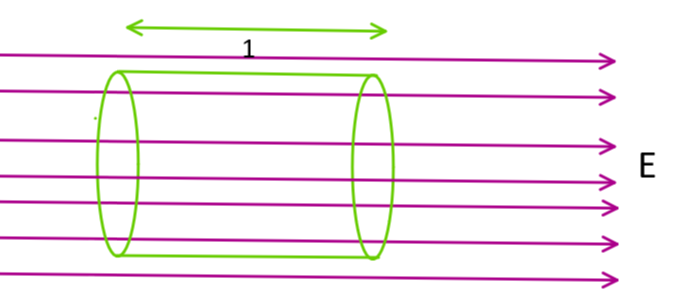
from the figure, we can write that the length will be,
$l=1$
The current density has been mentioned in the question as,
$\sigma =2.5A{{m}^{-2}}$
The current density is the ratio of the current to the area of the material. Therefore from this, the current can be found as
$i=2.5\times {{A}_{1}}$
Where ${{A}_{1}}$ be the area of the surface.
Now the voltage will be equivalent to the product of the current flowing and the resistance of the circuit. That is we can write that,
$V=iR$
And also we know that the voltage can be found by taking the product of the electric field and the length of the material. That is we can write that,
$V=El$
Comparing both these equation of voltage can be written as,
$iR=El$
Substituting the values in it will give,
$\begin{align}
& El=2.5{{A}_{1}}\times \dfrac{\rho l}{{{A}_{1}}} \\
& \Rightarrow E=2.5\rho \\
\end{align}$
The electric field has been mentioned in the question as,
$E=5\times {{10}^{-8}}V{{m}^{-1}}$
Substituting in the equation and rearranging it will give,
$\rho =\dfrac{5\times {{10}^{-8}}}{2.5}=2\times {{10}^{-8}}\Omega m$
That is the resistivity of the material has been obtained as \[2\times {{10}^{-8}}\Omega m\]. This has been given as option B.
Note: Electric field can be explained as the electric force per unit charge. The direction of the electric field can be taken to be the direction of the force it will be exerting on the test positive charge. The electric field from a positive charge will be radially outward and radially in towards a negative point charge.
Complete step-by-step solution
from the figure, we can write that the length will be,
$l=1$
The current density has been mentioned in the question as,
$\sigma =2.5A{{m}^{-2}}$
The current density is the ratio of the current to the area of the material. Therefore from this, the current can be found as
$i=2.5\times {{A}_{1}}$
Where ${{A}_{1}}$ be the area of the surface.
Now the voltage will be equivalent to the product of the current flowing and the resistance of the circuit. That is we can write that,
$V=iR$
And also we know that the voltage can be found by taking the product of the electric field and the length of the material. That is we can write that,
$V=El$
Comparing both these equation of voltage can be written as,
$iR=El$
Substituting the values in it will give,
$\begin{align}
& El=2.5{{A}_{1}}\times \dfrac{\rho l}{{{A}_{1}}} \\
& \Rightarrow E=2.5\rho \\
\end{align}$
The electric field has been mentioned in the question as,
$E=5\times {{10}^{-8}}V{{m}^{-1}}$
Substituting in the equation and rearranging it will give,
$\rho =\dfrac{5\times {{10}^{-8}}}{2.5}=2\times {{10}^{-8}}\Omega m$
That is the resistivity of the material has been obtained as \[2\times {{10}^{-8}}\Omega m\]. This has been given as option B.
Note: Electric field can be explained as the electric force per unit charge. The direction of the electric field can be taken to be the direction of the force it will be exerting on the test positive charge. The electric field from a positive charge will be radially outward and radially in towards a negative point charge.
Recently Updated Pages
Master Class 11 English: Engaging Questions & Answers for Success

Master Class 11 Physics: Engaging Questions & Answers for Success
Master Class 11 Computer Science: Engaging Questions & Answers for Success
Master Class 11 Chemistry: Engaging Questions & Answers for Success
Master Class 11 Social Science: Engaging Questions & Answers for Success
Master Class 11 Accountancy: Engaging Questions & Answers for Success
Trending doubts
Difference Between Prokaryotic Cells and Eukaryotic Cells
Two of the body parts which do not appear in MRI are class 11 biology CBSE
One Metric ton is equal to kg A 10000 B 1000 C 100 class 11 physics CBSE
10 examples of friction in our daily life
Draw a diagram of nephron and explain its structur class 11 biology CBSE
Draw a diagram of a plant cell and label at least eight class 11 biology CBSE