




The resistance of the ideal ammeter is:
(a). Zero
(b). Low
(c). High
(d). Infinit
Answer
 Verified
650.1k+ views
- Hint: An ammeter is a device which measures current.
Complete step-by-step solution -
An ammeter is a device which measures the current in an electric circuit. It is always connected in series with the circuit. Given below is an example,
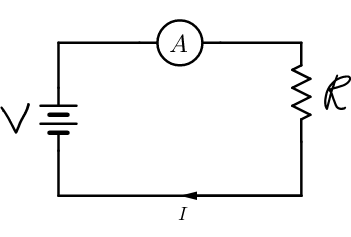
Since the ammeter is supposed to measure the current in the circuit, it should not change the current level in the circuit. So if an ammeter has infinite according to option (D), the ammeter will stop any current from passing through it. So it will act as a circuit breaker, which we do not want. If the ammeter has high resistance according to option (C), the ammeter will allow only some current to pass through it and it also causes a heating effect in the circuit which we should avoid. So if the ammeter has low resistance it allows most of the current to pass through but stops a few amperes of current from passing, so that the reading given by the ammeter will contain an error. According to option (A), if the ammeter has zero resistance, we call that ammeter as an ideal ammeter. This ideal ammeter will allow all the current to pass through it and so it can measure the actual value of current in the circuit.
So the answer to the question is option (A)-Zero.
Note: There are different types of ammeter which can measure DC current, AC current and both. Examples are Moving coil ammeter, Moving magnet ammeter, electrodynamic ammeter, digital ammeter etc….
Complete step-by-step solution -
An ammeter is a device which measures the current in an electric circuit. It is always connected in series with the circuit. Given below is an example,
Since the ammeter is supposed to measure the current in the circuit, it should not change the current level in the circuit. So if an ammeter has infinite according to option (D), the ammeter will stop any current from passing through it. So it will act as a circuit breaker, which we do not want. If the ammeter has high resistance according to option (C), the ammeter will allow only some current to pass through it and it also causes a heating effect in the circuit which we should avoid. So if the ammeter has low resistance it allows most of the current to pass through but stops a few amperes of current from passing, so that the reading given by the ammeter will contain an error. According to option (A), if the ammeter has zero resistance, we call that ammeter as an ideal ammeter. This ideal ammeter will allow all the current to pass through it and so it can measure the actual value of current in the circuit.
So the answer to the question is option (A)-Zero.
Note: There are different types of ammeter which can measure DC current, AC current and both. Examples are Moving coil ammeter, Moving magnet ammeter, electrodynamic ammeter, digital ammeter etc….
Recently Updated Pages
Master Class 12 Business Studies: Engaging Questions & Answers for Success

Master Class 12 Chemistry: Engaging Questions & Answers for Success
Master Class 12 Biology: Engaging Questions & Answers for Success
Class 12 Question and Answer - Your Ultimate Solutions Guide
Master Class 11 English: Engaging Questions & Answers for Success
Master Class 11 Social Science: Engaging Questions & Answers for Success
Trending doubts
Which are the Top 10 Largest Countries of the World?
Draw a labelled sketch of the human eye class 12 physics CBSE
The end of compass needle which points towards north class 12 physics CBSE
Differentiate between homogeneous and heterogeneous class 12 chemistry CBSE
Why is the cell called the structural and functional class 12 biology CBSE
When was the first election held in India a 194748 class 12 sst CBSE