




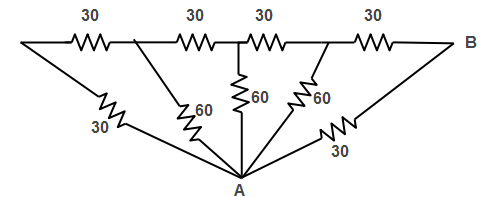
The resistance between A and B is
\[\begin{align}
& A)9\Omega \\
& B)2\Omega \\
& C)12\Omega \\
& D)8\Omega \\
\end{align}\]
\[E)20\Omega \]
Answer
 Verified
549.9k+ views
Hint: In the given circuit diagram we have to first name all resistance then identify them which are in series and which are in parallel. The resistance in which flowing current is same are defined in series and in which current gets divided and potential difference across the terminals are same is defined in parallel combination.
Complete answer:
Name all resistance as $R_1$, $R_2$, $R_3$, $R_4$, $R_5$, $R_6$, $R_7$, $R_8$, $R_9$ are respectively as shown in a figure.
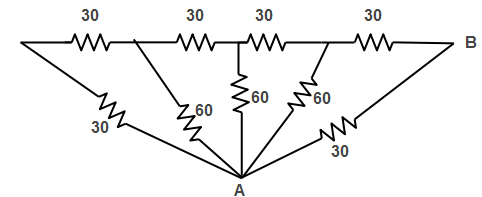
We will identify the resistance in series and parallel then we simplify them and obtain the effective resultant between A and B.
In the given Circuit firstly $R_1$ and $R_2$ are in series.
Let the resultant resistance of $R_1$ and $R_2$ is supposed to be $R_{s1}$.
So we apply the relation for series combinations of resistance.
\[{{R}_{s1}}={{R}_{1}}+{{R}_{2}}\]
\[\Rightarrow \]\[\begin{align}
& {{R}_{s1}}=30+30 \\
& {{R}_{s1}}=60\Omega \\
\end{align}\]
The effective value of $R_1$ and $R_2$ is\[60\Omega \].
Now this $R_{s1}$ and $R_3$ are in parallel Combination.
Let the resultant resistance of $R_{s1}$ and $R_3$ is supposed to be $R_{p1}$
So we apply relation for parallel combination of resistance.
\[\dfrac{1}{{{R}_{p1}}}=\dfrac{1}{{{R}_{s1}}}+\dfrac{1}{{{R}_{3}}}\]
\[\Rightarrow \]\[\dfrac{1}{{{R}_{p1}}}=\dfrac{1}{60}+\dfrac{1}{60}\]
\[\therefore \]\[{{R}_{p1}}=30\Omega \]
The effective value of $R_{s1}$ and $R_3$ is\[30\Omega \].
Now $R_{p1}$ and $R_5$ are in series combination
Let the resultant resistance of $R_{p1}$ and $R_5$ is supposed to be $R_{s2}$
so we apply a relation for series combinations of resistance.
\[{{R}_{s2}}={{R}_{p1}}+{{R}_{5}}\].
\[\Rightarrow \]\[{{R}_{s2}}=30+30\]
\[\therefore \]\[{{R}_{s2}}=60\Omega \]
The effective value of $R_{p1}$ and $R_5$ is\[60\Omega \].
Now this $R_{s2}$ is in parallel combination with $R_4$
Let their resultant is supposed to be $R_{p2}$.
\[\dfrac{1}{{{R}_{p2}}}=\dfrac{1}{{{R}_{s2}}}+\dfrac{1}{{{R}_{4}}}\]
\[\Rightarrow \]\[\dfrac{1}{{{R}_{p2}}}=\dfrac{1}{60}+\dfrac{1}{60}\]
\[\therefore \]\[{{R}_{p2}}=30\Omega \]
Now this resistance $R_{p2}$ is series with $R_7$ and
Let their net resultant is supposed to be $R_{s3}$.
\[{{R}_{s3}}={{R}_{p2}}+{{R}_{7}}\]
\[\Rightarrow \]\[{{R}_{s3}}=30+30\]
\[\therefore \]\[{{R}_{s3}}=60\Omega \]
Now this resistance $R_{s3}$ is parallel with $R_6$ and their resultant is represented by $R_{p3}$.
\[\dfrac{1}{{{R}_{p3}}}=\dfrac{1}{{{R}_{s3}}}+\dfrac{1}{{{R}_{6}}}\]
\[\Rightarrow \]\[\dfrac{1}{{{R}_{p3}}}=\dfrac{1}{60}+\dfrac{1}{60}\]
\[\therefore \]\[{{R}_{p3}}=30\Omega \]
Now $R_{p3}$ and $R_8$ are in series and their resultant is represented by\[{{R}_{s4}}\].
\[\Rightarrow \]\[\begin{align}
& {{R}_{s4}}={{R}_{p3}}+{{R}_{8}} \\
& {{R}_{s4}}=30+30 \\
& {{R}_{s4}}=60\Omega \\
\end{align}\]
Now \[{{R}_{s4}}\] and $R_9$ are in parallel combination and resultant is represented by $R_{AB}$.
\[\dfrac{1}{{{R}_{AB}}}=\dfrac{1}{{{R}_{s4}}}+\dfrac{1}{{{R}_{9}}}\]
\[\Rightarrow \]\[\dfrac{1}{{{R}_{AB}}}=\dfrac{1}{60}+\dfrac{1}{30}\]
\[\Rightarrow \]\[\dfrac{1}{{{R}_{AB}}}=\dfrac{1+2}{60}\]
\[\Rightarrow \]\[\dfrac{1}{{{R}_{AB}}}=\dfrac{3}{60}\]
\[\therefore \]\[{{R}_{AB}}=20\Omega \]
So effective resistance between A& B is \[20\Omega \].
So the correct option is E.
Note:
Current is measured in any circuit using an ammeter which is always connected in series in circuit while voltmeter is used in any circuit for measuring the potential difference which is always connected in parallel but these appliances do not measure the exact value because they are not ideal in nature.
Complete answer:
Name all resistance as $R_1$, $R_2$, $R_3$, $R_4$, $R_5$, $R_6$, $R_7$, $R_8$, $R_9$ are respectively as shown in a figure.
We will identify the resistance in series and parallel then we simplify them and obtain the effective resultant between A and B.
In the given Circuit firstly $R_1$ and $R_2$ are in series.
Let the resultant resistance of $R_1$ and $R_2$ is supposed to be $R_{s1}$.
So we apply the relation for series combinations of resistance.
\[{{R}_{s1}}={{R}_{1}}+{{R}_{2}}\]
\[\Rightarrow \]\[\begin{align}
& {{R}_{s1}}=30+30 \\
& {{R}_{s1}}=60\Omega \\
\end{align}\]
The effective value of $R_1$ and $R_2$ is\[60\Omega \].
Now this $R_{s1}$ and $R_3$ are in parallel Combination.
Let the resultant resistance of $R_{s1}$ and $R_3$ is supposed to be $R_{p1}$
So we apply relation for parallel combination of resistance.
\[\dfrac{1}{{{R}_{p1}}}=\dfrac{1}{{{R}_{s1}}}+\dfrac{1}{{{R}_{3}}}\]
\[\Rightarrow \]\[\dfrac{1}{{{R}_{p1}}}=\dfrac{1}{60}+\dfrac{1}{60}\]
\[\therefore \]\[{{R}_{p1}}=30\Omega \]
The effective value of $R_{s1}$ and $R_3$ is\[30\Omega \].
Now $R_{p1}$ and $R_5$ are in series combination
Let the resultant resistance of $R_{p1}$ and $R_5$ is supposed to be $R_{s2}$
so we apply a relation for series combinations of resistance.
\[{{R}_{s2}}={{R}_{p1}}+{{R}_{5}}\].
\[\Rightarrow \]\[{{R}_{s2}}=30+30\]
\[\therefore \]\[{{R}_{s2}}=60\Omega \]
The effective value of $R_{p1}$ and $R_5$ is\[60\Omega \].
Now this $R_{s2}$ is in parallel combination with $R_4$
Let their resultant is supposed to be $R_{p2}$.
\[\dfrac{1}{{{R}_{p2}}}=\dfrac{1}{{{R}_{s2}}}+\dfrac{1}{{{R}_{4}}}\]
\[\Rightarrow \]\[\dfrac{1}{{{R}_{p2}}}=\dfrac{1}{60}+\dfrac{1}{60}\]
\[\therefore \]\[{{R}_{p2}}=30\Omega \]
Now this resistance $R_{p2}$ is series with $R_7$ and
Let their net resultant is supposed to be $R_{s3}$.
\[{{R}_{s3}}={{R}_{p2}}+{{R}_{7}}\]
\[\Rightarrow \]\[{{R}_{s3}}=30+30\]
\[\therefore \]\[{{R}_{s3}}=60\Omega \]
Now this resistance $R_{s3}$ is parallel with $R_6$ and their resultant is represented by $R_{p3}$.
\[\dfrac{1}{{{R}_{p3}}}=\dfrac{1}{{{R}_{s3}}}+\dfrac{1}{{{R}_{6}}}\]
\[\Rightarrow \]\[\dfrac{1}{{{R}_{p3}}}=\dfrac{1}{60}+\dfrac{1}{60}\]
\[\therefore \]\[{{R}_{p3}}=30\Omega \]
Now $R_{p3}$ and $R_8$ are in series and their resultant is represented by\[{{R}_{s4}}\].
\[\Rightarrow \]\[\begin{align}
& {{R}_{s4}}={{R}_{p3}}+{{R}_{8}} \\
& {{R}_{s4}}=30+30 \\
& {{R}_{s4}}=60\Omega \\
\end{align}\]
Now \[{{R}_{s4}}\] and $R_9$ are in parallel combination and resultant is represented by $R_{AB}$.
\[\dfrac{1}{{{R}_{AB}}}=\dfrac{1}{{{R}_{s4}}}+\dfrac{1}{{{R}_{9}}}\]
\[\Rightarrow \]\[\dfrac{1}{{{R}_{AB}}}=\dfrac{1}{60}+\dfrac{1}{30}\]
\[\Rightarrow \]\[\dfrac{1}{{{R}_{AB}}}=\dfrac{1+2}{60}\]
\[\Rightarrow \]\[\dfrac{1}{{{R}_{AB}}}=\dfrac{3}{60}\]
\[\therefore \]\[{{R}_{AB}}=20\Omega \]
So effective resistance between A& B is \[20\Omega \].
So the correct option is E.
Note:
Current is measured in any circuit using an ammeter which is always connected in series in circuit while voltmeter is used in any circuit for measuring the potential difference which is always connected in parallel but these appliances do not measure the exact value because they are not ideal in nature.
Recently Updated Pages
Master Class 11 Social Science: Engaging Questions & Answers for Success

Master Class 11 Physics: Engaging Questions & Answers for Success
Master Class 11 Maths: Engaging Questions & Answers for Success
Master Class 11 Economics: Engaging Questions & Answers for Success
Master Class 11 Computer Science: Engaging Questions & Answers for Success
Master Class 11 Chemistry: Engaging Questions & Answers for Success
Trending doubts
One Metric ton is equal to kg A 10000 B 1000 C 100 class 11 physics CBSE
There are 720 permutations of the digits 1 2 3 4 5 class 11 maths CBSE
1 Quintal is equal to a 110 kg b 10 kg c 100kg d 1000 class 11 physics CBSE
State and prove Bernoullis theorem class 11 physics CBSE
Difference Between Prokaryotic Cells and Eukaryotic Cells
Which among the following are examples of coming together class 11 social science CBSE