




The relation between the potential difference (V) and the current (I) was discovered by
A. Newton
B. Ampere
C. Ohm
D. Volt
Answer
 Verified
647.4k+ views
Hint: The iconic law which is very familiar with us which gives the relation between the potential energy (V) and the current (I), it can be also written as
$V = IR$
Complete step by step answer:
The relation between the potential energy (V) and the current (I)
$V = IR$
Here V = It represents the Voltage applied
I = It gives the value of the current flowing in the conductor
R = It is the value of the resistance
And we all know that this relation was given by the Famous scientist Ohms
Or we can say the relationship between the potential energy (V) and the current (I) was given by the famous scientist Ohm and this law is known as Ohm's law
Ohm's Law state that the potential difference (voltage) across an ideal conductor is proportional to the current through it
Numerically it can be written as
$V = IR$
A linear VI curve has the constant slope and hence a constant resistance.
Constant resistance and the metals obey the Ohm's law and have a constant resistance this means that the V-I curve has a straight line passing through the origin.
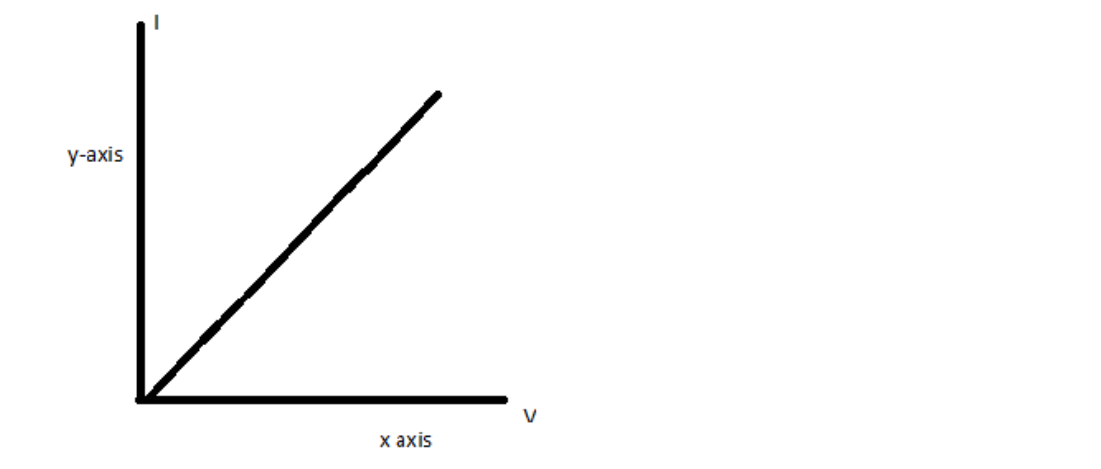
Therefore the correct option is C.
Note: In the home we use the copper material for the wire because It has less resistance when compared with the other material. One thing we have to know is that silver is better than the copper wire because it has a lower resistivity than that of the copper we use in our home. As silver is more expensive than the copper that’s why it is not used in our home.
$V = IR$
Complete step by step answer:
The relation between the potential energy (V) and the current (I)
$V = IR$
Here V = It represents the Voltage applied
I = It gives the value of the current flowing in the conductor
R = It is the value of the resistance
And we all know that this relation was given by the Famous scientist Ohms
Or we can say the relationship between the potential energy (V) and the current (I) was given by the famous scientist Ohm and this law is known as Ohm's law
Ohm's Law state that the potential difference (voltage) across an ideal conductor is proportional to the current through it
Numerically it can be written as
$V = IR$
A linear VI curve has the constant slope and hence a constant resistance.
Constant resistance and the metals obey the Ohm's law and have a constant resistance this means that the V-I curve has a straight line passing through the origin.
Therefore the correct option is C.
Note: In the home we use the copper material for the wire because It has less resistance when compared with the other material. One thing we have to know is that silver is better than the copper wire because it has a lower resistivity than that of the copper we use in our home. As silver is more expensive than the copper that’s why it is not used in our home.
Recently Updated Pages
Class 10 Question and Answer - Your Ultimate Solutions Guide

Master Class 12 Economics: Engaging Questions & Answers for Success
Master Class 12 Social Science: Engaging Questions & Answers for Success
Master Class 12 English: Engaging Questions & Answers for Success
Master Class 12 Maths: Engaging Questions & Answers for Success
Master Class 12 Physics: Engaging Questions & Answers for Success
Trending doubts
Explain the Treaty of Vienna of 1815 class 10 social science CBSE
The slogan Jai Hind was given by A Lal Bahadur Shastri class 10 social science CBSE
10 examples of evaporation in daily life with explanations
What is the full form of POSCO class 10 social science CBSE
Identify the feminine form of noun nephew a shenephew class 10 english CBSE
CSIR full form?