




The relation between the polarizing angle and the critical angle is
$A. { i }_{ p }=\tan ^{ -1 }{{ \left( \csc { { \theta }_{ c } } \right) }}$
$B. { i }_{ p }=\tan ^{ -1 }{{ \left( \sin { { \theta }_{ c } } \right) }}$
$C. { i }_{ p }=\cot ^{ -1 }{ { \left( \sin { { \theta }_{ c } } \right) } }$
$D. { i }_{ p }=\cot ^{ -1 }{ { \left( \csc { { \theta }_{ c } } \right) } }$
Answer
 Verified
584.9k+ views
Hint: Polarizing angle is defined as an angle of incidence at which light with a particular polarization is perfectly transmitted through a transparent dielectric surface. In optics, the smallest angle of incidence that causes total internal reflection of light is known as Critical angle. Now, use the formula for polarizing angle in terms of critical angle. Rearrange the equation and using trigonometric function find the relation between polarizing angle and critical angle.
Formula used:
$\tan { \left( { i }_{ p } \right) } = \dfrac { 1 }{ \sin { \left( { \theta }_{ c } \right) } }$
Complete solution step-by-step:
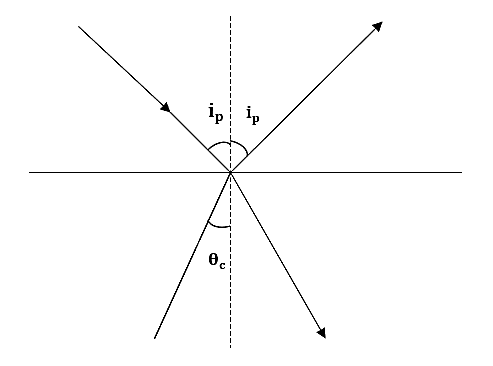
Let the polarizing angle be ${i}_{p}$
The critical angle be ${ \theta }_{ c }$
The relation between critical angle and polarizing angle is given by,
$\tan { \left( { i }_{ p } \right) } = \dfrac { 1 }{ \sin { \left( { \theta }_{ c } \right) } }$ …(1)
We know,
$\csc { { \theta }_{ c } } = \dfrac { 1 }{ \sin { \left( { \theta }_{ c } \right) } }$ …(2)
Substituting equation. (2) in equation. (1) we get,
$\tan { \left( { i }_{ p } \right) } =\csc { { \theta }_{ c } }$
Rearranging the above equation we get,
${ i }_{ p }=\tan ^{ -1 }{{ \left( \csc { { \theta }_{ c } } \right) }}$
Thus, the relation between the polarizing angle and the critical angle is
${ i }_{ p }=\tan ^{ -1 }{{ \left( \csc { { \theta }_{ c } } \right) }}$.
So, the correct answer is option A i.e. ${ i }_{ p }=\tan ^{ -1 }{{ \left( \csc { { \theta }_{ c } } \right) }}$.
Note:
Students must remember that the polarizing angle is also known as Brewster’s angle. When the light strikes at Brewster’s angle, the reflected ray and the refracted ray will be perpendicular to each other and the reflected ray will be linearly polarized. The incident ray will not be polarized. It is temporarily absorbed by the medium. Polarized sunglasses use the principle of Brewster’s angle to reduce the glare from the sun reflecting off horizontal surfaces such as water on the road.
Formula used:
$\tan { \left( { i }_{ p } \right) } = \dfrac { 1 }{ \sin { \left( { \theta }_{ c } \right) } }$
Complete solution step-by-step:
Let the polarizing angle be ${i}_{p}$
The critical angle be ${ \theta }_{ c }$
The relation between critical angle and polarizing angle is given by,
$\tan { \left( { i }_{ p } \right) } = \dfrac { 1 }{ \sin { \left( { \theta }_{ c } \right) } }$ …(1)
We know,
$\csc { { \theta }_{ c } } = \dfrac { 1 }{ \sin { \left( { \theta }_{ c } \right) } }$ …(2)
Substituting equation. (2) in equation. (1) we get,
$\tan { \left( { i }_{ p } \right) } =\csc { { \theta }_{ c } }$
Rearranging the above equation we get,
${ i }_{ p }=\tan ^{ -1 }{{ \left( \csc { { \theta }_{ c } } \right) }}$
Thus, the relation between the polarizing angle and the critical angle is
${ i }_{ p }=\tan ^{ -1 }{{ \left( \csc { { \theta }_{ c } } \right) }}$.
So, the correct answer is option A i.e. ${ i }_{ p }=\tan ^{ -1 }{{ \left( \csc { { \theta }_{ c } } \right) }}$.
Note:
Students must remember that the polarizing angle is also known as Brewster’s angle. When the light strikes at Brewster’s angle, the reflected ray and the refracted ray will be perpendicular to each other and the reflected ray will be linearly polarized. The incident ray will not be polarized. It is temporarily absorbed by the medium. Polarized sunglasses use the principle of Brewster’s angle to reduce the glare from the sun reflecting off horizontal surfaces such as water on the road.
Recently Updated Pages
Explain the structure of megasporangium class 12 biology CBSE

Why is chloroform kept in dark coloured bottles class 12 chemistry CBSE
Derive the balancing condition of a Wheatstone bri class 12 physics CBSE
Draw VI characteristics of a pn junction diode Explain class 12 physics CBSE
Is it possible to carry pride in ones language too class 12 english CBSE
In a population at Hardy Weinberg equilibrium the allele class 12 biology CBSE
Trending doubts
Draw a labelled sketch of the human eye class 12 physics CBSE
Which are the Top 10 Largest Countries of the World?
Draw ray diagrams each showing i myopic eye and ii class 12 physics CBSE
Which is the correct genotypic ratio of mendel dihybrid class 12 biology CBSE
Differentiate between homogeneous and heterogeneous class 12 chemistry CBSE
Which animal never drinks water in its entire life class 12 biology CBSE