




The reflection of the $x = 1$ in the line $x + y = 1$ is
A. $x = 0$
B. $x + y = - 1$
C. $x - y = - 1$
D. $y = 0$
Answer
 Verified
600.6k+ views
Hint:
Firstly, we shall draw a perpendicular on the line $x + y = 1$. Determine an arbitrary P point on the line $x = 1$ on a point Q on the perpendicular. Now the point R at which the perpendicular intersects the line $x + y = 1$ shall be the midpoint of line segment PQ. Now, assume the coordinates of the points P and R from the given information. Using these, find the coordinates of point Q. Use the condition of orthogonal lines and property of midpoint to evaluate the coordinates of point Q. Then you shall find your answer.
Complete step by step solution:
Firstly, construct a perpendicular PQ of the line $x + y = 1$ , such that point P is at the intersection of lines $x + y = 1$ and $x = 1$ . Also, Q $({x_1},{y_1})$ be an arbitrary point on PQ.
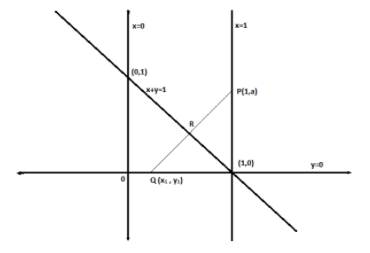
According to Question the point P lies on $x = 1$. So, let’s assume the arbitrary coordinates of P be $(1,a)$
Also, since we need to find reflection of the line we must find the image of the P $(1,a)$ .
Let’s assume the image of P be Q $({x_1},{y_1})$. Also, the point of intersection of the PQ and the line $x + y = 1$ be R. Since Q is the image of P, this means that R is the midpoint of PQ. Since R lies on the $x + y = 1$, the coordinates of general point R are given by $(x,1 - x)$
Now, let’s find the Direction Ratios of the perpendicular line segment PR.
Direction Ratios of PR are given by $(x - 1,1 - x - a)$
Direction Ratios of $x + y = 1$ are given by $(1, - 1)$
Now, Since PR is perpendicular to $x + y = 1$ the dot product of their Direction Ratios is 0
$
1.(x - 1) - 1(1 - x - a) = 0 \\
\Rightarrow 2x - 2 + a = 0 \\
\Rightarrow x = 1 - \dfrac{a}{2} \\
$
There the coordinates of R are $(x,1 - x) \Rightarrow (1 - \dfrac{a}{2},\dfrac{a}{2})$
Now, we have already established that R is the midpoint of PQ, So, the coordinates of point Q $({x_1},{y_1})$ are given by
$\dfrac{{{x_1} + 1}}{2} = 1 - \dfrac{a}{2}$ and $\dfrac{{{y_1} + a}}{2} = \dfrac{a}{2}$
${x_1} = 1 - a$ and ${y_1} = 0$
As point P is arbitrary hence ${x_1}$ is also arbitrary. This means Q can be any point in the form of $(x,0)$ which represents x-axis. The equation for x-axis is $y = 0$ .
Hence, the correct option is D.
Note:
The important thing to remember is that the distance of the image and the object from the mirror is always equal. Visualizations and rough sketches are necessary while attempting such types of questions.
Firstly, we shall draw a perpendicular on the line $x + y = 1$. Determine an arbitrary P point on the line $x = 1$ on a point Q on the perpendicular. Now the point R at which the perpendicular intersects the line $x + y = 1$ shall be the midpoint of line segment PQ. Now, assume the coordinates of the points P and R from the given information. Using these, find the coordinates of point Q. Use the condition of orthogonal lines and property of midpoint to evaluate the coordinates of point Q. Then you shall find your answer.
Complete step by step solution:
Firstly, construct a perpendicular PQ of the line $x + y = 1$ , such that point P is at the intersection of lines $x + y = 1$ and $x = 1$ . Also, Q $({x_1},{y_1})$ be an arbitrary point on PQ.
According to Question the point P lies on $x = 1$. So, let’s assume the arbitrary coordinates of P be $(1,a)$
Also, since we need to find reflection of the line we must find the image of the P $(1,a)$ .
Let’s assume the image of P be Q $({x_1},{y_1})$. Also, the point of intersection of the PQ and the line $x + y = 1$ be R. Since Q is the image of P, this means that R is the midpoint of PQ. Since R lies on the $x + y = 1$, the coordinates of general point R are given by $(x,1 - x)$
Now, let’s find the Direction Ratios of the perpendicular line segment PR.
Direction Ratios of PR are given by $(x - 1,1 - x - a)$
Direction Ratios of $x + y = 1$ are given by $(1, - 1)$
Now, Since PR is perpendicular to $x + y = 1$ the dot product of their Direction Ratios is 0
$
1.(x - 1) - 1(1 - x - a) = 0 \\
\Rightarrow 2x - 2 + a = 0 \\
\Rightarrow x = 1 - \dfrac{a}{2} \\
$
There the coordinates of R are $(x,1 - x) \Rightarrow (1 - \dfrac{a}{2},\dfrac{a}{2})$
Now, we have already established that R is the midpoint of PQ, So, the coordinates of point Q $({x_1},{y_1})$ are given by
$\dfrac{{{x_1} + 1}}{2} = 1 - \dfrac{a}{2}$ and $\dfrac{{{y_1} + a}}{2} = \dfrac{a}{2}$
${x_1} = 1 - a$ and ${y_1} = 0$
As point P is arbitrary hence ${x_1}$ is also arbitrary. This means Q can be any point in the form of $(x,0)$ which represents x-axis. The equation for x-axis is $y = 0$ .
Hence, the correct option is D.
Note:
The important thing to remember is that the distance of the image and the object from the mirror is always equal. Visualizations and rough sketches are necessary while attempting such types of questions.
Recently Updated Pages
Master Class 11 Social Science: Engaging Questions & Answers for Success

Master Class 11 Physics: Engaging Questions & Answers for Success
Master Class 11 Maths: Engaging Questions & Answers for Success
Master Class 11 Economics: Engaging Questions & Answers for Success
Master Class 11 Computer Science: Engaging Questions & Answers for Success
Master Class 11 Chemistry: Engaging Questions & Answers for Success
Trending doubts
One Metric ton is equal to kg A 10000 B 1000 C 100 class 11 physics CBSE
There are 720 permutations of the digits 1 2 3 4 5 class 11 maths CBSE
1 Quintal is equal to a 110 kg b 10 kg c 100kg d 1000 class 11 physics CBSE
State and prove Bernoullis theorem class 11 physics CBSE
Difference Between Prokaryotic Cells and Eukaryotic Cells
Discuss the various forms of bacteria class 11 biology CBSE