




The reflection of the point $P\left( 1,0,0 \right)$ in the line $\dfrac{x-1}{2}=\dfrac{y+1}{-3}=\dfrac{z+10}{8}$ is
(a) $\left( 3,-4,-2 \right)$
(b) $\left( 5,-8,-4 \right)$
(c) $\left( 1,-1,-10 \right)$
(d) $\left( 2,-3,8 \right)$
Answer
 Verified
640.2k+ views
Hint: We start solving the problem by finding the D.R’s of the line $\dfrac{x-1}{2}=\dfrac{y+1}{-3}=\dfrac{z+10}{8}$ using the fact that the D.R’s (Direction Ratios) of the line of the form $\dfrac{x-a}{d}=\dfrac{y-b}{e}=\dfrac{z-c}{f}$ is $\left( d,e,f \right)$. We then find the general form of the point that lies on the given line $\dfrac{x-1}{2}=\dfrac{y+1}{-3}=\dfrac{z+10}{8}$ by equating it to a constant. We then find the D.R’s of the line passing through point P and with foot of perpendicular on the given line. We then use the fact that if two lines with D.R’s $\left( {{x}_{1}},{{y}_{1}},{{z}_{1}} \right)$ and $\left( {{x}_{2}},{{y}_{2}},{{z}_{2}} \right)$ are perpendicular to each other, then ${{x}_{1}}{{x}_{2}}+{{y}_{1}}{{y}_{2}}+{{z}_{1}}{{z}_{2}}=0$ to find point Q. We then find the point of reflection by using the fact that Q is the mid-point of P and its reflection.
Complete step by step answer:
According to the problem, we are asked to find the reflection of the point $P\left( 1,0,0 \right)$ in the line $\dfrac{x-1}{2}=\dfrac{y+1}{-3}=\dfrac{z+10}{8}$.
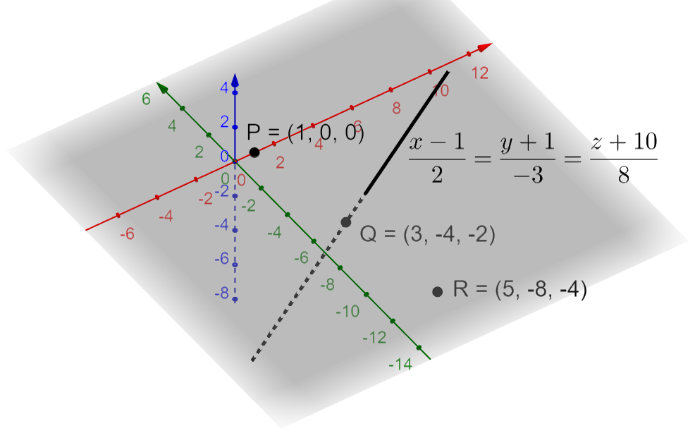
We know that the D.R’s (Direction Ratios) of the line of the form $\dfrac{x-a}{d}=\dfrac{y-b}{e}=\dfrac{z-c}{f}$ is $\left( d,e,f \right)$.
So, the D.R’s of the line $\dfrac{x-1}{2}=\dfrac{y+1}{-3}=\dfrac{z+10}{8}$ is $\left( 2,-3,8 \right)$ ---(1).
Now, let us find the common form of the points that were present on the line $\dfrac{x-1}{2}=\dfrac{y+1}{-3}=\dfrac{z+10}{8}$.
So, let us assume $\dfrac{x-1}{2}=\dfrac{y+1}{-3}=\dfrac{z+10}{8}=r$.
$\Rightarrow \dfrac{x-1}{2}=r$, $\dfrac{y+1}{-3}=r$, $\dfrac{z+10}{8}=r$.
$\Rightarrow x-1=2r$, $y+1=-3r$, $z+10=8r$.
$\Rightarrow x=1+2r$, $y=-1-3r$, $z=-10+8r$.
So, the general form of the points which lies on the line $\dfrac{x-1}{2}=\dfrac{y+1}{-3}=\dfrac{z+10}{8}$ is $\left( 1+2r,-1-3r,-10+8r \right)$.
So, let us assume the point $Q\left( 1+2r,-1-3r,-10+8r \right)$ which lies on the line $\dfrac{x-1}{2}=\dfrac{y+1}{-3}=\dfrac{z+10}{8}$ and perpendicular to the line passing through the points P and Q, where Q is the foot of perpendicular the line joining PQ on the line $\dfrac{x-1}{2}=\dfrac{y+1}{-3}=\dfrac{z+10}{8}$.
We know that the D.R’s of the line passing through $\left( {{x}_{1}},{{y}_{1}},{{z}_{1}} \right)$ and $\left( {{x}_{2}},{{y}_{2}},{{z}_{2}} \right)$ is $\left( {{x}_{2}}-{{x}_{1}},{{y}_{2}}-{{y}_{1}},{{z}_{2}}-{{z}_{1}} \right)$.
So, we get the D.R’s of line PQ as $\left( 1+2r-1,-1-3r-0,-10+8r-0 \right)=\left( 2r,-1-3r,-10+8r \right)$.
So, the D.R’s of the line PQ is $\left( 2r,-1-3r,-10+8r \right)$ ---(2).
So, we have line PQ perpendicular to $\dfrac{x-1}{2}=\dfrac{y+1}{-3}=\dfrac{z+10}{8}$.
We know that if two lines with D.R’s $\left( {{x}_{1}},{{y}_{1}},{{z}_{1}} \right)$ and $\left( {{x}_{2}},{{y}_{2}},{{z}_{2}} \right)$ are perpendicular to each other, then ${{x}_{1}}{{x}_{2}}+{{y}_{1}}{{y}_{2}}+{{z}_{1}}{{z}_{2}}=0$.
So, we have \[\left( 2r\times 2 \right)+\left( \left( -1-3r \right)\times -3 \right)+\left( \left( -10+8r \right)\times 8 \right)=0\].
$\Rightarrow 4r+3+9r-80+64r=0$.
$\Rightarrow 77r-77=0$.
$\Rightarrow 77r=77$.
$\Rightarrow r=1$. Let us use this to find point Q.
So, we get point Q as $Q\left( 1+2\left( 1 \right),-1-3\left( 1 \right),-10+8\left( 1 \right) \right)=Q\left( 1+2,-1-3,-10+8 \right)=Q\left( 3,-4,-2 \right)$.
Now, let us assume the reflection of point P be $R\left( {{a}_{1}},{{b}_{1}},{{c}_{1}} \right)$. We know that the point Q is midpoint of the line PR.
So, we have $\left( 3,-4,-2 \right)=\left( \dfrac{1+{{a}_{1}}}{2},\dfrac{0+{{b}_{1}}}{2},\dfrac{0+{{c}_{1}}}{2} \right)$.
$\Rightarrow \left( 3,-4,-2 \right)=\left( \dfrac{1+{{a}_{1}}}{2},\dfrac{{{b}_{1}}}{2},\dfrac{{{c}_{1}}}{2} \right)$.
$\Rightarrow \dfrac{1+{{a}_{1}}}{2}=3$, $\dfrac{{{b}_{1}}}{2}=-4$, $\dfrac{{{c}_{1}}}{2}=-2$.
$\Rightarrow 1+{{a}_{1}}=6$, ${{b}_{1}}=-8$, ${{c}_{1}}=-4$.
$\Rightarrow {{a}_{1}}=5$, ${{b}_{1}}=-8$, ${{c}_{1}}=-4$.
So, we have found the reflection of point P as $\left( 5,-8,-4 \right)$.
So, the correct answer is “Option b”.
Note: We can see that the given problem contains a huge amount of calculation so, we need to perform each step carefully to avoid mistakes and confusion. Whenever we get this type of problem, we first start with finding D.R’s and general form of the point on the line to proceed into the problem. We should know that the line passing through the point P should be perpendicular in order to find the reflection. Similarly, we can expect problems to find the equation of the line passing through P and R.
Complete step by step answer:
According to the problem, we are asked to find the reflection of the point $P\left( 1,0,0 \right)$ in the line $\dfrac{x-1}{2}=\dfrac{y+1}{-3}=\dfrac{z+10}{8}$.
We know that the D.R’s (Direction Ratios) of the line of the form $\dfrac{x-a}{d}=\dfrac{y-b}{e}=\dfrac{z-c}{f}$ is $\left( d,e,f \right)$.
So, the D.R’s of the line $\dfrac{x-1}{2}=\dfrac{y+1}{-3}=\dfrac{z+10}{8}$ is $\left( 2,-3,8 \right)$ ---(1).
Now, let us find the common form of the points that were present on the line $\dfrac{x-1}{2}=\dfrac{y+1}{-3}=\dfrac{z+10}{8}$.
So, let us assume $\dfrac{x-1}{2}=\dfrac{y+1}{-3}=\dfrac{z+10}{8}=r$.
$\Rightarrow \dfrac{x-1}{2}=r$, $\dfrac{y+1}{-3}=r$, $\dfrac{z+10}{8}=r$.
$\Rightarrow x-1=2r$, $y+1=-3r$, $z+10=8r$.
$\Rightarrow x=1+2r$, $y=-1-3r$, $z=-10+8r$.
So, the general form of the points which lies on the line $\dfrac{x-1}{2}=\dfrac{y+1}{-3}=\dfrac{z+10}{8}$ is $\left( 1+2r,-1-3r,-10+8r \right)$.
So, let us assume the point $Q\left( 1+2r,-1-3r,-10+8r \right)$ which lies on the line $\dfrac{x-1}{2}=\dfrac{y+1}{-3}=\dfrac{z+10}{8}$ and perpendicular to the line passing through the points P and Q, where Q is the foot of perpendicular the line joining PQ on the line $\dfrac{x-1}{2}=\dfrac{y+1}{-3}=\dfrac{z+10}{8}$.
We know that the D.R’s of the line passing through $\left( {{x}_{1}},{{y}_{1}},{{z}_{1}} \right)$ and $\left( {{x}_{2}},{{y}_{2}},{{z}_{2}} \right)$ is $\left( {{x}_{2}}-{{x}_{1}},{{y}_{2}}-{{y}_{1}},{{z}_{2}}-{{z}_{1}} \right)$.
So, we get the D.R’s of line PQ as $\left( 1+2r-1,-1-3r-0,-10+8r-0 \right)=\left( 2r,-1-3r,-10+8r \right)$.
So, the D.R’s of the line PQ is $\left( 2r,-1-3r,-10+8r \right)$ ---(2).
So, we have line PQ perpendicular to $\dfrac{x-1}{2}=\dfrac{y+1}{-3}=\dfrac{z+10}{8}$.
We know that if two lines with D.R’s $\left( {{x}_{1}},{{y}_{1}},{{z}_{1}} \right)$ and $\left( {{x}_{2}},{{y}_{2}},{{z}_{2}} \right)$ are perpendicular to each other, then ${{x}_{1}}{{x}_{2}}+{{y}_{1}}{{y}_{2}}+{{z}_{1}}{{z}_{2}}=0$.
So, we have \[\left( 2r\times 2 \right)+\left( \left( -1-3r \right)\times -3 \right)+\left( \left( -10+8r \right)\times 8 \right)=0\].
$\Rightarrow 4r+3+9r-80+64r=0$.
$\Rightarrow 77r-77=0$.
$\Rightarrow 77r=77$.
$\Rightarrow r=1$. Let us use this to find point Q.
So, we get point Q as $Q\left( 1+2\left( 1 \right),-1-3\left( 1 \right),-10+8\left( 1 \right) \right)=Q\left( 1+2,-1-3,-10+8 \right)=Q\left( 3,-4,-2 \right)$.
Now, let us assume the reflection of point P be $R\left( {{a}_{1}},{{b}_{1}},{{c}_{1}} \right)$. We know that the point Q is midpoint of the line PR.
So, we have $\left( 3,-4,-2 \right)=\left( \dfrac{1+{{a}_{1}}}{2},\dfrac{0+{{b}_{1}}}{2},\dfrac{0+{{c}_{1}}}{2} \right)$.
$\Rightarrow \left( 3,-4,-2 \right)=\left( \dfrac{1+{{a}_{1}}}{2},\dfrac{{{b}_{1}}}{2},\dfrac{{{c}_{1}}}{2} \right)$.
$\Rightarrow \dfrac{1+{{a}_{1}}}{2}=3$, $\dfrac{{{b}_{1}}}{2}=-4$, $\dfrac{{{c}_{1}}}{2}=-2$.
$\Rightarrow 1+{{a}_{1}}=6$, ${{b}_{1}}=-8$, ${{c}_{1}}=-4$.
$\Rightarrow {{a}_{1}}=5$, ${{b}_{1}}=-8$, ${{c}_{1}}=-4$.
So, we have found the reflection of point P as $\left( 5,-8,-4 \right)$.
So, the correct answer is “Option b”.
Note: We can see that the given problem contains a huge amount of calculation so, we need to perform each step carefully to avoid mistakes and confusion. Whenever we get this type of problem, we first start with finding D.R’s and general form of the point on the line to proceed into the problem. We should know that the line passing through the point P should be perpendicular in order to find the reflection. Similarly, we can expect problems to find the equation of the line passing through P and R.
Recently Updated Pages
Which of the following graphs shows the variation of class 12 physics CBSE

Draw a labelled diagram of the human male reproductive class 12 biology CBSE
Describe the experiment to compare the emf of two cells class 12 physics CBSE
What is standard hydrogen electrode
What is conventional current and electric current class 12 physics CBSE
2Bromopentane is treated with an alcoholic KOH solution class 12 chemistry CBSE
Trending doubts
A member of Simon commission later became Prime Minister class 12 social science CBSE
What is the Full Form of PVC, PET, HDPE, LDPE, PP and PS ?
Differentiate between internal fertilization and external class 12 biology CBSE
Differentiate between lanthanoids and actinoids class 12 chemistry CBSE
Sketch and label the Malpighian body class 12 biology CBSE
State the principle of an ac generator and explain class 12 physics CBSE