




The real expansion of a liquid is equal to the sum of its apparent expansion and the volume expansion of the vessel containing the liquid. Type1 for true and 0 for false.
Answer
 Verified
647.4k+ views
Hint: In this question use the basic concepts of real and apparent expansion of liquid contained in a vessel. When the vessel is heated the volume of the vessel also changes. Use them along with the fact that the apparent expansion of liquid is always less than the actual expansion of the liquid. This will help getting the answer.
Complete Step-by-Step solution:
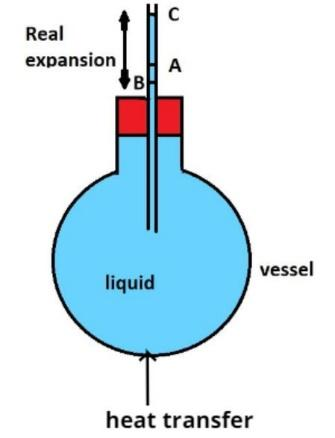
When we heated the liquid in the container first heat flows through the container so the volume of the container expands so that there is a significant fall in the level of water but as soon as the heat is transferred from the container to the liquid the liquid gets heated and the level of the liquid starts rising. We cannot observe the intermediate state. We can only observe the initial and final levels. This observed expansion of the liquid is known as the apparent expansion of the liquid and is less than its actual expansion.
Let us suppose that initially the level of the liquid is at A point then it drops to point B this is called as volume expansion of the vessel containing the liquid and finally it will settle to point C from point A to C it is called as apparent expansion of the liquid as shown in the figure.
So the real expansion of the liquid is always greater than the apparent expansion of the liquid.
So the real expansion of the liquid = volume expansion of the vessel containing the liquid + apparent expansion of the liquid.
So the given statement is true.
Note – The key point is that when a vessel is heated it eventually takes some time for the liquid to get heated up as in the first instant it’s the vessel that heats up. The walls of vessels expand due to the property of the material of the vessel. If it’s being made up of a substance that is rigid then there are chances of the vessel developing cracks upon heating.
Complete Step-by-Step solution:
When we heated the liquid in the container first heat flows through the container so the volume of the container expands so that there is a significant fall in the level of water but as soon as the heat is transferred from the container to the liquid the liquid gets heated and the level of the liquid starts rising. We cannot observe the intermediate state. We can only observe the initial and final levels. This observed expansion of the liquid is known as the apparent expansion of the liquid and is less than its actual expansion.
Let us suppose that initially the level of the liquid is at A point then it drops to point B this is called as volume expansion of the vessel containing the liquid and finally it will settle to point C from point A to C it is called as apparent expansion of the liquid as shown in the figure.
So the real expansion of the liquid is always greater than the apparent expansion of the liquid.
So the real expansion of the liquid = volume expansion of the vessel containing the liquid + apparent expansion of the liquid.
So the given statement is true.
Note – The key point is that when a vessel is heated it eventually takes some time for the liquid to get heated up as in the first instant it’s the vessel that heats up. The walls of vessels expand due to the property of the material of the vessel. If it’s being made up of a substance that is rigid then there are chances of the vessel developing cracks upon heating.
Recently Updated Pages
Master Class 11 English: Engaging Questions & Answers for Success

Master Class 11 Social Science: Engaging Questions & Answers for Success
Master Class 11 Maths: Engaging Questions & Answers for Success
Master Class 11 Biology: Engaging Questions & Answers for Success
Master Class 11 Physics: Engaging Questions & Answers for Success
Master Class 11 Chemistry: Engaging Questions & Answers for Success
Trending doubts
Explain the Treaty of Vienna of 1815 class 10 social science CBSE
What is the full form of POSCO class 10 social science CBSE
Define Potential, Developed, Stock and Reserved resources
Why is Venus called Earths sister planet class 10 physics CBSE
10 examples of evaporation in daily life with explanations
Identify the plural form of the word child from the class 10 english CBSE