




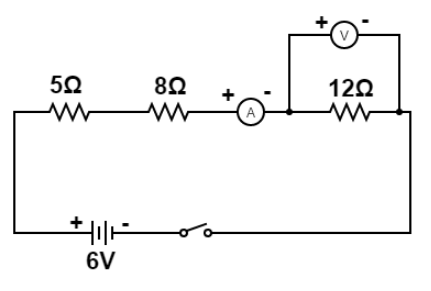
What would be the readings in ammeter and voltmeter when the key is closed?
Answer
 Verified
534k+ views
Hint: In order to solve this question, we need to understand ammeter and voltmeter. Ammeter is an electrical device which is used to measure currents up to microampere in circuit. In an ideal ammeter, a very low resistance is connected in parallel so that it can measure up to maximum current. Voltmeter is an electrical device that is used to measure voltage in a circuit. In an ideal voltmeter, a very high resistance is connected in series.An ammeter is always connected in series in circuit to measure maximum current and voltmeter is always connected in parallel to circuit so that it can measure voltage accurately.
Complete step by step answer:
For Ammeter reading we need to find current in the circuit, which can be found using Kirchhoff’s voltage law, which states that voltage across the loop must be zero.
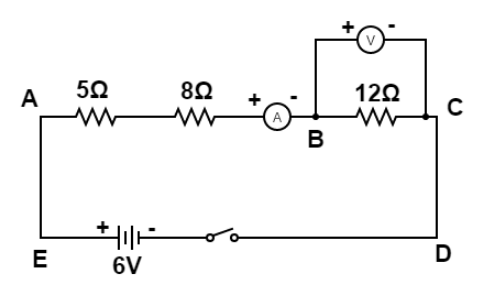
Let “$i$” current flowing in the circuit, then using Kirchhoff law which says that the sum of all potentials in a closed loop is zero while moving in particular direction, moving in loop ABCDEA we get,
$ - 6 + i(5\Omega ) + i(8\Omega ) + i(12\Omega ) = 0$
Solving we get, $i(5 + 8 + 12) = 6$
$i(25) = 6$
$\Rightarrow i = \dfrac{6}{{25}}A$
So ammeter reading is, $i = \dfrac{6}{{25}}A$ or, $i = 0.24\,A$.
For voltmeter reading, we have to find voltage across $12\Omega $ resistance;
From ammeter reading, current in circuit or across $12\Omega $ resistance is,
$i = \dfrac{6}{{25}}A$
Since, $R = \dfrac{V}{I}$ or $V = IR$
So for voltage across $12\Omega $ resistance is, $V = 12i$
Putting value of “i” we get,
$V = 12 \times \dfrac{6}{{25}}V$
$\Rightarrow V = \dfrac{{72}}{{25}}V$
$\therefore V = 2.88\,V$
Hence, the readings in the ammeter and voltmeter are 0.24 A and 2.88 V.
Note: It should be remembered that here we have considered ideal ammeter and voltmeter, in which ideal ammeter’s resistance is zero connected in parallel and voltmeter resistance is infinite connected in series with voltmeter. Voltages across resistance in series combination of resistance, are divided into inverse ratios of their resistance.
Complete step by step answer:
For Ammeter reading we need to find current in the circuit, which can be found using Kirchhoff’s voltage law, which states that voltage across the loop must be zero.
Let “$i$” current flowing in the circuit, then using Kirchhoff law which says that the sum of all potentials in a closed loop is zero while moving in particular direction, moving in loop ABCDEA we get,
$ - 6 + i(5\Omega ) + i(8\Omega ) + i(12\Omega ) = 0$
Solving we get, $i(5 + 8 + 12) = 6$
$i(25) = 6$
$\Rightarrow i = \dfrac{6}{{25}}A$
So ammeter reading is, $i = \dfrac{6}{{25}}A$ or, $i = 0.24\,A$.
For voltmeter reading, we have to find voltage across $12\Omega $ resistance;
From ammeter reading, current in circuit or across $12\Omega $ resistance is,
$i = \dfrac{6}{{25}}A$
Since, $R = \dfrac{V}{I}$ or $V = IR$
So for voltage across $12\Omega $ resistance is, $V = 12i$
Putting value of “i” we get,
$V = 12 \times \dfrac{6}{{25}}V$
$\Rightarrow V = \dfrac{{72}}{{25}}V$
$\therefore V = 2.88\,V$
Hence, the readings in the ammeter and voltmeter are 0.24 A and 2.88 V.
Note: It should be remembered that here we have considered ideal ammeter and voltmeter, in which ideal ammeter’s resistance is zero connected in parallel and voltmeter resistance is infinite connected in series with voltmeter. Voltages across resistance in series combination of resistance, are divided into inverse ratios of their resistance.
Recently Updated Pages
Master Class 12 Economics: Engaging Questions & Answers for Success

Master Class 12 English: Engaging Questions & Answers for Success
Master Class 12 Social Science: Engaging Questions & Answers for Success
Master Class 12 Maths: Engaging Questions & Answers for Success
Master Class 12 Physics: Engaging Questions & Answers for Success
Master Class 10 English: Engaging Questions & Answers for Success
Trending doubts
Explain the Treaty of Vienna of 1815 class 10 social science CBSE
Why is it 530 pm in india when it is 1200 afternoon class 10 social science CBSE
What is the full form of POSCO class 10 social science CBSE
Define Potential, Developed, Stock and Reserved resources
Which Country Has the Largest Border with India?
Complete the sentence with the most appropriate word class 10 english CBSE