




The reaction of sodium acetate and soda lime gives:
A. butane
B. ethane
C. methane
D. propane
Answer
 Verified
617.7k+ views
Hint: When Soda lime reacts with substrate, decarboxylation from the substrate happens. The formula of soda lime is \[NaOH + CaO\] . Sodium acetate is the sodium salt of acetic acid, which can be formed by reaction of sodium hydroxide which is a base and acetic acid. They undergo acid base reaction and form salt and water.
Complete step by step answer:
This reaction with soda lime is generally used to prepare alkanes from carboxylic acids. In this reaction the number of carbon atoms from the reactant is get decreased by one unit in terms of carbon dioxide
\[\left( {C{O_2}} \right).\]
The reaction equation of this reaction is,
\[C{H_3}COONa\xrightarrow{{NaOH/CaO}}C{H_4} + C{O_{2\,}}\, \uparrow \]
In this reaction \[CaO\] which is lime. It is a gray-white colored solid that can be produced in huge amounts by heating of \[\;CaC{O_3}\] . On heating \[\;CaC{O_3}\] emits \[C{O_2}\] and forms \[CaO\]. This \[CaO\] can easily absorb carbon dioxide at room temperature from the air.
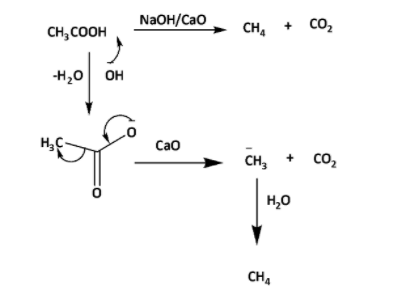
The reaction of sodium acetate with lime gives methane and sodium carbonate.
Hence, option C is correct.
Note:
In the case of \[{{\alpha }}\] -keto carboxylic acid decarboxylation can also be done by normal heating. This is also called oxidative decarboxylation. By this decarboxylation corresponding ketone is formed. The mechanism is shown below.
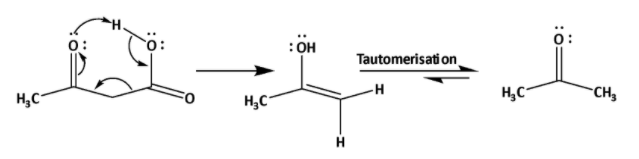
Due to presence of ketone group at alpha position reaction gets fascinated by formation of 6-membered cyclic arrangement for decarboxylation. In this reaction an enol is formed which undergoes tautomerization to form ketone.
Complete step by step answer:
This reaction with soda lime is generally used to prepare alkanes from carboxylic acids. In this reaction the number of carbon atoms from the reactant is get decreased by one unit in terms of carbon dioxide
\[\left( {C{O_2}} \right).\]
The reaction equation of this reaction is,
\[C{H_3}COONa\xrightarrow{{NaOH/CaO}}C{H_4} + C{O_{2\,}}\, \uparrow \]
In this reaction \[CaO\] which is lime. It is a gray-white colored solid that can be produced in huge amounts by heating of \[\;CaC{O_3}\] . On heating \[\;CaC{O_3}\] emits \[C{O_2}\] and forms \[CaO\]. This \[CaO\] can easily absorb carbon dioxide at room temperature from the air.
The reaction of sodium acetate with lime gives methane and sodium carbonate.
Hence, option C is correct.
Note:
In the case of \[{{\alpha }}\] -keto carboxylic acid decarboxylation can also be done by normal heating. This is also called oxidative decarboxylation. By this decarboxylation corresponding ketone is formed. The mechanism is shown below.
Due to presence of ketone group at alpha position reaction gets fascinated by formation of 6-membered cyclic arrangement for decarboxylation. In this reaction an enol is formed which undergoes tautomerization to form ketone.
Recently Updated Pages
Master Class 11 Social Science: Engaging Questions & Answers for Success

Master Class 11 English: Engaging Questions & Answers for Success
Master Class 11 Maths: Engaging Questions & Answers for Success
Master Class 11 Chemistry: Engaging Questions & Answers for Success
Master Class 11 Biology: Engaging Questions & Answers for Success
Class 11 Question and Answer - Your Ultimate Solutions Guide
Trending doubts
One Metric ton is equal to kg A 10000 B 1000 C 100 class 11 physics CBSE
Difference Between Prokaryotic Cells and Eukaryotic Cells
Find the value of the expression given below sin 30circ class 11 maths CBSE
1 ton equals to A 100 kg B 1000 kg C 10 kg D 10000 class 11 physics CBSE
Two of the body parts which do not appear in MRI are class 11 biology CBSE
Draw a diagram of nephron and explain its structur class 11 biology CBSE