




The reaction of ethyl magnesium bromide with water would give (ethane / methane / propane)?
Answer
 Verified
658.2k+ views
Hint: Ethyl magnesium bromide is a Grignard Reagent.Grignard reagent has the formula RMgX where X is a halogen, and R is an alkyl or aryl group.
Complete step by step answer:
The structure of ethyl magnesium bromide or Grignard reagent is –
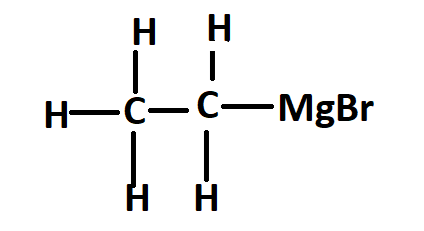
Ethylmagnesium bromide is a Grignard reagent with formula \[C_2H_5MgBr\]. It is widely used in the laboratory synthesis of many organic compounds.
Grignard reagents are made by adding halogenoalkane to magnesium in a flask having ethoxy – ethane (commonly known as diethyl ether or simply "ether"). The flask has a reflux condenser and the mixture is warmed over a water bath for nearly 20 - 30 minutes. Everything has to be perfectly dry because Grignard reagents react with water.
$ \Rightarrow CH_3CH_2Br + Mg\xrightarrow{{ethoxyethane}}CH_3CH_2MgBr$
It is used as a strong base to remove protons from various substrates such as alkynes –
$ \Rightarrow RC \equiv CH + EtMgBr \to RC \equiv CMgBr + EtH$
Ethyl magnesium bromide is a good nucleophile, i.e., it is attracted to electron deficient chemical species.
Grignard reagents react with water to produce alkanes.
$ \Rightarrow CH_3CH_2MgBr + H2O \to CH_3CH_3 + Mg(OH)Br$
The reaction of ethyl magnesium bromide with water will produce ethane. This is a wasteful process.
Additional information:
The inorganic product of this reaction, \[Mg\left( {OH} \right)Br\], is known as a "basic bromide". We can consider it as a sort of half-way stage between magnesium bromide and magnesium hydroxide.
Note:
We should always keep in mind that the Grignard reagent has to be stored in completely dry conditions else the reagent will get converted to their corresponding alkanes.
Complete step by step answer:
The structure of ethyl magnesium bromide or Grignard reagent is –
Ethylmagnesium bromide is a Grignard reagent with formula \[C_2H_5MgBr\]. It is widely used in the laboratory synthesis of many organic compounds.
Grignard reagents are made by adding halogenoalkane to magnesium in a flask having ethoxy – ethane (commonly known as diethyl ether or simply "ether"). The flask has a reflux condenser and the mixture is warmed over a water bath for nearly 20 - 30 minutes. Everything has to be perfectly dry because Grignard reagents react with water.
$ \Rightarrow CH_3CH_2Br + Mg\xrightarrow{{ethoxyethane}}CH_3CH_2MgBr$
It is used as a strong base to remove protons from various substrates such as alkynes –
$ \Rightarrow RC \equiv CH + EtMgBr \to RC \equiv CMgBr + EtH$
Ethyl magnesium bromide is a good nucleophile, i.e., it is attracted to electron deficient chemical species.
Grignard reagents react with water to produce alkanes.
$ \Rightarrow CH_3CH_2MgBr + H2O \to CH_3CH_3 + Mg(OH)Br$
The reaction of ethyl magnesium bromide with water will produce ethane. This is a wasteful process.
Additional information:
The inorganic product of this reaction, \[Mg\left( {OH} \right)Br\], is known as a "basic bromide". We can consider it as a sort of half-way stage between magnesium bromide and magnesium hydroxide.
Note:
We should always keep in mind that the Grignard reagent has to be stored in completely dry conditions else the reagent will get converted to their corresponding alkanes.
Recently Updated Pages
If x a + bt + ct2 where x is in meters and t is in class 11 physics CBSE

A car covers the first half distance between two places class 11 physics CBSE
The resultant of two vectors overrightarrow P and overrightarrow class 11 physics CBSE
Find the value of cos 135 class 11 maths CBSE
A mass M is held in place by an applied force F and class 11 physics CBSE
A solution of glucose in water is labelled as 10 dfracwv class 11 chemistry CBSE
Trending doubts
One Metric ton is equal to kg A 10000 B 1000 C 100 class 11 physics CBSE
Find the value of the expression given below sin 30circ class 11 maths CBSE
Draw a diagram of nephron and explain its structur class 11 biology CBSE
10 examples of friction in our daily life
Proton was discovered by A Thomson B Rutherford C Chadwick class 11 chemistry CBSE
Bond order ofO2 O2+ O2 and O22 is in order A O2 langle class 11 chemistry CBSE