




The ratio of total surface area that of lateral surface area of a cylinder whose radius is 20 cm and height 60 cm is
(a) 2:1
(b) 3:2
(c) 4:3
(d) 5:3
Answer
 Verified
634.5k+ views
Hint: We will use the formula of total surface area of the cylinder given by $2\pi rh+2\pi {{r}^{2}}$ and the formula of the lateral surface area of the cylinder given by $2\pi rh$ to solve the question. Here r is called the radius and h is the height of the cylinder. For the ratio we will divide these two formulas by each other.
Complete step-by-step answer:
The figure of the given cylinder with the dimensions of radius as 20 cm and height as 60 cm is drawn below.
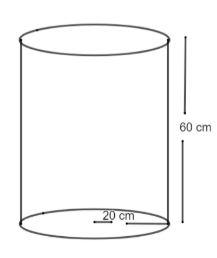
The total surface area of the cylinder is actually the addition of the curved surface area of the cylinder and the areas of the two circular plates as top and bottom of the cylinder. The curved surface area is the round surface of the cylinder which we can see in a 3d. This includes the height and radius of the cylinder. Therefore, we will have the formula of the curved surface as $2\pi rh$. Also, we have the area of the circle given by $\pi {{r}^{2}}$. Since, there are two circles thus we get the total surface area of the cylinder given by $2\pi rh+2\pi {{r}^{2}}$ or $\text{Total surface area = }2\pi r\left( h+r \right)$.
Now, we will find the value of the lateral surface area of the cylinder. It is given by the formula $2\pi rh$. After this we are going to divide total surface area to the lateral surface area of the cylinder. Thus, we get
$\begin{align}
& \text{Ratio = }\dfrac{2\pi r\left( h+r \right)}{2\pi rh} \\
& \Rightarrow \text{Ratio = }\dfrac{h+r}{h} \\
\end{align}$
As the height is 60 cm and the radius is 20 cm so , we will substitute the values into the ratio. Thus, we get
$\begin{align}
& \text{Ratio = }\dfrac{h+r}{h} \\
& \Rightarrow \text{Ratio = }\dfrac{60\,\text{cm}+20\text{ cm}}{60\,\text{cm}} \\
& \Rightarrow \text{Ratio = }\dfrac{80\,\text{cm}}{60\,\text{cm}} \\
& \Rightarrow \text{Ratio = }\dfrac{8}{6} \\
& \Rightarrow \text{Ratio = }\dfrac{4}{3} \\
\end{align}$
Hence, the required ratio of the respective areas is 4:3.
Note: Alternatively we can solve the question by first solving the areas completely as,
$\begin{align}
& 2\pi rh+2\pi {{r}^{2}}=2\times \dfrac{22}{7}\times 20\text{cm}\times 60\text{cm}\,+2\times \dfrac{22}{7}\times {{\left( 20\text{cm} \right)}^{2}} \\
& \Rightarrow 2\pi rh+2\pi {{r}^{2}}=2\times \dfrac{22}{7}\times 20\text{cm}\times 60\text{cm}\,+2\times \dfrac{22}{7}\times 20\text{cm}\times 20\text{cm} \\
\end{align}$
And,
$2\pi rh=2\times \dfrac{22}{7}\times 20\text{cm}\times 60\text{cm}$
Thus, we get the ratio of these two as $\begin{align}
& \dfrac{2\times \dfrac{22}{7}\times 20\text{cm}\times 60\text{cm}\,+2\times \dfrac{22}{7}\times 20\text{cm}\times 20\text{cm}}{2\times \dfrac{22}{7}\times 20\text{cm}\times 60\text{cm}}=\dfrac{2\times \dfrac{22}{7}\times 20\text{cm}\left( 60\text{cm}\,+20\text{cm} \right)}{2\times \dfrac{22}{7}\times 20\text{cm}\times 60\text{cm}} \\
& \Rightarrow \text{Ratio}=\dfrac{60\text{cm}\,+20\text{cm}}{60\text{cm}} \\
& \Rightarrow \text{Ratio}=\dfrac{\text{80cm}}{60\text{cm}} \\
& \Rightarrow \text{Ratio}=\dfrac{4}{3} \\
\end{align}$
Complete step-by-step answer:
The figure of the given cylinder with the dimensions of radius as 20 cm and height as 60 cm is drawn below.
The total surface area of the cylinder is actually the addition of the curved surface area of the cylinder and the areas of the two circular plates as top and bottom of the cylinder. The curved surface area is the round surface of the cylinder which we can see in a 3d. This includes the height and radius of the cylinder. Therefore, we will have the formula of the curved surface as $2\pi rh$. Also, we have the area of the circle given by $\pi {{r}^{2}}$. Since, there are two circles thus we get the total surface area of the cylinder given by $2\pi rh+2\pi {{r}^{2}}$ or $\text{Total surface area = }2\pi r\left( h+r \right)$.
Now, we will find the value of the lateral surface area of the cylinder. It is given by the formula $2\pi rh$. After this we are going to divide total surface area to the lateral surface area of the cylinder. Thus, we get
$\begin{align}
& \text{Ratio = }\dfrac{2\pi r\left( h+r \right)}{2\pi rh} \\
& \Rightarrow \text{Ratio = }\dfrac{h+r}{h} \\
\end{align}$
As the height is 60 cm and the radius is 20 cm so , we will substitute the values into the ratio. Thus, we get
$\begin{align}
& \text{Ratio = }\dfrac{h+r}{h} \\
& \Rightarrow \text{Ratio = }\dfrac{60\,\text{cm}+20\text{ cm}}{60\,\text{cm}} \\
& \Rightarrow \text{Ratio = }\dfrac{80\,\text{cm}}{60\,\text{cm}} \\
& \Rightarrow \text{Ratio = }\dfrac{8}{6} \\
& \Rightarrow \text{Ratio = }\dfrac{4}{3} \\
\end{align}$
Hence, the required ratio of the respective areas is 4:3.
Note: Alternatively we can solve the question by first solving the areas completely as,
$\begin{align}
& 2\pi rh+2\pi {{r}^{2}}=2\times \dfrac{22}{7}\times 20\text{cm}\times 60\text{cm}\,+2\times \dfrac{22}{7}\times {{\left( 20\text{cm} \right)}^{2}} \\
& \Rightarrow 2\pi rh+2\pi {{r}^{2}}=2\times \dfrac{22}{7}\times 20\text{cm}\times 60\text{cm}\,+2\times \dfrac{22}{7}\times 20\text{cm}\times 20\text{cm} \\
\end{align}$
And,
$2\pi rh=2\times \dfrac{22}{7}\times 20\text{cm}\times 60\text{cm}$
Thus, we get the ratio of these two as $\begin{align}
& \dfrac{2\times \dfrac{22}{7}\times 20\text{cm}\times 60\text{cm}\,+2\times \dfrac{22}{7}\times 20\text{cm}\times 20\text{cm}}{2\times \dfrac{22}{7}\times 20\text{cm}\times 60\text{cm}}=\dfrac{2\times \dfrac{22}{7}\times 20\text{cm}\left( 60\text{cm}\,+20\text{cm} \right)}{2\times \dfrac{22}{7}\times 20\text{cm}\times 60\text{cm}} \\
& \Rightarrow \text{Ratio}=\dfrac{60\text{cm}\,+20\text{cm}}{60\text{cm}} \\
& \Rightarrow \text{Ratio}=\dfrac{\text{80cm}}{60\text{cm}} \\
& \Rightarrow \text{Ratio}=\dfrac{4}{3} \\
\end{align}$
Recently Updated Pages
Master Class 9 General Knowledge: Engaging Questions & Answers for Success

Master Class 9 Maths: Engaging Questions & Answers for Success
Master Class 9 Science: Engaging Questions & Answers for Success
Master Class 9 English: Engaging Questions & Answers for Success
Master Class 9 Social Science: Engaging Questions & Answers for Success
Class 9 Question and Answer - Your Ultimate Solutions Guide
Trending doubts
What is the situation called when no party gets the class 9 social science CBSE
Find the sum of series 1 + 2 + 3 + 4 + 5 + + 100 class 9 maths CBSE
Difference Between Plant Cell and Animal Cell
Fill the blanks with the suitable prepositions 1 The class 9 english CBSE
What is pollution? How many types of pollution? Define it
What is the Full Form of ICSE / ISC ?