




The ratio of the number of hybrid and pure orbitals in $ {C_6}{H_6} $ is:
(A) $ 3:1 $
(B) $ 2:3 $
(C) $ 1:1 $
(D) $ 4:3 $
Answer
 Verified
549.3k+ views
Hint :Hybrid orbitals can be defined as when two or more nonequivalent orbitals form the same atom combining in preparation of bond formation. There are three different types of hybridization: $ sp,s{p^2}{\text{ and }}s{p^3} $ .
Pure orbitals are the atomic orbitals that contain electrons of the same atom. In pure orbitals, the orbitals are not mixed like hybrid orbitals and give the most probable location of the electrons.
Complete Step By Step Answer:
We can find the number of orbitals by a simple way:
Number of hybrid orbitals $ = $ number of carbons $ \times $ number denoting the hybridization of carbon
Number of pure orbitals $ = $ number of hydrogen present $ + $ $ 2 \times $ (number of $ \pi $ $ - $ orbitals present)
In the given question, we need to find out the number of hybrid and pure orbitals of benzene.
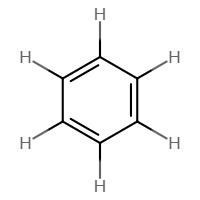
In benzene, the carbon is $ s{p^2} $ hybridized. The $ 2s{\text{ and 2p}} $ orbitals of carbon undergo hybridization to form $ 3{p^2} $ hybrid orbitals, but the $ 1s{\text{ and one }}2p $ orbital does not undergo hybridization.
On the other hand, hydrogen has only one $ 1s $ orbital and a single orbital cannot undergo hybridization, so it remains in pure form.
Now, let’s find out the number of hybrid and pure orbitals in $ {C_6}{H_6} $ .
Number of hybrid orbitals $ = $ $ 6 \times 3 = 18 $
Number of pure orbitals $ = 6 + 2 \times 3 = 12 $
Now, if we try to make it in the form of a ratio, we get $ 3:2 $ or $ 2:3 $ , which satisfies our option (b) $ 2:3 $ .
Therefore, the ratio of the number of hybrid and pure orbitals in $ {C_6}{H_6} $ is option (B) $ 2:3 $ .
Note :
Benzene molecule possesses $ s{p^2} $ hybridization and is planar i.e. all carbon atoms are bonded to three other atoms at an angle of $ {120^ \circ } $ . With $ s{p^2} $ hybridization, each carbon atom has an unhybridized atomic $ p $ orbitals associated with it and each carbon atom forms a different bond with two similar carbon atoms.
Pure orbitals are the atomic orbitals that contain electrons of the same atom. In pure orbitals, the orbitals are not mixed like hybrid orbitals and give the most probable location of the electrons.
Complete Step By Step Answer:
We can find the number of orbitals by a simple way:
Number of hybrid orbitals $ = $ number of carbons $ \times $ number denoting the hybridization of carbon
Number of pure orbitals $ = $ number of hydrogen present $ + $ $ 2 \times $ (number of $ \pi $ $ - $ orbitals present)
In the given question, we need to find out the number of hybrid and pure orbitals of benzene.
In benzene, the carbon is $ s{p^2} $ hybridized. The $ 2s{\text{ and 2p}} $ orbitals of carbon undergo hybridization to form $ 3{p^2} $ hybrid orbitals, but the $ 1s{\text{ and one }}2p $ orbital does not undergo hybridization.
On the other hand, hydrogen has only one $ 1s $ orbital and a single orbital cannot undergo hybridization, so it remains in pure form.
Now, let’s find out the number of hybrid and pure orbitals in $ {C_6}{H_6} $ .
Number of hybrid orbitals $ = $ $ 6 \times 3 = 18 $
Number of pure orbitals $ = 6 + 2 \times 3 = 12 $
Now, if we try to make it in the form of a ratio, we get $ 3:2 $ or $ 2:3 $ , which satisfies our option (b) $ 2:3 $ .
Therefore, the ratio of the number of hybrid and pure orbitals in $ {C_6}{H_6} $ is option (B) $ 2:3 $ .
Note :
Benzene molecule possesses $ s{p^2} $ hybridization and is planar i.e. all carbon atoms are bonded to three other atoms at an angle of $ {120^ \circ } $ . With $ s{p^2} $ hybridization, each carbon atom has an unhybridized atomic $ p $ orbitals associated with it and each carbon atom forms a different bond with two similar carbon atoms.
Recently Updated Pages
Master Class 11 Social Science: Engaging Questions & Answers for Success

Master Class 11 English: Engaging Questions & Answers for Success
Master Class 11 Maths: Engaging Questions & Answers for Success
Master Class 11 Chemistry: Engaging Questions & Answers for Success
Master Class 11 Biology: Engaging Questions & Answers for Success
Master Class 11 Physics: Engaging Questions & Answers for Success
Trending doubts
Differentiate between an exothermic and an endothermic class 11 chemistry CBSE
One Metric ton is equal to kg A 10000 B 1000 C 100 class 11 physics CBSE
Difference Between Prokaryotic Cells and Eukaryotic Cells
There are 720 permutations of the digits 1 2 3 4 5 class 11 maths CBSE
Draw a diagram of a plant cell and label at least eight class 11 biology CBSE
Two of the body parts which do not appear in MRI are class 11 biology CBSE