




The ratio between the length and breadth of a rectangular park is $3:2$. If a man cycling along a boundary of the park at the speed of 12kmph completes one round in 8 minutes, then calculate the area of the park.
Answer
 Verified
632.4k+ views
Hint: Use the fact that speed is the ratio of distance covered to the time taken to calculate the length of the boundary of the park. The boundary of the park is the perimeter. Assume that the length of the park is ‘x’. Write breadth in terms of length of the park. Write the equation for perimeter and simplify them to calculate the value of length and breadth of the park. Multiply both of them to calculate the area of the park.
Complete step-by-step answer:
We know the ratio between length and breadth of the park and the time taken by a man to cycle along the boundary of the park at the speed of 12kmph. We have to calculate the area of the park.
We know that the ratio between length and breadth is $3:2$. Let’s assume that the length of the park is ‘x’. We will now write the breadth of the park in terms of ‘x’.
Thus, we have $\dfrac{x}{breadth}=\dfrac{3}{2}$. Cross multiplying the terms of the above equation, the breadth of the park is $\dfrac{2x}{3}$.
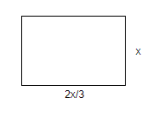
We know that a man cycles along the boundary of the park in 8 minutes at a speed of 12kmph. We will convert this speed from kmph to $m/\sec $. To do so, we will multiply the value of speed in kmph by $\dfrac{5}{18}$.
Thus, we can write 12kmph as $12kmph=12\times \dfrac{5}{18}=\dfrac{10}{3}m/\sec $.
We will now convert 8 minutes into seconds. We know that $1\min =60\sec $. So, we will multiply 8 by 60 to convert it into minutes.
Thus, we can write 8 minutes into seconds as $8\min =8\times 60=480\sec $.
So, the man walked around the boundary at a speed of $\dfrac{10}{3}m/\sec $ in 480 seconds. We will now calculate the distance covered by the man by using the fact that speed is the ratio of distance covered to the time taken.
To calculate the length of the boundary of the park, we will multiply the speed with the time taken.
Thus, the boundary of the park is $=\dfrac{10}{3}\times 480=1600m$.
We know the boundary of the park is equal to the perimeter of the park. We know that the perimeter of the park with length ‘l’ and breadth ‘b’ is given by $2\left( l+b \right)$.
Substituting $l=x,b=\dfrac{2x}{3}$ in the above expression, the perimeter of the park is $=2\left( x+\dfrac{2x}{3} \right)=1600m$.
Simplifying the above equation, we have $\dfrac{3x+2x}{3}=\dfrac{5x}{3}=\dfrac{1600}{2}=800$.
Cross multiplying the terms of the above equation, we have $x=\dfrac{3\times 800}{5}=480m$.
Thus, the length is $x=480m$.
We will now calculate the breadth of the rectangle. Thus, the breadth of the rectangle $=\dfrac{2x}{3}=\dfrac{2\times 480}{3}=320m$.
Thus, the length and breadth of the rectangle are 480m and 320m respectively.
We will now calculate the area of the rectangle. The area of the rectangle is the product of the length and breadth of the rectangle.
Thus, the area of the rectangle is $=320\times 480=153600{{m}^{2}}$.
Hence, the area of the given rectangle is $153600{{m}^{2}}$.
Note: One must be careful about the units while calculating the area. We have calculated the length and breadth of the park in metres, so the area will be in metres square. We can also solve this question by assuming that the breadth of the park is ‘x’ and then write the length in terms of x to solve the question.
Complete step-by-step answer:
We know the ratio between length and breadth of the park and the time taken by a man to cycle along the boundary of the park at the speed of 12kmph. We have to calculate the area of the park.
We know that the ratio between length and breadth is $3:2$. Let’s assume that the length of the park is ‘x’. We will now write the breadth of the park in terms of ‘x’.
Thus, we have $\dfrac{x}{breadth}=\dfrac{3}{2}$. Cross multiplying the terms of the above equation, the breadth of the park is $\dfrac{2x}{3}$.
We know that a man cycles along the boundary of the park in 8 minutes at a speed of 12kmph. We will convert this speed from kmph to $m/\sec $. To do so, we will multiply the value of speed in kmph by $\dfrac{5}{18}$.
Thus, we can write 12kmph as $12kmph=12\times \dfrac{5}{18}=\dfrac{10}{3}m/\sec $.
We will now convert 8 minutes into seconds. We know that $1\min =60\sec $. So, we will multiply 8 by 60 to convert it into minutes.
Thus, we can write 8 minutes into seconds as $8\min =8\times 60=480\sec $.
So, the man walked around the boundary at a speed of $\dfrac{10}{3}m/\sec $ in 480 seconds. We will now calculate the distance covered by the man by using the fact that speed is the ratio of distance covered to the time taken.
To calculate the length of the boundary of the park, we will multiply the speed with the time taken.
Thus, the boundary of the park is $=\dfrac{10}{3}\times 480=1600m$.
We know the boundary of the park is equal to the perimeter of the park. We know that the perimeter of the park with length ‘l’ and breadth ‘b’ is given by $2\left( l+b \right)$.
Substituting $l=x,b=\dfrac{2x}{3}$ in the above expression, the perimeter of the park is $=2\left( x+\dfrac{2x}{3} \right)=1600m$.
Simplifying the above equation, we have $\dfrac{3x+2x}{3}=\dfrac{5x}{3}=\dfrac{1600}{2}=800$.
Cross multiplying the terms of the above equation, we have $x=\dfrac{3\times 800}{5}=480m$.
Thus, the length is $x=480m$.
We will now calculate the breadth of the rectangle. Thus, the breadth of the rectangle $=\dfrac{2x}{3}=\dfrac{2\times 480}{3}=320m$.
Thus, the length and breadth of the rectangle are 480m and 320m respectively.
We will now calculate the area of the rectangle. The area of the rectangle is the product of the length and breadth of the rectangle.
Thus, the area of the rectangle is $=320\times 480=153600{{m}^{2}}$.
Hence, the area of the given rectangle is $153600{{m}^{2}}$.
Note: One must be careful about the units while calculating the area. We have calculated the length and breadth of the park in metres, so the area will be in metres square. We can also solve this question by assuming that the breadth of the park is ‘x’ and then write the length in terms of x to solve the question.
Recently Updated Pages
Master Class 12 Business Studies: Engaging Questions & Answers for Success

Master Class 12 Biology: Engaging Questions & Answers for Success
Master Class 12 Chemistry: Engaging Questions & Answers for Success
Class 12 Question and Answer - Your Ultimate Solutions Guide
Master Class 11 Social Science: Engaging Questions & Answers for Success
Master Class 11 English: Engaging Questions & Answers for Success
Trending doubts
Explain the Treaty of Vienna of 1815 class 10 social science CBSE
Who Won 36 Oscar Awards? Record Holder Revealed
What is the median of the first 10 natural numbers class 10 maths CBSE
Why is it 530 pm in india when it is 1200 afternoon class 10 social science CBSE
What is the full form of POSCO class 10 social science CBSE
The highest temperature in Karnataka is recorded in class 10 social science CBSE