




The rate of transpiration ……… the process of the ascent of sap
(a) Increases
(b) Decreases
(c) Do not affect
(d) Increases and then decreases
Answer
 Verified
577.8k+ views
Hint: Transpiration creates a negative pressure which creates a pull in the upward direction and it aids the process of upward movement of minerals and water from the root to the leaves.
Complete Step by Step Answer:
As you may know that transpiration is the phenomenon of the loss of water through the leaves and which is lost to the atmosphere. This is the main reason behind the movement of the water present inside the xylem. Due to transpiration, a negative pressure also termed as tension, is created on the surface of the leaves. The pressure created is quite large and can be approximated to a value of - 2MegaPascals.
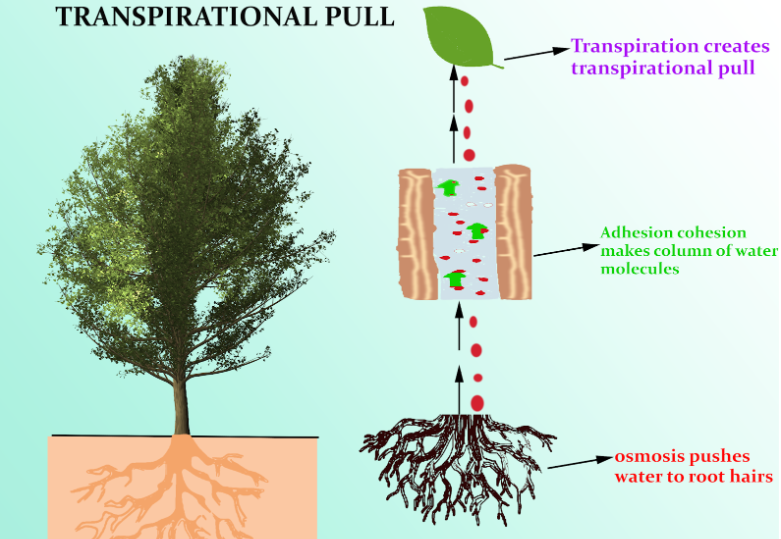
The rate of transpiration affects the pull or the negative pressure created. The rate of transpiration is further affected by the relative humidity in the weather which may vary according to the temperature conditions. Water or sap is pulled up from the roots by this pressure created through transpiration. And it will also be clear to you by now that the ascent of sap is directly proportional to the rate of transpiration. Hence, as transpiration increases the ascent of sap also increases.
Additional Information:
- Transpiration occurs through the tiny pores present on the leaf surface called the stomata.
- During the night, the stomata remain shut, the transpiration is also interrupted, due to which the ascent of sap stops too. The sap is held through the force of cohesion of the sap molecules in the cell walls present in the xylem vessels.
- The force or the tension created during the day when the stomata are open, which is used to pull up the sap to the upper extremities of the pant body combined with the cohesive force during the night with which the sap does not descend forms the cohesion- tension theory related to the ascent of sap.
So, the correct option is, “Increases”.
Note:
- You must know that the plants use the properties of water, i.e., the cohesive and the adhesive properties of water to successfully transport the sap to the upper parts.
- You must also note that even though the tension force is quite large, yet tension force may reach higher values depending on the height of the plant. For tall plants, the tension force required would also increase.
Complete Step by Step Answer:
As you may know that transpiration is the phenomenon of the loss of water through the leaves and which is lost to the atmosphere. This is the main reason behind the movement of the water present inside the xylem. Due to transpiration, a negative pressure also termed as tension, is created on the surface of the leaves. The pressure created is quite large and can be approximated to a value of - 2MegaPascals.
The rate of transpiration affects the pull or the negative pressure created. The rate of transpiration is further affected by the relative humidity in the weather which may vary according to the temperature conditions. Water or sap is pulled up from the roots by this pressure created through transpiration. And it will also be clear to you by now that the ascent of sap is directly proportional to the rate of transpiration. Hence, as transpiration increases the ascent of sap also increases.
Additional Information:
- Transpiration occurs through the tiny pores present on the leaf surface called the stomata.
- During the night, the stomata remain shut, the transpiration is also interrupted, due to which the ascent of sap stops too. The sap is held through the force of cohesion of the sap molecules in the cell walls present in the xylem vessels.
- The force or the tension created during the day when the stomata are open, which is used to pull up the sap to the upper extremities of the pant body combined with the cohesive force during the night with which the sap does not descend forms the cohesion- tension theory related to the ascent of sap.
So, the correct option is, “Increases”.
Note:
- You must know that the plants use the properties of water, i.e., the cohesive and the adhesive properties of water to successfully transport the sap to the upper parts.
- You must also note that even though the tension force is quite large, yet tension force may reach higher values depending on the height of the plant. For tall plants, the tension force required would also increase.
Recently Updated Pages
Master Class 11 Computer Science: Engaging Questions & Answers for Success

Master Class 11 Business Studies: Engaging Questions & Answers for Success
Master Class 11 Economics: Engaging Questions & Answers for Success
Master Class 11 English: Engaging Questions & Answers for Success
Master Class 11 Maths: Engaging Questions & Answers for Success
Master Class 11 Biology: Engaging Questions & Answers for Success
Trending doubts
One Metric ton is equal to kg A 10000 B 1000 C 100 class 11 physics CBSE
There are 720 permutations of the digits 1 2 3 4 5 class 11 maths CBSE
Discuss the various forms of bacteria class 11 biology CBSE
Draw a diagram of a plant cell and label at least eight class 11 biology CBSE
State the laws of reflection of light
10 examples of friction in our daily life