




The range of a rifle bullet is 1000m, when \[\theta \] is the angle of projection. If the bullet is fired with the same angle of projection from a car travelling horizontally at \[36km/hr\] towards the target, the increase in the range will be:
(given \[\sqrt{\dfrac{5}{9.8}}=0.712\])
(a) \[173\sqrt{\tan \theta }\]
(b) \[183\sqrt{\tan \theta }\]
(c) \[143\sqrt{\tan \theta }\]
(d) \[113\sqrt{\tan \theta }\]
Answer
 Verified
616.8k+ views
Hint: For this question, we need to remember the formula of horizontal distance/range and velocity of car is mentioned in the question. The vertical and horizontal components play a crucial role in the given solution.
Formula used:
Range\[R=\dfrac{2{{u}^{2}}\sin \theta \cos \theta }{g}\]
Complete answer:
Let us consider a bullet projected at an angle \[\theta \] and the maximum distance covered i.e. range is 1000m. Now, according to the question if the same bullet will be fired with the same angle of projection, when travelling from a car moving with the velocity \[36km/hr\], we need to find the range.
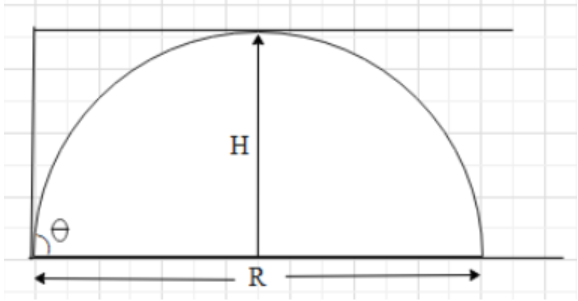
Given data -
velocity(u)= \[36km/hr=10m/s\]
Initial range \[R=\dfrac{2{{u}^{2}}\sin \theta \cos \theta }{g}\]
\[R=\dfrac{2}{g}PQ\]…………(1)
Here \[P=u\cos \theta ,Q=u\sin \theta \]
let range be \[{{R}^{'}}\] when the bullet is projected from a car.
\[{{R}^{'}}=\dfrac{2}{g}(P+10)Q\]………(2)
As the range is changing, therefore the vertical component will remain the same.
Difference in range \[{{R}^{'}}-R=\dfrac{20Q}{g}=\dfrac{20u\sin \theta }{g}\]
From (1) \[R=\dfrac{2{{u}^{2}}\sin \theta \cos \theta }{g}=1000\]
Rearranging the terms, \[{{u}^{2}}=\dfrac{1000\times g}{2\sin \theta \cos \theta }\]
Solving (1) and (2) \[R-{{R}^{'}}=\dfrac{20\sqrt{1000}}{5g}\times \dfrac{\sqrt{\tan \theta }}{\sqrt{2}}\]
\[=143\sqrt{\tan \theta }\]
Therefore, the difference in range is found to be \[143\sqrt{\tan \theta }\] .
So option C is the correct answer.
Additional Information:
Range of an object is the maximum horizontal distance the object can cover when projected at any angle. Solving these kinds of problems, we have to be careful while breaking the vector into its component, i.e. horizontal component along x – axis and vertical component along y-axis.
Note:
It is better to draw face body drawing which will help to break the vector into its component. Face body diagram helps in visualizing the scenario framed in the question. The formula for height and range is alike, so it should not be confused.
Formula used:
Range\[R=\dfrac{2{{u}^{2}}\sin \theta \cos \theta }{g}\]
Complete answer:
Let us consider a bullet projected at an angle \[\theta \] and the maximum distance covered i.e. range is 1000m. Now, according to the question if the same bullet will be fired with the same angle of projection, when travelling from a car moving with the velocity \[36km/hr\], we need to find the range.
Given data -
velocity(u)= \[36km/hr=10m/s\]
Initial range \[R=\dfrac{2{{u}^{2}}\sin \theta \cos \theta }{g}\]
\[R=\dfrac{2}{g}PQ\]…………(1)
Here \[P=u\cos \theta ,Q=u\sin \theta \]
let range be \[{{R}^{'}}\] when the bullet is projected from a car.
\[{{R}^{'}}=\dfrac{2}{g}(P+10)Q\]………(2)
As the range is changing, therefore the vertical component will remain the same.
Difference in range \[{{R}^{'}}-R=\dfrac{20Q}{g}=\dfrac{20u\sin \theta }{g}\]
From (1) \[R=\dfrac{2{{u}^{2}}\sin \theta \cos \theta }{g}=1000\]
Rearranging the terms, \[{{u}^{2}}=\dfrac{1000\times g}{2\sin \theta \cos \theta }\]
Solving (1) and (2) \[R-{{R}^{'}}=\dfrac{20\sqrt{1000}}{5g}\times \dfrac{\sqrt{\tan \theta }}{\sqrt{2}}\]
\[=143\sqrt{\tan \theta }\]
Therefore, the difference in range is found to be \[143\sqrt{\tan \theta }\] .
So option C is the correct answer.
Additional Information:
Range of an object is the maximum horizontal distance the object can cover when projected at any angle. Solving these kinds of problems, we have to be careful while breaking the vector into its component, i.e. horizontal component along x – axis and vertical component along y-axis.
Note:
It is better to draw face body drawing which will help to break the vector into its component. Face body diagram helps in visualizing the scenario framed in the question. The formula for height and range is alike, so it should not be confused.
Recently Updated Pages
Master Class 12 Economics: Engaging Questions & Answers for Success

Master Class 12 English: Engaging Questions & Answers for Success
Master Class 12 Social Science: Engaging Questions & Answers for Success
Master Class 12 Maths: Engaging Questions & Answers for Success
Master Class 12 Physics: Engaging Questions & Answers for Success
Master Class 9 General Knowledge: Engaging Questions & Answers for Success
Trending doubts
One Metric ton is equal to kg A 10000 B 1000 C 100 class 11 physics CBSE
Difference Between Prokaryotic Cells and Eukaryotic Cells
Two of the body parts which do not appear in MRI are class 11 biology CBSE
1 ton equals to A 100 kg B 1000 kg C 10 kg D 10000 class 11 physics CBSE
Draw a diagram of nephron and explain its structur class 11 biology CBSE
10 examples of friction in our daily life