




The radius of the curvature of a railway line at a place when the train is moving with a speed of the 36km/hr is 1000m the distance between the two rails being the 1.5mk the elevation of the outer rail above the inner rail is
(A) $ \dfrac{{1.5}}{{98}} $
(B) $ \dfrac{3}{{98}} $
(C) $ \dfrac{{4.5}}{{98}} $
(D) $ \dfrac{1}{{98}} $
Answer
 Verified
643.2k+ views
Hint
Here we have to find the elevation of the outer rail above the inner rail so it totally meant we have to find the height
It can be find out using the formula
$\Rightarrow \tan \theta $ = $ \dfrac{{{v^2}}}{{rg}} $
Complete step by step answer
By drawing free body diagram
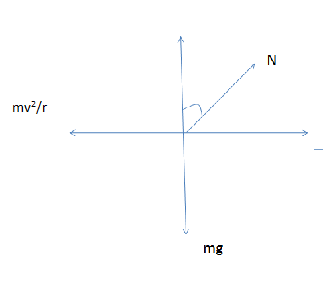
As we can say that
For the normal component of N making angle $ \theta $ with the y-axis
$\Rightarrow N \sin \theta $ = $ \dfrac{{m{v^2}}}{r} $ … (1)
N = normal reaction
Here $ \dfrac{{m{v^2}}}{r} $ = centripetal force
And for the horizontal component of the N
$\Rightarrow N \cos \theta = mg$ ... (2)
Dividing equation (1) by equation (2)
We get,
$\Rightarrow \tan \theta $ = $ \dfrac{{{v^2}}}{{rg}} $
Here we will define the h as ate elevation
So on putting the values in the equation
$\Rightarrow \dfrac{h}{{1.5}} $ = $ \dfrac{{100}}{{1000\; \times 9.8}} $
So on solving the equation we get the value that
$\Rightarrow h = \dfrac{{1.5}}{{98}} $
Hence the correct answer is given by
$\Rightarrow h = \dfrac{{1.5}}{{98}} $
Option (A) is correct.
Note
Banking of the road is defined as the phenomenon in which the edges are raised for the curved roads above the inner edge to provide the necessary centripetal force to the vehicle so that they can have a safe turn. The angle at which the vehicle is inclined is known as the bank angle.
Centripetal force: It is the force that is necessary to keep an object moving to the curved path and that is directed inward together with the center of the rotation.
Here we have to find the elevation of the outer rail above the inner rail so it totally meant we have to find the height
It can be find out using the formula
$\Rightarrow \tan \theta $ = $ \dfrac{{{v^2}}}{{rg}} $
Complete step by step answer
By drawing free body diagram
As we can say that
For the normal component of N making angle $ \theta $ with the y-axis
$\Rightarrow N \sin \theta $ = $ \dfrac{{m{v^2}}}{r} $ … (1)
N = normal reaction
Here $ \dfrac{{m{v^2}}}{r} $ = centripetal force
And for the horizontal component of the N
$\Rightarrow N \cos \theta = mg$ ... (2)
Dividing equation (1) by equation (2)
We get,
$\Rightarrow \tan \theta $ = $ \dfrac{{{v^2}}}{{rg}} $
Here we will define the h as ate elevation
So on putting the values in the equation
$\Rightarrow \dfrac{h}{{1.5}} $ = $ \dfrac{{100}}{{1000\; \times 9.8}} $
So on solving the equation we get the value that
$\Rightarrow h = \dfrac{{1.5}}{{98}} $
Hence the correct answer is given by
$\Rightarrow h = \dfrac{{1.5}}{{98}} $
Option (A) is correct.
Note
Banking of the road is defined as the phenomenon in which the edges are raised for the curved roads above the inner edge to provide the necessary centripetal force to the vehicle so that they can have a safe turn. The angle at which the vehicle is inclined is known as the bank angle.
Centripetal force: It is the force that is necessary to keep an object moving to the curved path and that is directed inward together with the center of the rotation.
Recently Updated Pages
Lysosomes are known as suicidal bags of cell why class 11 biology CBSE

Father s age is three times the sum of the ages of-class-11-maths-CBSE
Give a comparative account of the classes of kingdom class 11 biology CBSE
The ceiling of a long hall is 25m high What is the class 11 physics CBSE
Name the Largest and the Smallest Cell in the Human Body ?
Draw a welllabelled diagram of a plant cell class 11 biology CBSE
Trending doubts
Find the value of the expression given below sin 30circ class 11 maths CBSE
One Metric ton is equal to kg A 10000 B 1000 C 100 class 11 physics CBSE
10 examples of friction in our daily life
Draw a diagram of nephron and explain its structur class 11 biology CBSE
Proton was discovered by A Thomson B Rutherford C Chadwick class 11 chemistry CBSE
Frogs heart when taken out of the body continues to class 11 biology CBSE