




The radius of gyration of the body about the axis at distance $ 5cm $ from centre of mass is $ 10cm $ . What will be the radius of gyration about the parallel axis through the centre of mass?
Answer
 Verified
478.8k+ views
Hint: This question is based on the concept of radius of gyration. Here we will apply the parallel axis theorem i.e. $ {I_{parallel}} = {I_{cm}} + M{d^2} $ where $ {I_{parallel}} $ is the momentum of inertia of the body, $ {I_{cm}} $ is the momentum about the centre and $ d $ is the distance between the two parallel axes. On putting the required values, we will arrive at the answer.
Complete Step By Step Answer:
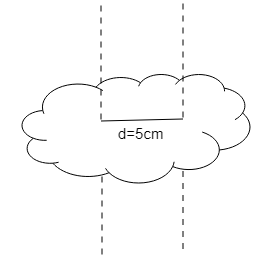
According to the question, we are given a body which has a radius of gyration about an axis which is $ 5cm $ from its centre of mass is $ 10cm $ .
Radius of gyration is an imaginary point where it is a concentrated mass of the body from the centre of the body and the momentum of inertia at the radius of gyration is assumed to be the equal as it is about the axis of actual mass. The momentum of inertia of a body in terms of radius of gyration is given by the expression $ I = M{k^2} $ .
In this question, it is given that the distance of radius of gyration from centre of mass is $ 5cm $
So by the parallel axis theorem, $ {I_{parallel}} = {I_{cm}} + M{d^2} $ where $ {I_{parallel}} $ is the momentum of inertia of the body, $ {I_{cm}} $ is the momentum about the centre and $ d $ is the distance between the two parallel axes.
On substituting the required values in the above equation, we get,
$ {I_1} = {I_2} + M{d^2} $
$ M{(10)^2} = {I_2} + M{(5)^2} $
On opening the squares, we get,
$ 100M = {I_2} + 25M $
$ {I_2} = 100M - 25M $
On further solving,
$ {I_2} = 75M $
This can also be written as,
$ {I_2} = M{(5 \sqrt{3})^2} $
On comparing the above equation with the general equation which is given by $ I = M{k^2} $ ,
$ k = 5\sqrt{3}cm $
Hence, the radius of gyration through the centre of mass is $ k = 5\sqrt{3}cm $ .
Note:
The centre of mass that we used in this particular solution can be defined as the fixed location relative to an entity or group of objects. This can also be defined as the average position of all elements of the system, weighted by their masses. The centre of mass is found to be present on the centroid of a triangle when three masses are involved, for simple solid structures of uniform density.
Complete Step By Step Answer:
According to the question, we are given a body which has a radius of gyration about an axis which is $ 5cm $ from its centre of mass is $ 10cm $ .
Radius of gyration is an imaginary point where it is a concentrated mass of the body from the centre of the body and the momentum of inertia at the radius of gyration is assumed to be the equal as it is about the axis of actual mass. The momentum of inertia of a body in terms of radius of gyration is given by the expression $ I = M{k^2} $ .
In this question, it is given that the distance of radius of gyration from centre of mass is $ 5cm $
So by the parallel axis theorem, $ {I_{parallel}} = {I_{cm}} + M{d^2} $ where $ {I_{parallel}} $ is the momentum of inertia of the body, $ {I_{cm}} $ is the momentum about the centre and $ d $ is the distance between the two parallel axes.
On substituting the required values in the above equation, we get,
$ {I_1} = {I_2} + M{d^2} $
$ M{(10)^2} = {I_2} + M{(5)^2} $
On opening the squares, we get,
$ 100M = {I_2} + 25M $
$ {I_2} = 100M - 25M $
On further solving,
$ {I_2} = 75M $
This can also be written as,
$ {I_2} = M{(5 \sqrt{3})^2} $
On comparing the above equation with the general equation which is given by $ I = M{k^2} $ ,
$ k = 5\sqrt{3}cm $
Hence, the radius of gyration through the centre of mass is $ k = 5\sqrt{3}cm $ .
Note:
The centre of mass that we used in this particular solution can be defined as the fixed location relative to an entity or group of objects. This can also be defined as the average position of all elements of the system, weighted by their masses. The centre of mass is found to be present on the centroid of a triangle when three masses are involved, for simple solid structures of uniform density.
Recently Updated Pages
Master Class 11 Computer Science: Engaging Questions & Answers for Success

Master Class 11 Business Studies: Engaging Questions & Answers for Success
Master Class 11 Economics: Engaging Questions & Answers for Success
Master Class 11 English: Engaging Questions & Answers for Success
Master Class 11 Maths: Engaging Questions & Answers for Success
Master Class 11 Biology: Engaging Questions & Answers for Success
Trending doubts
One Metric ton is equal to kg A 10000 B 1000 C 100 class 11 physics CBSE
There are 720 permutations of the digits 1 2 3 4 5 class 11 maths CBSE
Discuss the various forms of bacteria class 11 biology CBSE
Draw a diagram of a plant cell and label at least eight class 11 biology CBSE
State the laws of reflection of light
Explain zero factorial class 11 maths CBSE