




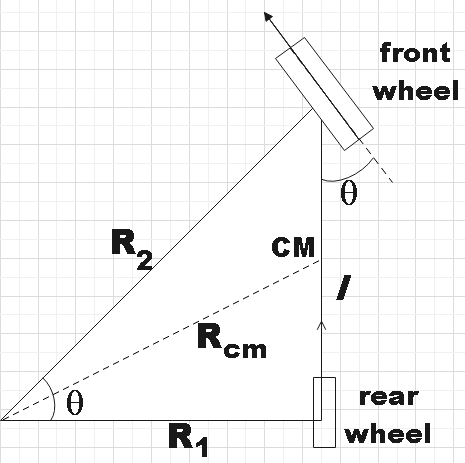
The radius of curvature of the centre of mass of the bike is
A. $\dfrac{l}{\tan \theta }\sqrt{4+{{\tan }^{2}}\theta }$
B. $\dfrac{l}{\tan \theta }\sqrt{2+{{\tan }^{2}}\theta }$
C. $\dfrac{l}{2\tan \theta }\sqrt{4+{{\tan }^{2}}\theta }$
D. $\dfrac{l}{2\tan \theta }\sqrt{2+{{\tan }^{2}}\theta }$
Answer
 Verified
533.7k+ views
Hint: We are actually given all the necessary conditions that would be required so as to find the radius of curvature of the centre of mass. First you could find the tangent of the angle in the figure. Then you could make use of Pythagorean theorem and later do necessary substitutions to get the required quantity in the form given in the options.
Complete answer:
In the question, we are given a figure with the alignment of the wheels of a bike and also its center of mass marked. Let us assume that the bike doesn’t slip. We are supposed to find the radius of curvature of the centre of mass of the bike by using these conditions.
From the given figure, we see that the tangent of the angle $\theta $ could be given by,
$\tan \theta =\dfrac{l}{{{R}_{1}}}$
$\Rightarrow {{R}_{1}}=\dfrac{l}{\tan \theta }$ ……………………………………………. (1)
Now, we could simply use the Pythagorean theorem to find the radius of curvature.
By Pythagorean theorem, we know that the squares of the hypotenuse is equal to the sum of the squares of the other two sides of the triangle. That is,
${{R}_{CM}}^{2}={{\left( \dfrac{l}{2} \right)}^{2}}+{{R}_{1}}^{2}$
Substituting (1), we get,
${{R}_{CM}}^{2}={{\left( \dfrac{l}{2} \right)}^{2}}+{{\left( \dfrac{l}{\tan \theta } \right)}^{2}}$
$\Rightarrow {{R}_{CM}}=\sqrt{\dfrac{{{l}^{2}}}{4{{\tan }^{2}}\theta }\left( {{\tan }^{2}}\theta +4 \right)}$
$\therefore {{R}_{CM}}=\dfrac{l}{2\tan \theta }\sqrt{4+{{\tan }^{2}}\theta }$
Therefore, we found the radius of curvature of the centre of curvature to be,
${{R}_{CM}}=\dfrac{l}{2\tan \theta }\sqrt{4+{{\tan }^{2}}\theta }$
So the correct answer is option C.
Note:
We have assumed the weight of the tires to be the same as we have chosen the midpoint joining these tires to be the point at which the center of mass of the bike resides. The rest of the conditions are made based on the assumption that the bike doesn’t skid on the road.
Complete answer:
In the question, we are given a figure with the alignment of the wheels of a bike and also its center of mass marked. Let us assume that the bike doesn’t slip. We are supposed to find the radius of curvature of the centre of mass of the bike by using these conditions.
From the given figure, we see that the tangent of the angle $\theta $ could be given by,
$\tan \theta =\dfrac{l}{{{R}_{1}}}$
$\Rightarrow {{R}_{1}}=\dfrac{l}{\tan \theta }$ ……………………………………………. (1)
Now, we could simply use the Pythagorean theorem to find the radius of curvature.
By Pythagorean theorem, we know that the squares of the hypotenuse is equal to the sum of the squares of the other two sides of the triangle. That is,
${{R}_{CM}}^{2}={{\left( \dfrac{l}{2} \right)}^{2}}+{{R}_{1}}^{2}$
Substituting (1), we get,
${{R}_{CM}}^{2}={{\left( \dfrac{l}{2} \right)}^{2}}+{{\left( \dfrac{l}{\tan \theta } \right)}^{2}}$
$\Rightarrow {{R}_{CM}}=\sqrt{\dfrac{{{l}^{2}}}{4{{\tan }^{2}}\theta }\left( {{\tan }^{2}}\theta +4 \right)}$
$\therefore {{R}_{CM}}=\dfrac{l}{2\tan \theta }\sqrt{4+{{\tan }^{2}}\theta }$
Therefore, we found the radius of curvature of the centre of curvature to be,
${{R}_{CM}}=\dfrac{l}{2\tan \theta }\sqrt{4+{{\tan }^{2}}\theta }$
So the correct answer is option C.
Note:
We have assumed the weight of the tires to be the same as we have chosen the midpoint joining these tires to be the point at which the center of mass of the bike resides. The rest of the conditions are made based on the assumption that the bike doesn’t skid on the road.
Recently Updated Pages
Master Class 11 Computer Science: Engaging Questions & Answers for Success

Master Class 11 Business Studies: Engaging Questions & Answers for Success
Master Class 11 Economics: Engaging Questions & Answers for Success
Master Class 11 English: Engaging Questions & Answers for Success
Master Class 11 Maths: Engaging Questions & Answers for Success
Master Class 11 Biology: Engaging Questions & Answers for Success
Trending doubts
One Metric ton is equal to kg A 10000 B 1000 C 100 class 11 physics CBSE
There are 720 permutations of the digits 1 2 3 4 5 class 11 maths CBSE
Discuss the various forms of bacteria class 11 biology CBSE
Draw a diagram of a plant cell and label at least eight class 11 biology CBSE
State the laws of reflection of light
Explain zero factorial class 11 maths CBSE